
27 May 2026 · 6 min read
Rolex Explorer ref. 5504: The Rarest Link Between Everest and Icon
By Wasting Time
The <em>Explorer ref. 5504</em> stands as the scarcest chapter in the lineage, a fleeting two-year experiment that refined the Everest prototype into the template for six decades of design. Fewer than a handful reach auction annually.
The Rolex Explorer ref. 5504 occupies a singular position in horological history, a watch produced in such limited numbers and for so brief a window that its very existence feels like a footnote appended to a more famous story. Yet it is precisely this transitional status, between the raw expedition prototypes worn on Everest and the long-running ref. 1016 that would define the Explorer aesthetic for three decades, that renders the 5504 indispensable to any serious account of Rolex's tool watch philosophy. Introduced around 1956 and discontinued by 1959, the reference bridged two eras. It retained the smaller 36mm Oyster case and high-beat Cal. 1030 movement of its immediate predecessors, yet its dial layout, applied gilt indices, the iconic 3-6-9 numeral configuration, served as the template for every Explorer that followed. Fewer than a handful appear at auction each year, and most reside in private collections, rendering the 5504 among the most elusive references in the entire Rolex sports catalogue.
A Short History of the Reference
The story of the Explorer begins not in a boardroom but on a mountain. When Sir Edmund Hillary and Tenzing Norgay reached the summit of Everest on 29 May 1953, they carried prototype Oyster Perpetuals supplied by Rolex, watches tested to destruction in the thin air and sub-zero cold of the Himalayas. The expedition's success provided Rolex with a narrative too potent to ignore, and by 1953, the company had launched the first production Explorer, the ref. 6350, followed swiftly by the 6610. These early references were functional rather than refined, tool watches in the truest sense, with black dials, luminous markers, and a utilitarian aesthetic that prioritised legibility over elegance.
The ref. 5504 emerged around 1956 as Rolex sought to standardise the Explorer line without abandoning the design language that had proven itself at altitude. Externally, it retained the 36mm Oyster case, graceful by modern standards, though robust enough to house the automatic Cal. 1030, a fifteen-jewel movement beating at 18,000 vibrations per hour. The dial, however, marked a departure. Where earlier Explorers had featured painted markers and cruder numeral printing, the 5504 introduced applied gilt indices and a more refined execution of the 3-6-9 hour markers, a configuration that would become the visual signature of the model. Production lasted only two to three years before Rolex introduced the ref. 1016 in 1959, a watch that would remain in the catalogue until 1989 and cement the Explorer's reputation as the thinking person's sports watch.
The brevity of the 5504's production run, combined with relatively modest original sales, means that surviving examples are vanishingly rare. Most were worn hard, by geologists, mountaineers, expedition leaders, and many did not survive the decades of field use for which they were designed. Today, the reference is recognised as the missing link between the Everest prototypes and the mature sports line, a watch that distilled the lessons of the world's highest peak into a design template that would endure for generations.
The Piece in Front of You
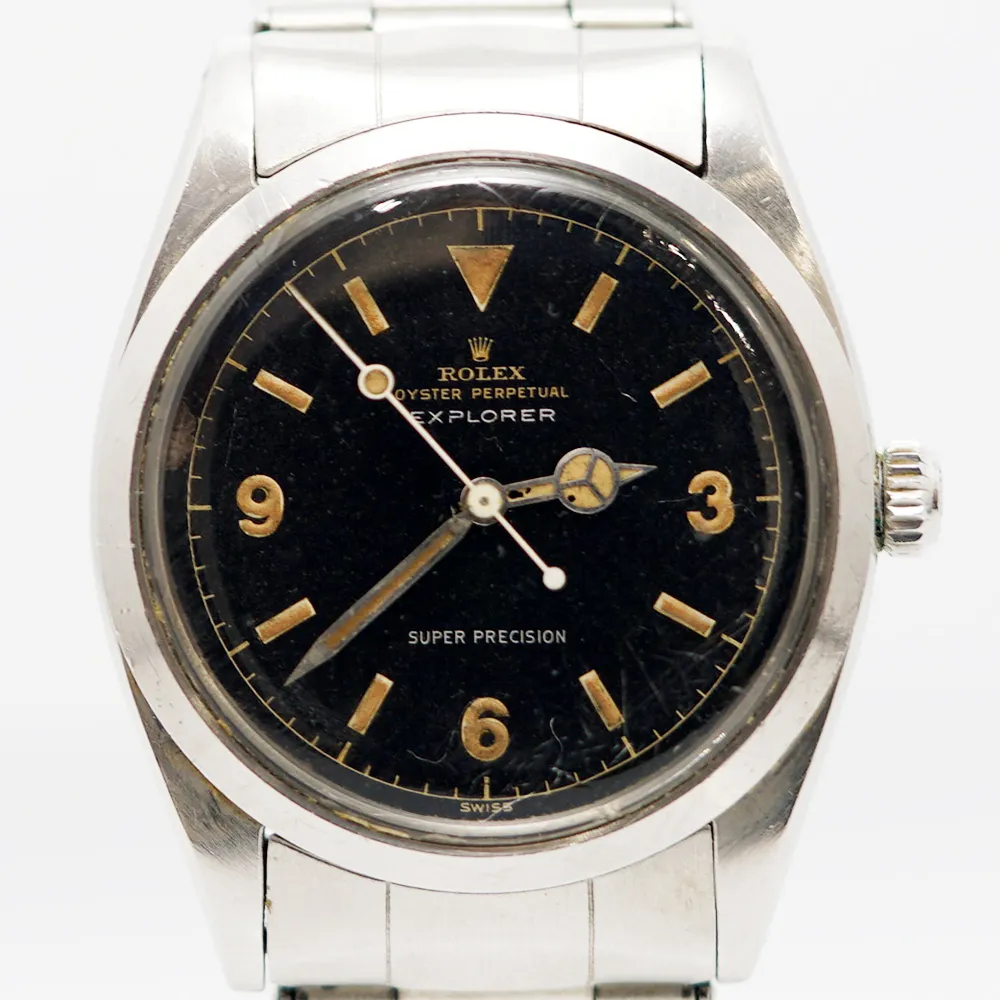
This example of the ref. 5504 presents in good condition, a testament both to careful stewardship and to the durability of Rolex's mid-century engineering. The 36mm Oyster case retains its original proportions, with bevelled lugs and a profile that speaks to an era when tool watches were still sized for discretion rather than statement. The absence of heavy polishing is evident in the preservation of the case lines, though decades of wear have softened the edges in the manner typical of watches that have lived rather than languished in safes. The screw-down crown, unmarked by later service interventions, bears the Rolex coronet in relief, a small but telling detail that confirms the watch's originality.
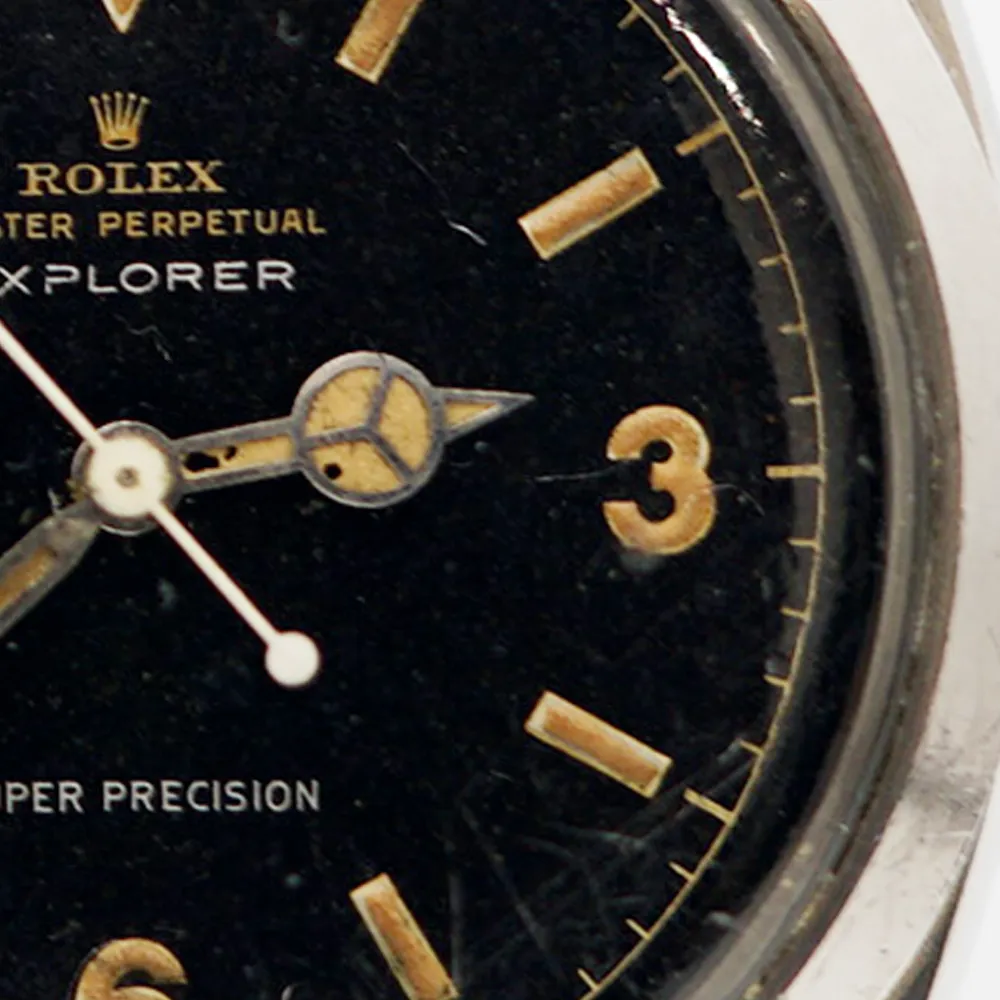
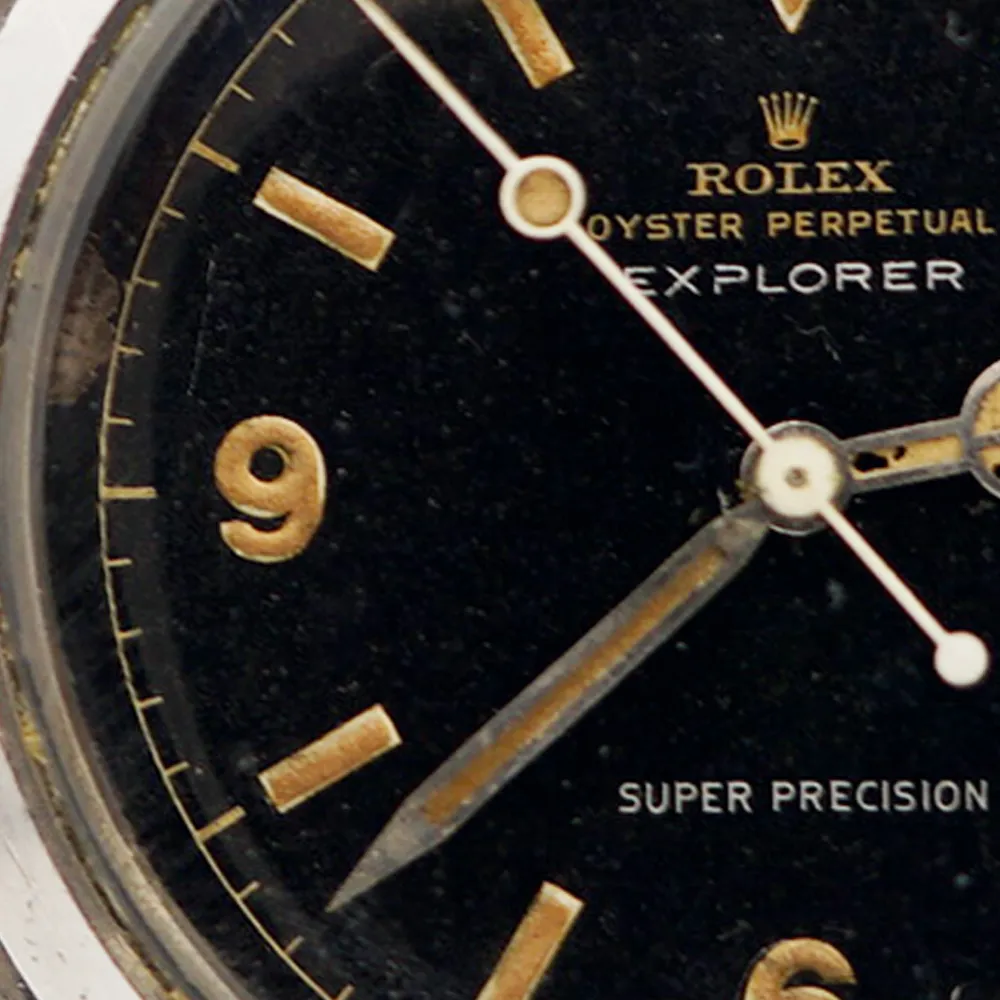
The dial is where the 5504 reveals its significance. Applied gilt hour markers catch the light at oblique angles, their warmth contrasting with the matte black lacquer beneath. The 3-6-9 Arabic numerals, rendered in a sans-serif typeface that would remain largely unchanged through the 1016 era, provide the visual anchors around which the rest of the dial is organised. Luminous plots at each index have aged to a soft cream patina, consistent across the dial and matching the tritium fill in the pencil hands, a uniformity that suggests the watch has remained unmolested by restoration. The Explorer script, printed in gilt beneath the centre axis, is crisp and centred, a small typographic detail that separates early examples from later, more heavily manufactured iterations.
Accompanying the watch is its period-correct box, a rarity in itself. Rolex boxes from the 1950s were seldom retained, viewed as packaging rather than collectibles, and their survival rate is low. The absence of papers is less surprising; many Explorers were purchased by institutional buyers, universities, research expeditions, who discarded documentation as a matter of course. The presence of the box, then, suggests an owner who understood the watch's significance early, or at least recognised it as something worth preserving beyond its utility.
On the Wrist and the Movement
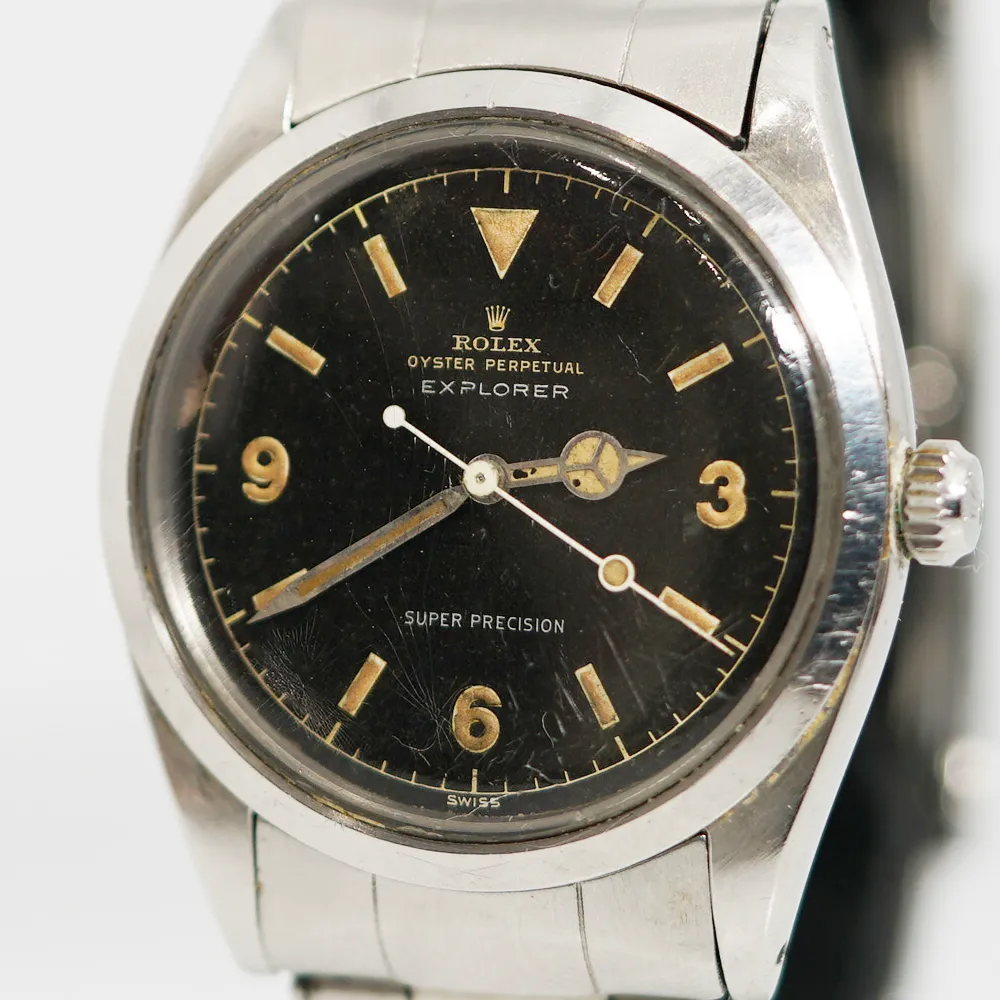
At 36mm, the ref. 5504 wears with a restraint that modern sports watches have largely abandoned. The case sits close to the wrist, its slim profile and short lugs allowing it to slip beneath a shirt cuff without protest. There is none of the wrist presence associated with contemporary Submariners or GMT-Masters; instead, the 5504 offers a quieter kind of authority, the confidence of a watch that does not need to announce itself. The bezel-free design and absence of crown guards lend it a cleaner, almost dress-watch silhouette, yet the matte black dial and luminous indices betray its tool watch origins. It is this duality, elegance married to utility, that makes the Explorer enduringly versatile.
Inside, the Cal. 1030 represents Rolex's first generation of high-beat automatic movements, introduced in the mid-1950s as an evolution of the earlier Cal. 1030 series. Beating at 18,000 vibrations per hour, it offered improved timekeeping stability over the 16,200 vph movements that preceded it, a meaningful advancement in an era when mechanical chronometry was still the benchmark of horological quality. The movement is a fifteen-jewel calibre, simpler than the later Cal. 1560 series that would power the ref. 1016, but robust and serviceable, with a proven track record in extreme conditions. The rotor winds bidirectionally via a perpetual mechanism, and the balance wheel, equipped with a free-sprung Microstella adjustment system, provides fine regulation without the need for an index lever.
Servicing a Cal. 1030 today requires a watchmaker familiar with vintage Rolex architecture, as parts availability is limited and movement swaps, common in the 1970s and 1980s, have complicated the landscape of originality. This example, having been preserved with its box, suggests an owner attuned to such concerns, though definitive confirmation would require a case opening and inspection of serial engravings. On the wrist, the movement delivers the smooth, near-silent operation characteristic of well-maintained high-beat calibres, the seconds hand sweeping across the dial with the fluidity that separates mechanical watches from their quartz successors.
Why It Matters Now
The Explorer ref. 5504 has become one of the most sought-after references in the vintage Rolex market, not because of celebrity provenance or dramatic auction records, but because of scarcity and historical significance. The reference was produced for no more than three years, and production numbers are believed to have been modest even by the standards of the 1950s. Most examples have been lost to hard use, case swaps, or ill-advised restorations, and those that survive in original condition command premiums that reflect their rarity. At auction, the 5504 routinely outperforms longer-production Explorers, and private transactions are often concluded quietly, before the watch ever reaches a catalogue.
For collectors building a comprehensive narrative of Rolex's sports watch evolution, the 5504 is essential. It represents the moment when the company transitioned from expedition prototypes to series production, refining the design language that would define the Explorer for six decades. It is the watch that bridges Hillary's Everest and the boardrooms of the 1960s, a tool watch that succeeded not because it was revolutionary, but because it distilled hard-won lessons into a design of uncommon clarity. Where the ref. 1016 became iconic through longevity, the 5504 achieved significance through brevity, a reference whose importance was recognised only in retrospect.
The broader collector appeal of the 5504 lies in its accessibility, not in terms of price, but in terms of narrative. It is not a watch that requires deep technical knowledge to appreciate. The story is legible in the dial, in the proportions, in the understated elegance of a watch designed to be read at altitude. It is a watch that rewards close inspection without demanding it, a piece that can be worn daily without apology. In an era when vintage sports watches have become speculative assets, the 5504 remains, at its core, what it was always intended to be: a tool, refined to the point of art.
This example, accompanied by its period box and presenting in good original condition, offers a rare opportunity to acquire one of the scarcest chapters in the Explorer story, a watch that matters not because it was worn by a celebrity or survived a shipwreck, but because it represents a fleeting moment when Rolex was still learning what a tool watch could be. For the collector who values provenance over hype and scarcity over fashion, the ref. 5504 is not merely desirable. It is essential.
This piece is currently available through Wasting Time. View the listing or enquire for full provenance and pricing.