
27 May 2026 · 6 min read
Rolex GMT-Master Ref. 1675 'Tropical' Pepsi Bezel, The Defining Dual-Time Watch
By Wasting Time
Introduced in 1959 for Pan Am's jet-age pilots, the <em>GMT-Master</em> <em>ref. 1675</em> remains the most collected dual-time wristwatch ever made. This tropical-dialled example from the late 1960s to mid-1970s shows the reference at its mature peak.
Introduced in 1959 as a collaboration between Rolex and Pan American World Airways, the GMT-Master ref. 1675 was designed to assist pilots navigating multiple time zones during the dawn of intercontinental jet travel. The model succeeded the short-lived ref. 6542, which had used a fragile bakelite bezel insert, and would remain in production for over two decades, making it one of the longest-running references in the Rolex catalogue and arguably the most significant tool watch of the twentieth century.
At its heart sits the Cal. 1575, a 26-jewel movement beating at 19,800 vph (2.75 Hz) and derived from the proven Cal. 1570 architecture. The addition of the independently adjustable 24-hour hand, driven through an ingenious gear train, allowed wearers to track a second time zone via the bi-directional rotating bezel. The 1675 is perhaps most celebrated for its matte dials and Perspex bezels in the 1960s and early 1970s, though by this period many examples had transitioned to glossy dials and more durable aluminium inserts, reflecting Rolex's ongoing refinement of the reference throughout its production life.
The 40mm Oyster case, with its crown guards introduced around 1965, strikes a balance between tool-watch practicality and the proportions expected of a professional instrument. The 1675 was available in both steel and two-tone configurations, but collectors today favour all-steel examples for their understated utility and resistance to the fashions that would later inflate case sizes beyond recognition. Culturally, the GMT-Master transcended its aviation origins. Marlon Brando wore a 1675 in Apocalypse Now, having removed the bezel to suit his character's maverick sensibilities. Che Guevara was photographed wearing one during the Cuban Revolution. These associations, combined with the model's two-decade production span, have made the 1675 a cornerstone of any serious vintage Rolex collection, a watch that serves equally well as daily wearer or investment-grade artefact.
A Short History of the Reference
When Rolex unveiled the ref. 1675 in 1959, it represented a substantial evolution from the pioneering but problematic ref. 6542. That first GMT-Master, launched in 1954, had featured a bakelite bezel insert prone to cracking under the thermal stresses of pressurised cabins and varying altitudes. The 1675 addressed this vulnerability with an aluminium insert, anodised in the now-iconic red-and-blue 'Pepsi' colourway to denote day and night hours on the 24-hour scale.
Early examples from 1959 to circa 1965 featured small crown guards or none at all, reflecting the transitional design language Rolex employed across its professional range during this period. By 1965, the crown guards had grown more pronounced, offering greater protection to the Twinlock winding crown. Dial configurations evolved in parallel: gilt chapter rings and radium luminous material gave way to matte black dials with painted white markers, and eventually to glossy dials with applied tritium plots by the early 1970s. Serial number dating places examples from this period, roughly 1965 to 1975, within the 1.5 million to 4 million range, a decade that saw the 1675 reach its aesthetic and technical maturity.
The movement underwent its own refinements. Early 1675 references housed the Cal. 1565, a non-chronometer-rated calibre. By 1965, Rolex had introduced the Cal. 1575, which featured improved shock protection via Kif Flector springs and earned chronometer certification. This shift marked the 1675 as not merely a functional tool but a precision instrument capable of withstanding the rigours of professional aviation. Production continued until 1980, when the reference was succeeded by the ref. 16750 and its quickset date mechanism, an undeniable convenience, but one that many purists argue diluted the austere functionality that defined the 1675.
The Piece in Front of You
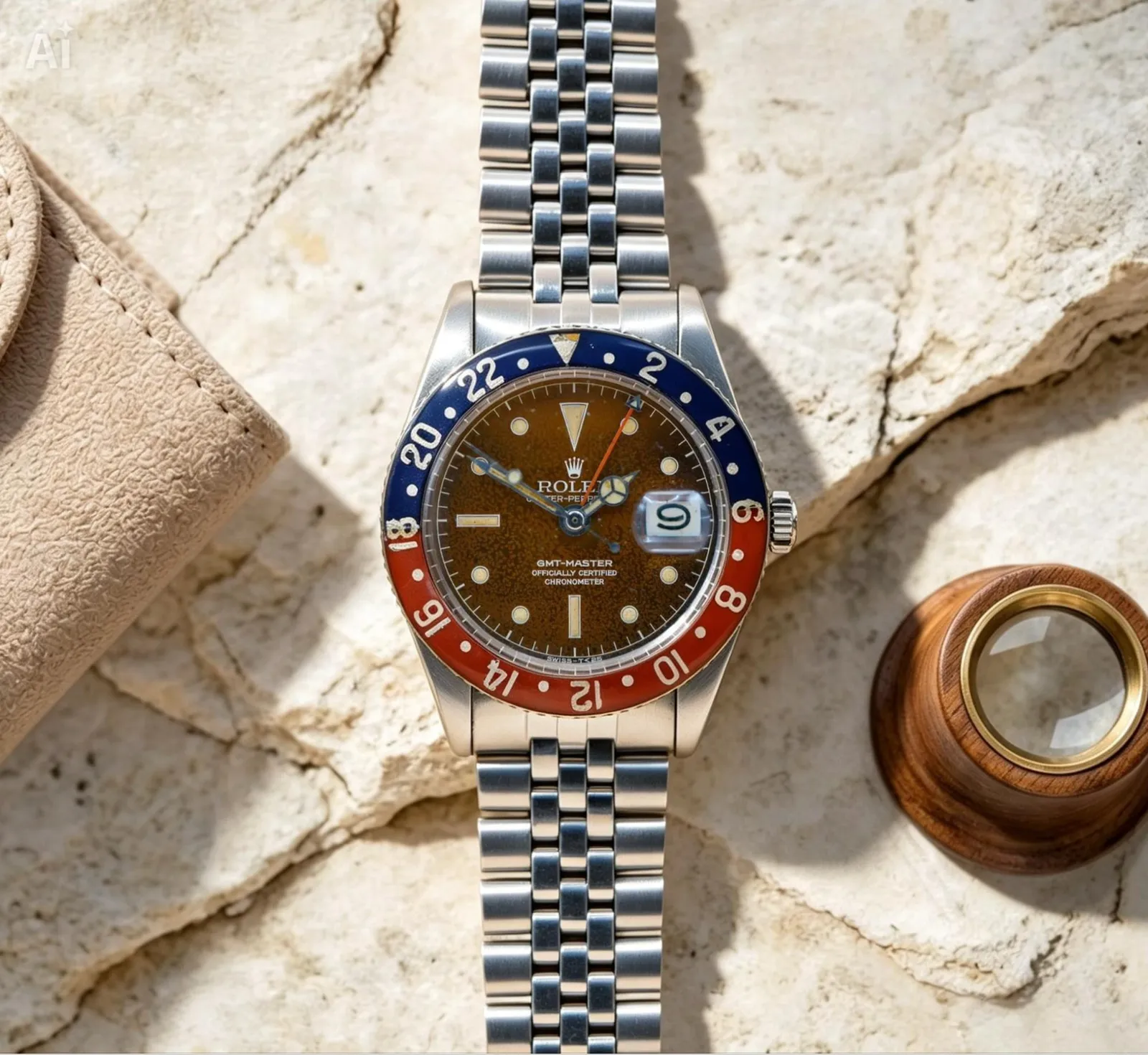
This example presents one of the most sought-after characteristics in a vintage GMT-Master: a tropical dial. Over decades of exposure to ultraviolet light, the originally black lacquer has faded to a warm, mottled brown, a patina impossible to replicate and highly prized among collectors for its individuality. No two tropical dials age identically; the interplay of ambient conditions, wearing habits, and storage environments produces a unique chromatic signature in each watch. Here, the dial has taken on a rich chocolate tone with subtle gradations, lending the piece an unmistakable vintage character that modern reissues cannot approximate.
The 40mm stainless steel Oyster case retains its characteristic crown guards, suggesting this example dates from the mid-1960s onwards. Surface wear consistent with decades of use is to be expected, though a detailed in-hand inspection would be required to assess the originality of the luminous plots, hands, and bezel insert. The Pepsi bezel, red and blue anodised aluminium, shows signs of age, including the inevitable fading and surface scratches that accompany regular rotation. These marks are not flaws but rather evidence of a watch that has fulfilled its intended purpose as a working tool, rather than languishing unworn in a safe.
The watch is presented on a stainless steel Jubilee bracelet, the five-link design introduced as an option for the GMT-Master in the 1960s. While the Oyster bracelet is perhaps more commonly associated with the reference today, the Jubilee was favoured by many original owners for its suppleness and comfort during long-haul flights. Originality of the bracelet cannot be confirmed without reference to the lug width and end-link fitment, though period-correct bracelets remain widely available and are often considered acceptable within the collector community, provided they are of appropriate vintage and configuration.
This example is offered as watch only, without original box or papers. Provenance and ownership history are not documented, a common situation for tool watches that circulated through professional and military channels before entering the collector market. Potential buyers should verify the service history and confirm the movement's authenticity, as Cal. 1575 examples from this era are occasionally found with replaced components or non-original parts following decades of regional servicing. The absence of papers, while limiting documentation, does not diminish the watch's intrinsic appeal, indeed, many of the most storied 1675 examples lack such ephemera, having been purchased as working instruments rather than collectables.
On the Wrist and the Movement
At 40mm, the ref. 1675 occupies a rare position in the modern landscape: a vintage tool watch that wears comfortably on contemporary wrists without feeling oversized or anachronistic. The proportions are balanced, the lugs taper gracefully, and the case height, approximately 13mm with the acrylic crystal, ensures the watch slips easily beneath a shirt cuff. The Jubilee bracelet, if original or period-correct, drapes with a fluidity that modern solid-link bracelets cannot match, though some wearers may find the hollow links less reassuring than the heft of a modern Oyster.
The bi-directional bezel rotates with a smooth, tool-like precision, though decades of wear may have introduced some play. This is characteristic of aluminium inserts from the period and should not be considered a defect. The bezel's function, allowing the wearer to set a second time zone by aligning the red and blue sections with the 24-hour hand, remains brilliantly intuitive. To track home time while travelling, one simply rotates the bezel until the 24-hour hand points to the correct hour on the insert. The utility is immediate and tactile, a reminder that the 1675 was designed by engineers for pilots, not by marketers for collectors.
Beneath the dial, the Cal. 1575 represents the zenith of Rolex's non-quickset movement architecture. The 26-jewel calibre, beating at 19,800 vph, offers a 42-hour power reserve and incorporates Kif shock protection, a free-sprung balance, and Breguet overcoil for superior isochronism. The movement is robust, reliable, and eminently serviceable, qualities that have allowed many 1675 examples to survive decades of hard use with minimal intervention. Chronometer certification, denoted by the dial's 'Superlative Chronometer Officially Certified' script, underscores Rolex's commitment to precision even in its tool watches.
Winding the crown reveals the satisfying resistance of the Cal. 1575's mainspring, while the date quickset function, absent here, as it would not be introduced until the ref. 16750, requires advancing the hands past midnight to change the date. This manual process, while less convenient than modern mechanisms, reinforces the watch's connection to an era when function dictated form, and patience was a virtue rather than an inconvenience. Timekeeping, assuming proper service, should fall within COSC chronometer standards, typically ±5 seconds per day under normal wearing conditions.
Why It Matters Now
The ref. 1675 occupies a unique position in the vintage Rolex market. Unlike the Submariner ref. 5513, which remained visually consistent throughout its production, or the Daytona ref. 6263, which was produced in relatively limited numbers, the 1675 was made in substantial quantities over two decades, resulting in a wide array of dial configurations, bezel variations, and case evolutions. This diversity has created distinct sub-markets within the reference, with certain combinations, particularly matte dials, Bakelite bezels, and tropical patina, commanding significant premiums over glossy-dialled examples from the late 1970s.
Tropical dials, such as the one present on this example, have become especially coveted. The phenomenon occurs when ultraviolet light degrades the lacquer over decades, transforming the original black into shades ranging from milk chocolate to deep espresso. Because the process is irreversible and unpredictable, each tropical dial is inherently unique. Collectors prize this individuality, and auction results reflect the premium: a well-preserved tropical 1675 can fetch double or triple the price of a standard black-dial example, depending on the depth and uniformity of the fading.
Market dynamics have shifted considerably in recent years. Where once the 1675 was considered an affordable entry point into vintage Rolex collecting, rising demand and diminishing supply have pushed prices upward. Five-figure sums are now routine for examples in good condition, with exceptional pieces, those retaining original components, strong provenance, or rare dial variations, reaching six figures at major auction houses. The 1675 has transitioned from under-appreciated tool watch to blue-chip collectible, a trajectory mirrored across the broader vintage sports watch market.
Yet the 1675 retains an accessibility that more rarefied references lack. Unlike the Paul Newman Daytona or the Submariner ref. 6538, which have ascended into the realm of museum pieces and billionaire collections, the 1675 remains within reach of serious enthusiasts. Its two-decade production run ensures a steady supply of examples entering the market, while its robust movement and serviceable design mean that even well-worn pieces can be restored to functioning order without controversy. This combination of collectability and wearability, rare in the vintage market, explains why the 1675 continues to attract both first-time buyers and seasoned collectors.
For Wasting Time, this tropical 1675 represents an opportunity to acquire a watch that bridges function and collectability. The absence of box and papers will deter some buyers, but for those who prioritise the watch itself over its ancillary documentation, this example offers the chance to own a piece of horological and cultural history, a watch worn by pilots and revolutionaries alike, now aged into something irreplaceable.
The GMT-Master ref. 1675 is not merely a vintage watch; it is the vintage watch, the reference against which all subsequent dual-time complications are measured. This example, with its tropical patina and decades of honest wear, is a reminder that the finest watches are those that have lived.
This piece is currently available through Wasting Time. View the listing or enquire for full provenance and pricing.