
27 May 2026 · 6 min read
Rolex GMT-Master Ref. 1675 'Tropical' Pepsi Bezel
By Wasting Time
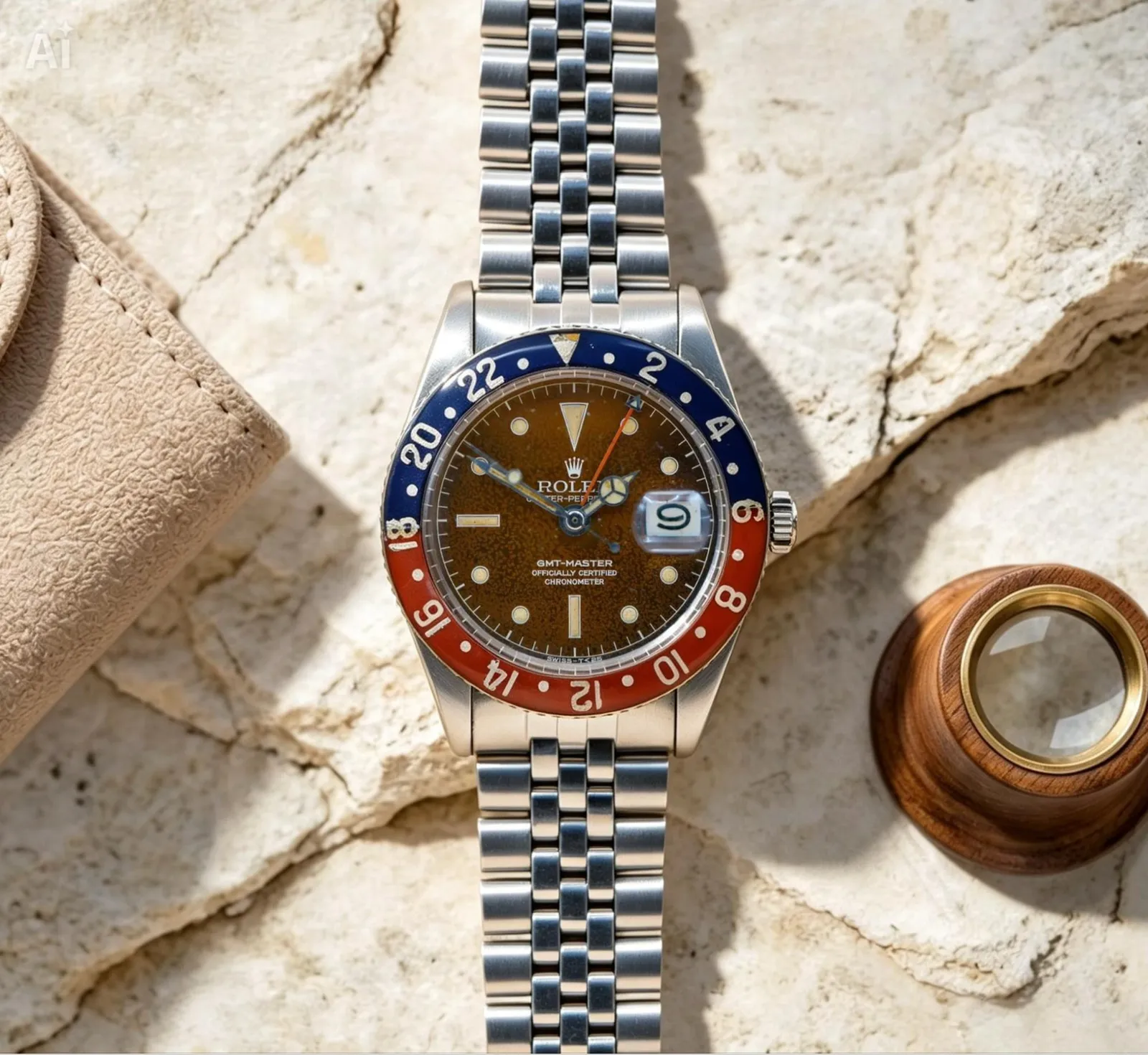
The stainless steel <em>ref. 1675</em> represents the defining dual-time wristwatch of the jet age, produced from 1959 to 1980 for Pan Am pilots and worn from cockpits to film sets. This example presents the tropical brown dial patina that has made the model a cornerstone of vintage collecting.
Introduced in 1959 as a collaboration between Rolex and Pan American World Airways, the GMT-Master ref. 1675 was designed to assist pilots navigating multiple time zones during the dawn of intercontinental jet travel. The model succeeded the short-lived ref. 6542, which had relied upon a fragile Bakelite bezel insert prone to cracking, and would remain in production for over two decades, making it one of the longest-running references in the Rolex catalogue and a bellwether of the brand's mid-century ambitions.
At its heart sat the Cal. 1575, a 26-jewel movement beating at 19,800 vph and derived from the proven Cal. 1570 architecture. The addition of the independently adjustable 24-hour hand, driven through an ingenious gear train, allowed wearers to track a second time zone via the bi-directional rotating bezel. The bezel itself, most famously rendered in the red-and-blue 'Pepsi' configuration, was originally constructed from acrylic in the early years before transitioning to more durable anodised aluminium inserts as production matured into the mid-1960s.
The 40mm Oyster case, with its crown guards introduced around 1965, strikes a balance between tool-watch practicality and the proportions expected of a professional instrument. The 1675 is perhaps most celebrated for its matte dials and acrylic bezels of the 1960s and early 1970s, though by the latter half of the reference's production run, many examples had transitioned to glossy dials and the aforementioned aluminium inserts, reflecting evolving manufacturing standards and material availability.
Culturally, the GMT-Master transcended its aviation origins almost immediately. Marlon Brando wore a 1675 in Apocalypse Now, having removed the bezel to suit his character's maverick sensibilities. Che Guevara was photographed wearing one during the Cuban Revolution. These associations, combined with the model's two-decade production span, have made the 1675 a cornerstone of any serious vintage Rolex collection, a watch that serves equally well as daily wearer or investment-grade artefact.
A Short History of the Reference
The ref. 1675 emerged at a moment when commercial aviation was reshaping global connectivity. Pan Am's request for a pilot's watch capable of displaying two time zones simultaneously, home and destination, gave Rolex the brief for what would become one of the most enduring complications in horology. Unlike the earlier ref. 6542, which had been rushed into production and suffered material failures, the 1675 benefitted from iterative refinement and a more considered approach to durability.
Early examples from 1959 through the mid-1960s featured gilt dials, pointed crown guards, and smaller crown guard profiles that collectors now refer to as 'pre-crown guard' or 'PCG' variants. Around 1965, Rolex introduced the more substantial crown guards seen on later examples, a change that coincided with the shift from gilt to white gold surrounds on the hour markers and the transition to matte black dials. These matte dials, when subjected to decades of ultraviolet exposure and tropical climates, often aged to rich tobacco or chocolate browns, a phenomenon now prized as 'tropical' patina and one of the most sought-after characteristics among collectors.
By the early 1970s, the 1675 had become ubiquitous within professional circles, issued by airlines, militaries, and exploration teams alike. Its presence on the wrists of everyone from commercial pilots to revolutionaries speaks to its cross-cultural appeal and functional versatility. Production continued until 1980, when the reference was succeeded by the ref. 16750, which introduced a quickset date mechanism and higher-frequency movement, features that increased convenience but arguably diluted the austere purity of the original design.
The Piece in Front of You
This stainless steel example from the period between 1965 and 1975 presents the model at its mature apex, after the introduction of crown guards but before the adoption of quickset complications. The 40mm Oyster case retains the proportions that have made the 1675 a template for modern sports watches, neither oversized nor overly delicate, and the brushed surfaces bear the honest wear one expects from a tool watch that has seen use.
The dial has aged to a warm tropical brown, a transformation that occurs when the original black lacquer degrades under prolonged exposure to heat and light. This patination is uneven by nature, some dials shift uniformly, others mottle or fade in gradients, and the specific character of this example would require in-hand inspection to assess fully. Tropical dials divide opinion within the collecting community: purists prize them as evidence of a watch's lived history, whilst others question whether such degradation compromises the manufacturer's original intent. Wasting Time takes the former view, regarding tropical patina as a fingerprint of time that cannot be replicated.
The red-and-blue 'Pepsi' bezel insert remains the most iconic colourway associated with the GMT-Master, originally chosen for its high contrast and readability in cockpit lighting conditions. Aluminium inserts from this era are prone to fading and scratching, and the condition of this example's bezel would warrant close scrutiny. Equally, the luminous plots on both dial and hands merit verification, Rolex used tritium-based lume during this period, which ages to a creamy patina, and replacements or relumed components are not uncommon in watches that have passed through decades of regional servicing.
The stainless steel Jubilee bracelet, a five-link design originally developed for the Datejust but frequently paired with the 1675, provides a dressier counterpoint to the watch's utilitarian origins. Stretch in vintage Jubilee bracelets is almost inevitable, and prospective buyers should assess whether the end links remain secure and whether the clasp retains sufficient tension.
On the Wrist and the Movement
Worn today, the ref. 1675 offers a masterclass in ergonomic restraint. The 40mm case diameter, 13mm thickness, and approximately 48mm lug-to-lug measurement allow the watch to sit comfortably beneath a cuff whilst retaining sufficient wrist presence to anchor a casual outfit. The crown guards, though initially controversial among collectors accustomed to the slimmer profiles of earlier references, provide functional protection without the aggressive angularity that would characterise later sports models.
The bi-directional rotating bezel turns with the satisfying resistance characteristic of Rolex tooling from this era, looser than modern ceramic bezels but precise enough for functional use. The bezel's utility lies in its simplicity: by aligning the 24-hour hand with the current hour in a second time zone, the wearer can track both home and destination times simultaneously, a feature that remains as relevant for modern travellers as it was for Pan Am crews in 1965.
Inside, the Cal. 1575 represents the zenith of Rolex's non-quickset date architecture. Derived from the Cal. 1570, which itself evolved from the Cal. 1560 family, the movement beats at 19,800 vph with a 26-jewel count and offers approximately 42 hours of power reserve. The 1575 incorporates a hack seconds mechanism, allowing the seconds hand to stop when the crown is pulled to the time-setting position, a refinement introduced across the Rolex range during the 1960s to improve setting accuracy.
The movement's hacking feature and date complication are accessed via a two-position crown: the first position advances the date via slow rotation of the hands past midnight (a process requiring patience and care to avoid damage to the date mechanism), whilst the second position allows independent adjustment of the hour hand in one-hour increments. This latter function, unique to GMT movements, permits the wearer to reset the local hour hand upon arrival in a new time zone without disturbing the running seconds or 24-hour reference hand, a brilliantly intuitive solution that predates the quickset complications adopted in later references.
Service history for a watch of this age is paramount, as the Cal. 1575 requires regular maintenance to preserve its precision and longevity. Prospective buyers should verify the authenticity of internal components, as decades of regional servicing occasionally result in replaced wheels, springs, or even entire movements swapped from donor watches. Wasting Time advises a thorough inspection by a qualified watchmaker before purchase to confirm originality and assess the movement's condition.
Why It Matters Now
The ref. 1675 occupies a unique position within the vintage Rolex market, straddling the line between accessible entry point and blue-chip collectible depending on condition, provenance, and dial variation. Whilst early gilt-dial examples or military-issued 'MilSub' variants command six-figure sums, later matte-dial references such as this example remain within reach of collectors seeking a genuine tool watch with historical significance.
Tropical dials have emerged as one of the most divisive yet sought-after characteristics in vintage Rolex collecting. Auction results over the past decade demonstrate that well-preserved tropical examples can achieve premiums of 30 to 50 per cent over their non-tropical counterparts, though this premium hinges on originality and even patination. Uneven fading, mismatched lume plots, or signs of artificial ageing can drastically reduce desirability, underscoring the importance of due diligence.
The 1675 also benefits from its cultural cachet. The Brando association alone has driven demand for bezel-less examples, whilst the model's appearance in films, photographs of historical figures, and advertisements from the 1960s and 1970s lends it a narrative depth that newer references struggle to match. In an era when Rolex sports models have become synonymous with status signalling, the 1675 offers a reprieve, a watch designed for function, adopted by iconoclasts, and aged with character rather than pristine perfection.
From an investment perspective, the ref. 1675 remains one of the more stable references within the vintage Rolex market. Production numbers were substantial, ensuring a steady supply of examples, yet the combination of two-decade manufacturing span, material variations, and the natural attrition of watches worn hard means that truly original, well-preserved pieces are becoming increasingly scarce. Collectors entering the market today face a landscape where authenticity verification is paramount, as the proliferation of franken-watches, assembled from period-correct but mismatched components, has complicated the buying process.
For Wasting Time, the 1675 represents everything a vintage sports watch should be: functional without pretension, historically significant without requiring a provenance letter, and capable of daily wear without the anxiety that accompanies six-figure collectibles. It is a watch that rewards knowledge, rewards patience, and rewards the willingness to embrace imperfection as evidence of a life lived beyond the safe.
This example, with its tropical patina and Pepsi bezel, stands as a testament to the enduring appeal of the GMT-Master formula, a watch that remains as relevant in 2025 as it was in 1965, worn not because it is fashionable, but because it works.
This piece is currently available through Wasting Time. View the listing or enquire for full provenance and pricing.