
27 May 2026 · 8 min read
The Rolex Oyster Perpetual ref. 6062, a vanishing breed
By Wasting Time
Fewer than 500 examples produced across all metals, the <em>Rolex</em> <em>ref. 6062</em> married triple calendar and moonphase complications to the brand's patented <em>Oyster</em> case. A landmark of mid-century complication watchmaking, rarely seen outside auction catalogues.
The Rolex ref. 6062 occupies an eccentric corner of the brand's history. Introduced in the early 1950s, it brought calendar complications, day, date, month, and moonphase, into the waterproof Oyster case at a moment when Rolex was better known for robust tool watches than dressy complications. Fewer than 500 examples are believed to have been produced across all metals during a three-year production window, making it one of the scarcest serially manufactured references the brand ever offered. This steel-and-gold variant, known in collectors' shorthand as 'Rolesor', represents an even narrower subset within that already vanishing population.
To understand the 6062, one must first recognise what it was not. This was not a Submariner in waiting, nor a precursor to the professional sport watches that would define Rolex from the mid-1950s onward. It was, instead, a bid for legitimacy in the realm of classical complications, territory long dominated by the grandes maisons of Geneva and the Vallée de Joux. The decision to embed a triple calendar and moonphase movement inside a screw-down case was audacious, blending the brand's patented water resistance with a complication set more commonly found in fragile snap-back dress watches. The 6062 thus stands as evidence of a road not taken: a Rolex that prioritised horological sophistication over utilitarian ruggedness.
Production spanned approximately 1950 to 1953, though precise dating remains elusive in the absence of complete factory records. The reference was catalogued alongside its all-gold sibling, the ref. 8171, and both shared the same manually wound Cal. 14¼ SCQ movement. Dial configurations varied, silver, champagne, and black examples are documented, with the latter commanding substantial premiums due to rarity. The steel-and-gold case construction balanced cost against prestige, appealing to buyers who desired complication without the weight or expense of solid gold. Yet even this compromise could not sustain demand. By 1953, production had ceased, and Rolex pivoted decisively toward the tool watch philosophy that would make its name.
The piece in front of you
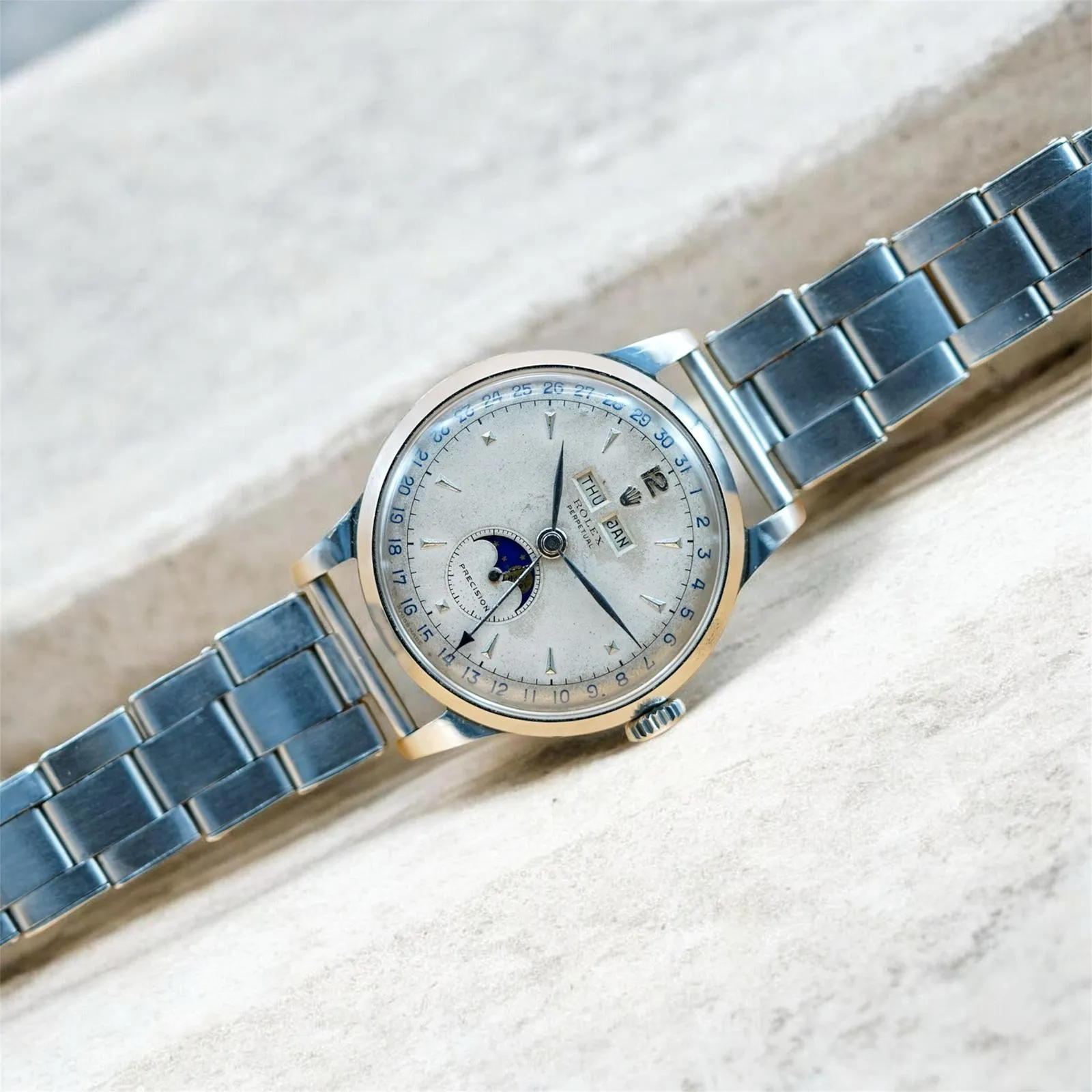
This example presents the classical proportions of the 6062: a 36mm Oyster case in stainless steel with yellow gold bezel, silver dial, and the signature moonphase aperture at 6 o'clock. The dial architecture follows the reference's familiar template, twin apertures for day and month at 12 o'clock, an outer date track read by a centre pointer, and the moonphase disc below. The layout achieves a symmetry rare in calendar watches, with each complication given equal visual weight.
The bezel, engine-turned in a 'coin-edge' pattern, provides textural contrast against the polished case flanks. The screw-down case back and Twinlock crown, though modest by modern standards, represented meaningful technical advancement in 1950, when most calendar watches relied on snap-backs vulnerable to moisture ingress. The stainless steel Oyster bracelet, while likely a later addition or service replacement, maintains period-correct proportions and folded-link construction typical of mid-century Rolex bracelets.
Without physical inspection, definitive statements regarding originality are necessarily provisional. The dial, hands, and moonphase disc are the components most frequently replaced or refinished over seven decades of service life. Authenticity verification should focus on printing style, lume patina, and the moonphase disc's star pattern, all of which vary across early and late production batches. The absence of box and papers, unsurprising given the reference's age, leaves provenance unverified, though the watch's configuration aligns with documented examples from the production period.
On the wrist
At 36mm, the 6062 wears with the compact assurance common to mid-century dress watches. The proportions suit a contemporary wrist far better than period advertising might suggest; what was once considered a generous size now reads as understated, even reserved. The steel-and-gold case construction lends visual warmth without the heft of solid gold, and the short lugs allow the watch to sit flat against the wrist rather than cantilevering outward.
The silver dial catches light softly, its applied markers and printed calendar track creating subtle dimensionality. The moonphase aperture introduces a touch of whimsy, an anthropomorphic moon face gazing upward, that tempers the dial's otherwise formal demeanour. This is not a watch that announces itself across a room. It rewards proximity, inviting the wearer to linger over the layered complications, to track the slow rotation of the date hand, to note the gradual waxing of the painted moon.
Legibility, always a concern with calendar watches, is adequate rather than exemplary. The outer date track requires a slight wrist tilt to read clearly, and the twin day-month apertures demand focused attention. These are not flaws so much as concessions to complication density within a 36mm case. The watch was never intended for split-second time checks; it exists to be consulted, considered, worn with intention.
The bracelet, though comfortable, cannot claim the integration of modern designs. Its folded links flex audibly, and the stamped clasp feels provisional by current standards. Yet this, too, is period-correct, a reminder that even Rolex bracelets were works in progress during the 1950s. On the wrist, the 6062 feels less like a tool and more like a companion, a mechanical metronome marking not just hours but days, months, lunar cycles.
The movement and build
The Cal. 14¼ SCQ beats at 18,000 vibrations per hour within the sealed Oyster case, a 15-jewel manually wound movement derived from the Venus 14 SC ebauche. Rolex modified the base calibre to accommodate the triple calendar and moonphase complication, adding a complex gear train to drive the day, date, and month indicators alongside the moonphase disc. The movement measures 14¼ lignes in diameter, approximately 32mm, filling the case and requiring precise tolerances to function reliably within the water-resistant architecture.
The calendar mechanism operates through a series of cams and levers actuated by the primary going train. The date advances via a finger activated at midnight, pushing a 31-tooth wheel forward one increment per day. The day and month discs turn independently, requiring manual correction for months with fewer than 31 days, an operational quirk common to simple calendar watches of the era. The moonphase disc completes one full rotation every 59 days, a 29.5-day approximation that accumulates error slowly over years but remains accurate enough for practical use.
Build quality reflects Rolex's emerging manufacturing standards. The movement plates are finished with Geneva stripes, the screws heat-blued, and the jewels set in gold chatons. The automatic winding rotor seen in later Oyster Perpetual references is absent here; the Cal. 14¼ SCQ requires manual winding via the crown, typically every 36 to 42 hours depending on mainspring condition. This makes the 6062 a more engaged wearing experience than contemporary automatics, demanding daily ritual rather than passive operation.
The screw-down case back, engraved with Oyster markings and a serial number, seals against a synthetic gasket, period rubber gaskets having long since degraded. The Twinlock crown threads into the case tube, compressing a secondary gasket to complete the waterproof envelope. These features, revolutionary in 1950, are now standard across the industry, yet they retain their functional elegance. The case construction has allowed the 6062 to survive decades of wear with fewer catastrophic failures than open-back calendar watches of the same vintage.
Why it matters now
The ref. 6062 matters because it represents a Rolex that never quite was, a brand courting complication collectors rather than professional divers and pilots. In the early 1950s, Rolex stood at a crossroads. The Oyster case had proven its worth, and the brand possessed the manufacturing capability to scale production. The question was: scale toward what? The 6062 and its siblings suggested one answer: classical complications in waterproof cases, competing with Patek Philippe, Vacheron Constantin, and the independent watchmakers of Geneva.
History chose differently. By 1953, Rolex had introduced the Submariner, and by 1954, the GMT-Master. These tool watches, purpose-built, legible, robust, defined the brand's trajectory for the next seventy years. The 6062 became an anomaly, a footnote, a curiosity for collectors who valued rarity over ubiquity. Its scarcity is both historical accident and commercial failure; the watch simply did not sell in meaningful numbers during its production run.
Yet this failure has paradoxically secured its status. The 6062 is now recognised as a blue-chip collector's piece, regularly appearing at auction with estimates in the low-to-mid six figures depending on condition and provenance. Examples with original dials, particularly black-dial variants, command substantial premiums. The steel-and-gold configuration occupies a middle ground, rarer than all-gold examples in some markets, more versatile for contemporary wear, and less overtly precious.
The watch also serves as a counterpoint to the narrative of Rolex as a monolithic tool-watch manufacturer. It demonstrates that even the most commercially successful brands have experimental phases, moments when the product line zigged before decisively zagging. The 6062 is evidence that Rolex once aspired to a different kind of prestige, one measured in complication density rather than depth rating.
For collectors, the 6062 offers several appeals. First, the sheer rarity: fewer than 500 examples across all metals, with steel-and-gold variants representing a fraction of that total. Second, the complication set, which remains engaging to wear and operate despite its mechanical simplicity compared to modern perpetual calendars. Third, the historical significance, as a bridge between pre-war classical watchmaking and post-war tool watch pragmatism. And fourth, the aesthetic, which balances formality with the utilitarian cues of the Oyster case, a watch equally at home with a suit or a casual weekend wardrobe.
This particular example, offered without box or papers, requires due diligence. Prospective buyers should verify originality of the dial, hands, and moonphase disc, ideally through comparison with documented examples or consultation with a recognised specialist. The movement should be inspected for wear in the calendar mechanism, which is susceptible to damage from improper adjustment. Case condition, particularly lug profile and evidence of polishing, merits careful scrutiny; over-restoration diminishes value in a reference this rare.
The Rolex ref. 6062 will never be a common sight. Its production numbers ensure continued scarcity, and attrition, through damage, modification, and loss, has only tightened supply. For those who value complexity over simplicity, rarity over recognition, and historical footnotes over headline references, the 6062 offers a compelling proposition: a Rolex that asks more of its wearer, and rewards accordingly.
This piece is currently available through Wasting Time. View the listing or enquire for full provenance and pricing.