
27 May 2026 · 6 min read
The Rolex Submariner ref. 5513: Three Decades of the Definitive Dive Watch
By Wasting Time
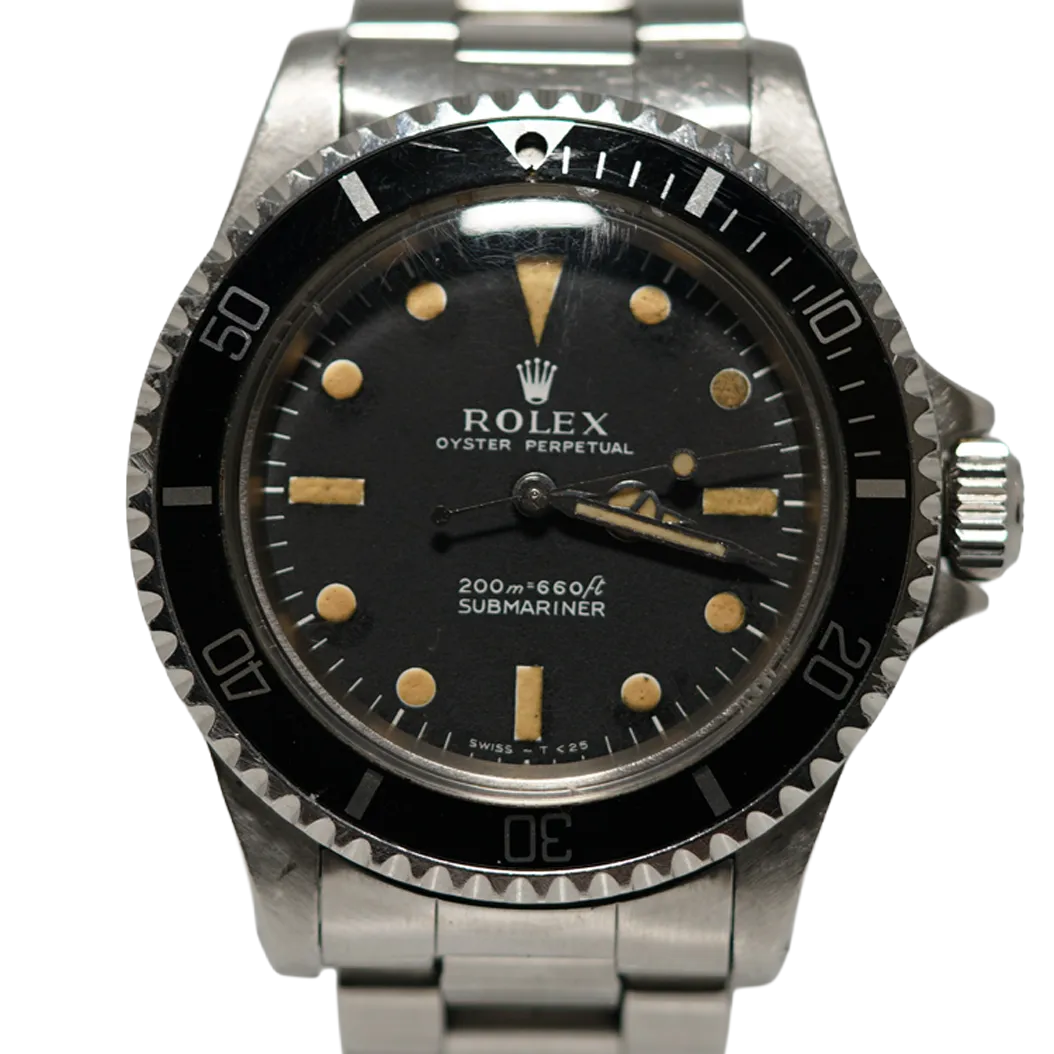
Produced from 1962 to 1989, the <em>Rolex Submariner ref. 5513</em> represents the longest-running and most varied reference in the marque's dive watch lineage. This matte-dialled tool watch became the template against which all others are judged.
The Rolex Submariner ref. 5513 occupies a singular position in horological history, not merely as a milestone reference, but as a living archive of evolving design philosophy across twenty-seven years of continuous production. Where other references came and went, subject to the vagaries of fashion and technical advancement, the 5513 endured, absorbing incremental changes that today serve as a chronology of Rolex manufacturing standards. Its matte black dial, devoid of chronometer certification, distinguished it from the outset as the working diver's Submariner, a tool priced for utility rather than prestige, yet constructed to identical standards as its certified siblings.
This example arrives at Wasting Time as an exemplar of the reference's enduring collectability, offering entry into a lineage that begins in the early 1960s and extends into the final years of that decade's aesthetic ideals. Without chronometer designation, the 5513 presented a more accessible proposition than the ref. 5512, yet sacrificed nothing in construction or capability. Its appeal lay precisely in this restraint, a watch that performed its function without ceremony, whose very lack of gilded text suggested seriousness of purpose.
A Short History of the Reference
Introduced in 1962, the Submariner ref. 5513 arrived as the non-chronometer counterpart to the ref. 5512, which had debuted the previous year with crown guards and COSC certification. Where the 5512 bore four lines of text proclaiming its superlative chronometer credentials, the 5513 carried only two: "Submariner" and the depth rating. This economy of decoration proved prophetic. The reference would outlast its certified sibling by years, becoming the longest-produced Submariner variant in Rolex history and the canvas upon which the brand explored myriad dial configurations and case evolutions.
Early 5513 examples wore gilt dials, gold text on glossy black lacquer, and featured pointed crown guards that echoed the aggressive styling of the ref. 5512. By the mid-1960s, these gave way to matte dials with white printing, a transition that aligned with broader industry moves toward legibility over luxury. Simultaneously, the crown guards evolved from sharply pointed to softly bevelled, a change implemented around 1965 that improved wearability without compromising the watch's protective function. The reference underwent further refinement in 1969 when depth ratings switched from feet-first to metres-first, reflecting continental European market preferences and the march toward metrication.
Throughout the 1970s, the 5513 served as Rolex's volume dive watch, its accessible pricing and proven reliability making it the choice for military contracts and professional divers worldwide. British Royal Navy units, marine research teams, and special forces operators across multiple continents wore the reference in conditions that validated its 200-metre water resistance and robust construction. The watch's cultural footprint extended into popular imagination through its appearances in adventure photography and documentary filmmaking, always presented as equipment rather than emblem. By the time production ceased in 1989, the 5513 had defined the aesthetic and functional parameters of the modern dive watch more thoroughly than any other single reference.
The Piece in Front of You
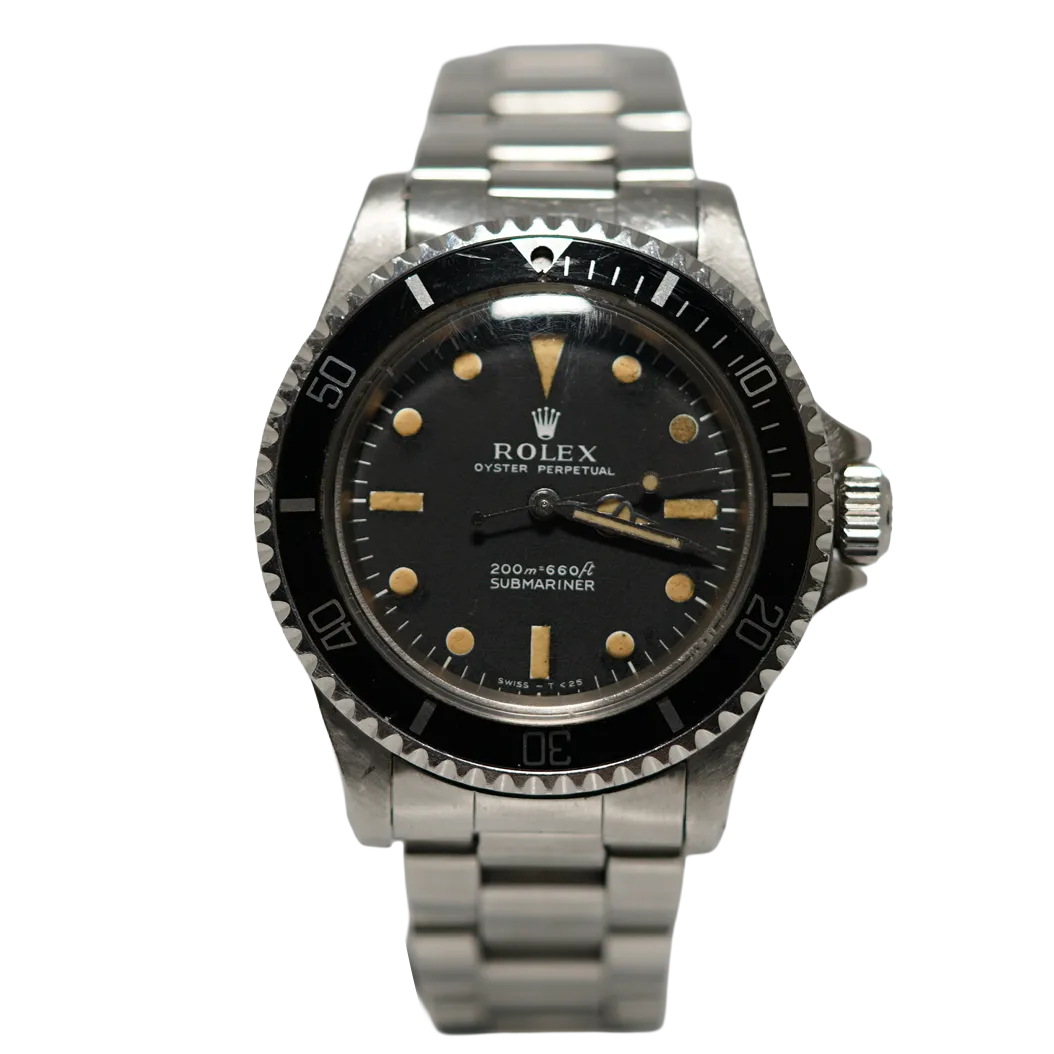
This Submariner ref. 5513 presents the archetypal matte-dial configuration that characterises the reference's mature production years. The absence of chronometer designation across the lower dial reinforces the watch's identity as the purist's Submariner, a tool unencumbered by certification text, speaking through proportion and clarity alone. The matte black surface, intended to reduce glare in underwater environments, exhibits the texture that distinguished Rolex service dials of the era: finely grained, absorptive, designed for legibility at depth.
Without detailed inspection, the originality of key components, dial printing, luminous plots, bezel insert, and handset, remains to be confirmed through close examination. The 5513 reference saw numerous dial variations across its production span, from early gilt examples through multiple iterations of matte configurations, each with subtle differences in text placement, lume application, and printing weight. Originality in these elements forms the primary determinant of collector desirability, separating commercially restored examples from those retaining factory-applied components. Prospective admirers of this piece are encouraged to request comprehensive photography under varied lighting conditions, with particular attention to dial texture, lume patina, and the condition of applied indices.
The 40mm Oyster case, a dimension that Rolex perfected with the ref. 5512/5513 generation and maintained for decades afterward, established proportions that remain relevant today. Its combination of presence and wearability, substantial enough to read at a glance, restrained enough for daily wear beneath a shirt cuff, proved so successful that subsequent Submariner references retained these exact measurements until the introduction of the six-digit references in the twenty-first century. The unidirectional rotating bezel, with its sixty-minute demarcations, served the practical function of tracking elapsed dive time whilst contributing to the watch's unmistakable visual signature.
As with all vintage Rolex timepieces, the condition and originality of this example warrant careful assessment. Case integrity, the preservation of factory bevels and the absence of excessive polishing, affects both aesthetic appeal and long-term value. Similarly, the movement's service history and the state of its luminous material contribute to a comprehensive understanding of the watch's suitability for collection or active wear. The dealer encourages direct inquiry to establish these particulars before commitment.
On the Wrist and the Movement
The ref. 5513 wears with the assurance of a design refined across decades rather than conceived in a single gesture. Its 40mm case settles naturally on the wrist, neither dominating nor receding, occupying that narrow bandwidth where a watch registers as present without announcing itself. The relatively short lug-to-lug measurement, approximately 47mm, allows the case to sit close to the wrist's contour, avoiding the top-heavy stance that plagues oversized dive watches. On its Oyster bracelet, the 5513 presents a continuity of brushed surfaces that extends the case's utilitarian aesthetic, each link sharing the same functional finish.
The matte dial, designed for maximum contrast in low-visibility environments, performs its function with directness. Large luminous plots at cardinal positions and substantial Mercedes hands, Rolex's signature hour hand design since the 1950s, provide instant orientation. The absence of date complication maintains dial symmetry and simplifies the watch's operation: a single crown pull sets the time, nothing more. This reduction to essentials characterises the 5513 throughout its design, every element serves a purpose, nothing decorative intrudes. The result is a watch that rewards extended wear through reliability rather than novelty, becoming familiar rather than tiresome.
Powering this example is the Calibre 1520 or 1530, depending on production year, both non-chronometer variants within the 1560 movement family that served Rolex throughout the 1960s and 1970s. These 26-jewel automatic calibres beat at 19,800 vibrations per hour (2.75 Hz), a frequency that balances chronometric stability with power reserve efficiency. The movements lack the Microstella regulating system found in chronometer-grade calibres, relying instead on traditional regulator arms for rate adjustment, a cost-saving measure that in practice made little difference to daily timekeeping for well-regulated examples.
The Cal. 1520/1530 architecture reflects Rolex engineering priorities of the era: robustness, serviceability, and proven performance. The movements feature full bridge construction, providing superior stability compared to three-quarter plate designs, and incorporate the brand's self-winding Perpetual rotor system, which winds in both directions for efficient energy transfer. Service intervals, assuming proper maintenance, extend to five years or more, a testament to the calibre's conservative design and generous tolerances. For collectors, the movement's non-chronometer status offers the satisfaction of wearing a thoroughly capable mechanism without the premium attached to certified variants, a democratisation of quality that defined the 5513 throughout its existence.
Why It Matters Now
The Submariner ref. 5513 occupies an increasingly important position in the vintage Rolex market, where it serves multiple constituencies simultaneously. For the entering collector, it represents accessible exposure to significant design history, a watch whose lineage and influence justify serious attention without requiring six-figure commitment. For the advanced enthusiast, the reference's twenty-seven-year production span and myriad dial variations offer a collecting pursuit unto itself, with early metres-first examples, military-issued pieces, and transitional dials each commanding specialist interest. The 5513 thus functions both as entry point and lifetime study, a duality that few references achieve.
Market dynamics have favoured the 5513 in recent years as collectors increasingly value originality over condition. A well-preserved example retaining its factory dial, hands, and bezel insert, even with moderate wear, commands premiums over over-restored pieces presenting as flawless but inauthentic. This shift reflects maturing collector sensibility: the recognition that patina and honest wear document a watch's history more valuably than cosmetic perfection. The 5513, with its long production run and widespread use, exists in sufficient numbers that patient collectors can pursue originality without confronting the scarcity that defines other vintage Rolex references. Yet truly unmolested examples grow scarcer each year as restoration and parts replacement diminish the population of factory-correct watches.
Beyond market considerations, the 5513 offers the satisfaction of wearing a design that defined its category. Every modern dive watch, from affordable field watches to haute horlogerie complications, references the proportions, dial layout, and functional elements that Rolex codified with this reference. The 40mm case, the high-contrast dial, the rotating elapsed-time bezel: these became industry standards because the 5513 proved their effectiveness across decades of real-world use. To wear the reference today is to engage directly with this foundation, to understand through daily experience why certain design decisions endured whilst others fell away.
The reference also represents the last generation of Rolex dive watches sized and styled for genuine tool-watch application rather than luxury positioning. Subsequent references grew larger, more complex, more overtly premium in materials and finish. The 5513 remained committed to its original brief: a robust, legible, reliable timekeeper for underwater work, priced for working professionals rather than collectors. That this utilitarian object has become collectible speaks to the quality of its execution and the authenticity of its purpose. It was never designed to be admired; it was designed to be used. The irony that today's examples command reverence as historical artefacts rather than service as working tools represents no failure of the watch, but rather recognition that few objects achieve such complete realisation of their intended function that they transcend it entirely.
This example, awaiting detailed assessment and the discerning collector who values the reference's significance, continues a lineage that began in the early 1960s and extends into contemporary horology through influence and imitation. The Submariner ref. 5513 remains what it always was: the definitive dive watch, rendered in its purest form.
This piece is currently available through Wasting Time. View the listing or enquire for full provenance and pricing.