
27 May 2026 · 8 min read
The Rolex Submariner 6538, big crown, no guards, pure archetype
By Wasting Time
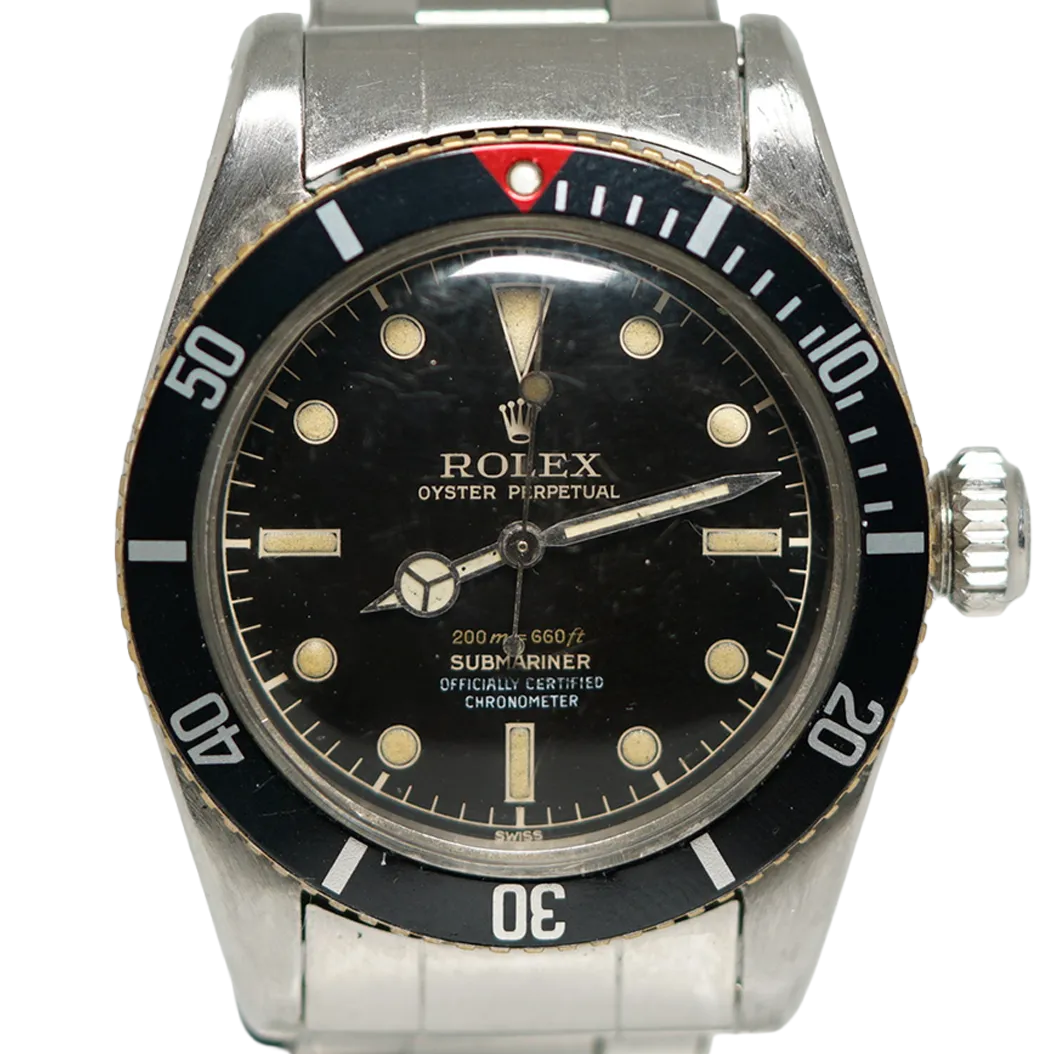
The <em>ref. 6538</em>, produced from 1955 to 1959, remains the most coveted vintage dive watch ever made. Distinguished by its 8mm big crown, unguarded case flanks, and four-line gilt dial, it is the watch Sean Connery wore as James Bond, and the reference against which all subsequent tool watches are judged.
Introduced in 1955, the Rolex Submariner ref. 6538 represents the purest expression of the tool watch ethos that emerged in the post-war decade. Where the preceding ref. 6205 and 6204 had established the template, waterproof case, rotating bezel, time-only dial, the 6538 refined it into something approaching perfection. The case diameter remained 38mm, modest by contemporary standards, but Rolex fitted the distinctively large 8mm "big crown" that gave the watch its enduring sobriquet. This outsized winding crown, unmarked by guards or shoulders, allowed divers to operate the watch while wearing thick neoprene gloves, a functional imperative that became, inadvertently, an aesthetic hallmark. The absence of crown guards, introduced only with the ref. 5512 in 1959, lends the 6538 a lean, purposeful symmetry that later references never quite recaptured.
A short history of the reference
The 6538 emerged at a pivotal moment in Rolex's evolution from Geneva manufacture to global powerhouse. By the mid-1950s, the brand had already established its credentials in professional circles: the Oyster Perpetual had proven waterproof reliability, and the inaugural Submariner models, launched in 1953, had been tested by naval divers, spearfishermen, and Jacques Cousteau's pioneering aquanauts. But the 6538 was the first Submariner to consolidate these lessons into a definitive form. It was powered by the robust Calibre 1030, a 25-jewel automatic movement beating at 18,000 vph (2.5 Hz), certified chronometer-grade by the Contrôle Officiel Suisse des Chronomètres (COSC). The bi-directional rotating bezel, calibrated to sixty minutes, allowed elapsed-time tracking, critical for managing air supply on dives, and the domed acrylic crystal contributed to the watch's unmistakable wrist presence.
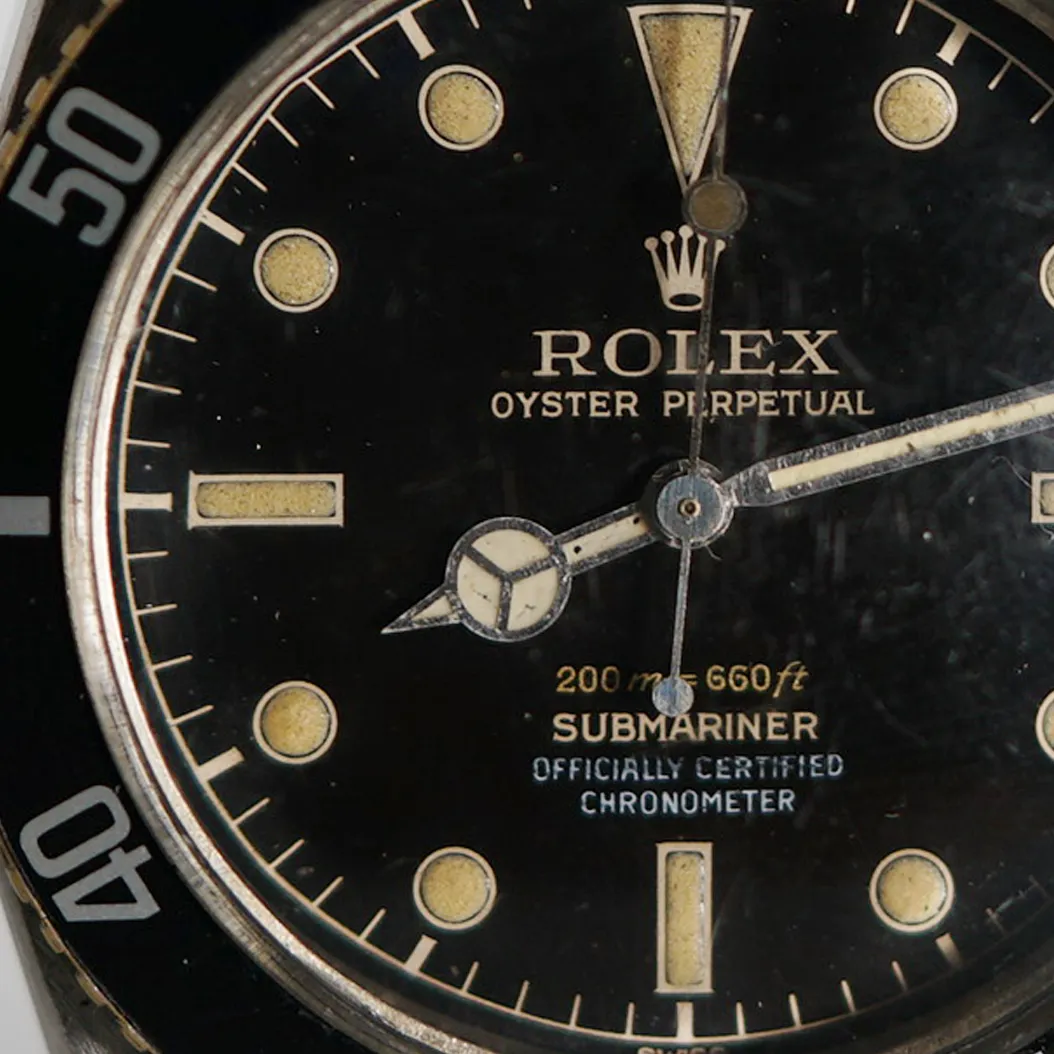
The dial architecture of the 6538 evolved across its four-year production run, but the earliest examples bear the now-iconic four-line gilt script: "Submariner" and "200m=660ft" rendered in gold, beneath the Rolex coronet and "Officially Certified Chronometer" designation. These early gilt dials, paired with the unguarded big crown, constitute the single most desirable configuration in vintage Rolex collecting. Later iterations introduced red depth ratings and explorer-style 3-6-9 numerals on some variants, but it is the pure four-line gilt, minimalist, symmetrical, devoid of extraneous text, that commands the steepest premiums today. The watch was built to what would later be codified as ISO 6425 standards, waterproof to 200 metres and fitted with luminous hour markers and hands for legibility in zero-visibility conditions. By the time production ceased in 1959, fewer than 10,000 examples had been manufactured across all dial variants, and attrition through hard professional use has rendered survivors increasingly scarce.
Cultural mythology has elevated the 6538 beyond its already considerable mechanical merits. Sean Connery wore a 6538 on a striped NATO strap in Dr. No (1962) and From Russia with Love (1963), establishing the template for every cinematic secret agent who followed. This was no product placement, early Bond was outfitted from the costume department's own resources, but the association proved indelible. The watch Connery wore was unmodified save for the fabric strap, and the image of the 6538 on his wrist during the casino scenes and underwater sequences became one of the most reproduced stills in horological history. Simultaneously, Cousteau's divers at Comex relied on the 6538 during Mediterranean expeditions, cementing its bona fides among professional aquanauts who valued function over form.
The piece in front of you
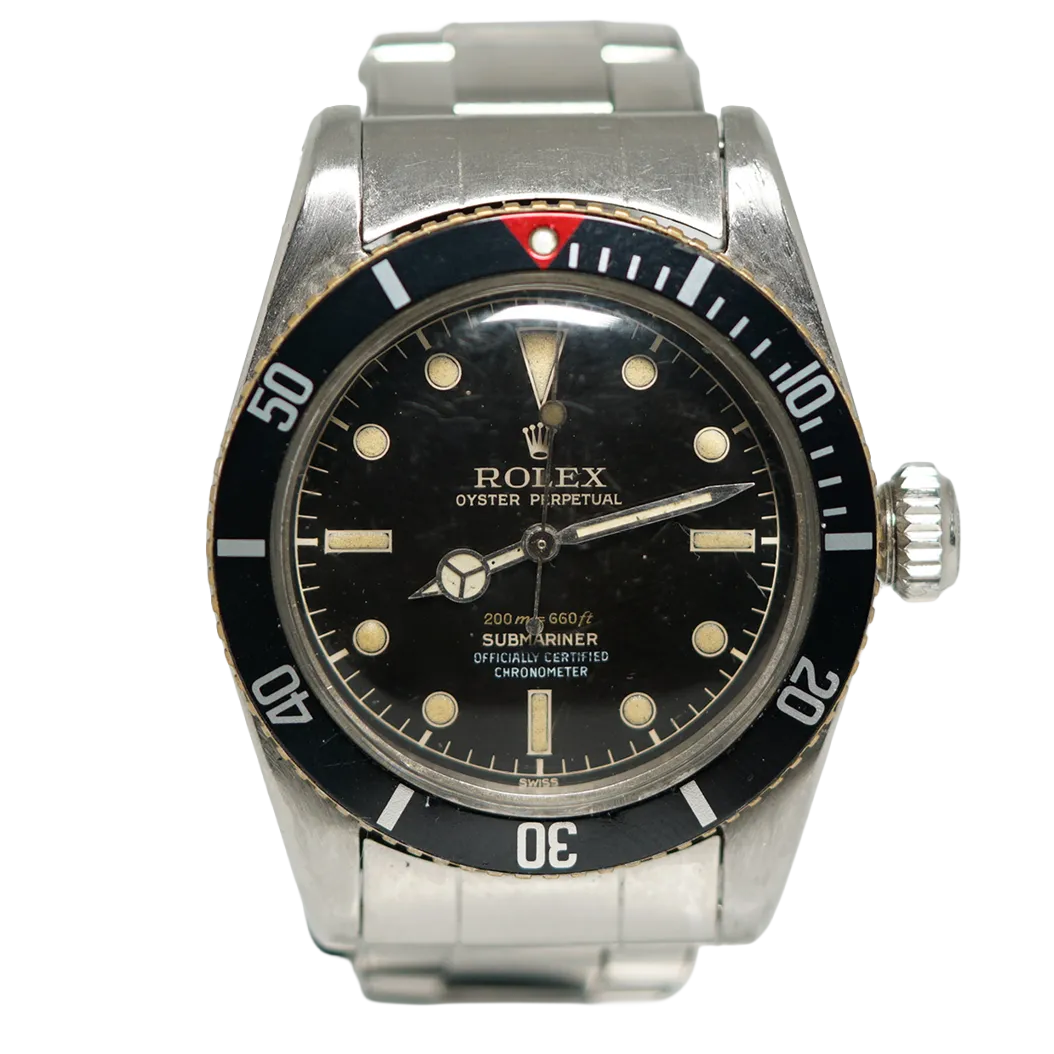
The example held by Wasting Time is a four-line gilt dial 6538, presenting the configuration most prized by collectors of mid-century tool watches. The dial retains its original gilt text, the gold lettering now mellowed to a warm ochre patina consistent with six decades of age. The luminous plots at each hour marker have aged to a creamy ivory tone, matching the tritium fill in the sword hands, a hallmark of unmolested originality. The large 8mm crown remains unsigned, as per the early production spec, and operates smoothly through its winding and time-setting functions. The case shows honest wear: the bevels along the lugs retain their factory edges, and the case back remains crisp, suggesting minimal intervention over the decades.
The bi-directional bezel rotates with the characteristic resistance of a 6538, firm enough to prevent accidental adjustment, loose enough to operate underwater. The domed acrylic crystal bears the fine concentric scratches one expects from a watch that has lived, but remains clear and free from cracks. The case measures 38mm across, a dimension that felt substantial in 1955 and reads today as perfectly proportioned. The caseback is smooth and unadorned, its brushed finish interrupted only by the faint tool marks left by watchmakers during prior services. No crown guards interrupt the flow from lug to crown to lug, just the big crown, proud and functional, jutting from the case flank like the business end of a precision instrument.
Inside, the Cal. 1030 continues to keep chronometer-grade time, its 18,000 vph beat audible when held to the ear. The movement has been serviced, as any sixty-five-year-old calibre must be, but the dial and hands remain untouched, original, unrestored, and all the more compelling for it. This is not a watch that has been "improved" by well-meaning restorers; it is a watch that has been preserved, maintained, and allowed to age with dignity.
On the wrist
On the wrist, the 6538 wears with a presence that belies its 38mm case. The short lugs hug the wrist closely, and the domed crystal catches the light at every angle, refracting it across the gilt dial in a way that modern sapphire can never replicate. The lack of crown guards transforms the watch's profile: where later Submariners feel armoured and robust, the 6538 feels lean and purposeful. The big crown sits at exactly the right height to operate comfortably without digging into the back of the hand, a detail Rolex's designers got right on the first attempt.
The weight is substantial but not oppressive, the heft of the 1030 movement balanced by the hollow mid-case construction. Rotating the bezel produces a satisfying mechanical click, sixty increments of tactile feedback that confirm the watch's origins as a tool, not an ornament. The gilt dial shifts tone depending on the light: warm honey in direct sun, deep bronze in shadow. Legibility is exemplary, the broad sword hands and generous lume plots were designed for underwater use, and they remain instantly readable at a glance even in low light.
There is an honesty to wearing a 6538 that later, more refined Submariners lack. This is a watch that predates the luxury sports category, a watch designed for men who worked underwater for a living. Yet it adapts effortlessly to civilian life, its proportions and restraint rendering it appropriate with everything from a wetsuit to a dinner jacket. The NATO strap, an anachronism in 1955, canonical by 1962, remains the most evocative choice, though the watch wears equally well on a simple leather strap or a vintage Oyster bracelet.
The movement and build
The Calibre 1030 that powers the 6538 represents the zenith of Rolex's first-generation automatic movements. Derived from the Cal. 1030 introduced in 1953, it features 25 jewels, a Breguet overcoil hairspring, and a full rotor winding system that operates in both directions. The movement beats at 18,000 vph, a frequency that prioritises reliability and longevity over the higher precision of later 28,800 vph calibres. Chronometer certification was mandatory for every 6538, each movement individually tested and regulated at the COSC facility in Le Locle. The result is a watch capable of maintaining -4/+6 seconds per day across all positions and temperatures, more than adequate for professional dive use.
The case construction adheres to Rolex's Oyster architecture: a three-piece design with a screw-down caseback and a screw-down crown that compresses a gasket to ensure watertight integrity to 200 metres. The crown threads are cut with extreme precision, each rotation drawing the crown deeper into the case tube until the final seal is achieved. The case itself is turned from a single billet of stainless steel, the mid-case machined to accept the movement ring and the bezel assembly. The bezel insert, originally black aluminium, is calibrated in five-minute increments from zero to fifteen, then in single increments to sixty, a configuration designed for quick readability during ascent.
The crystal is secured by a compression ring, allowing it to pop free under extreme pressure rather than shatter and compromise the case seal. This was standard practice for professional dive watches of the era, and it remains one of the cleverest fail-safes in mid-century watchmaking. The caseback is smooth and engraved only with the reference number and serial number, no exhibition window, no decorative flourishes. The 6538 was built to be opened, serviced, sealed, and returned to duty. It is a watch designed by engineers, not stylists, and every element of its construction reflects that priority.
Why it matters now
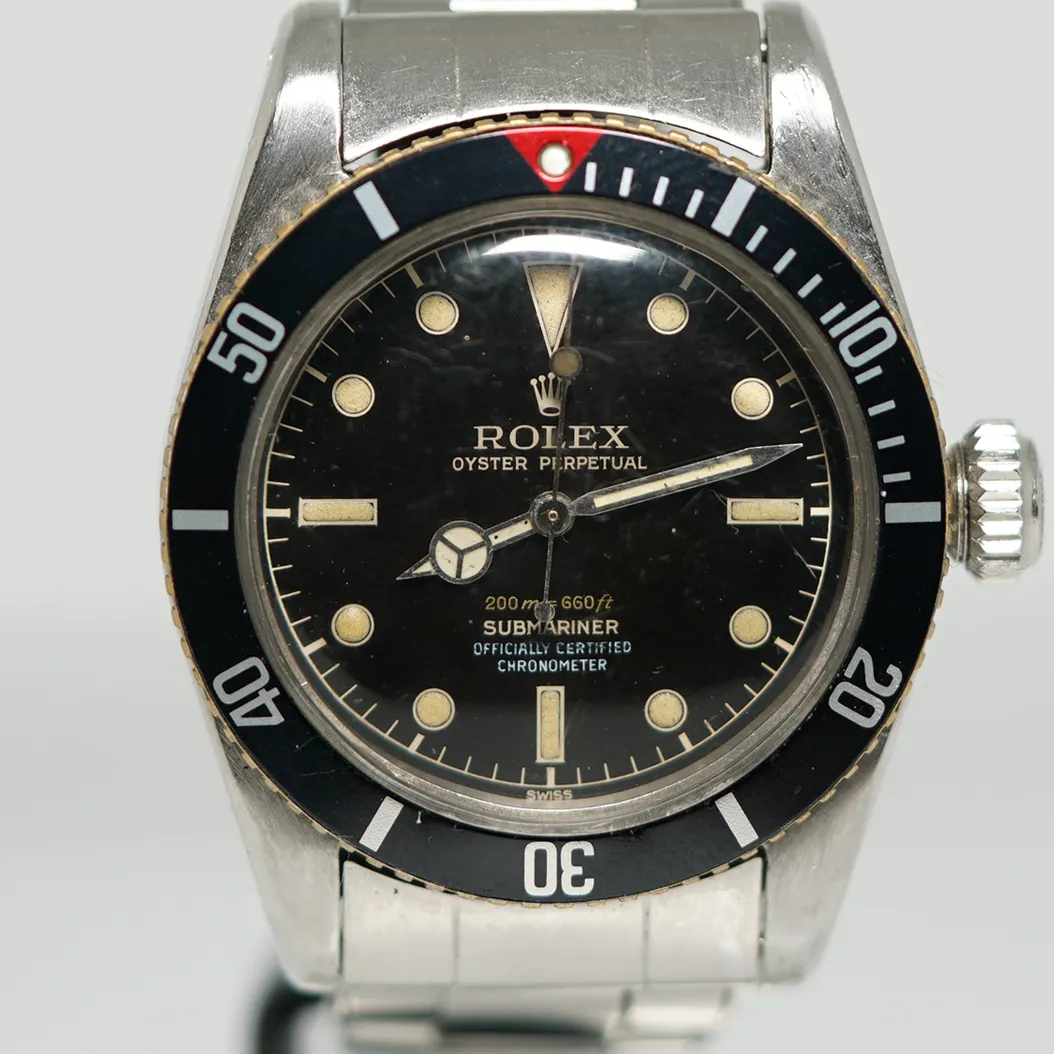
The Rolex Submariner ref. 6538 occupies a singular position in the hierarchy of collectable watches. It is not merely a desirable vintage reference; it is the archetype against which all subsequent dive watches are measured. Every modern Submariner, every Seamaster, every Fifty Fathoms reissue, all trace their lineage to the big crown, no-guards template that Rolex perfected with the 6538. The watch predates the luxury sports category by two decades, yet it established the aesthetic grammar that category would later adopt: monochromatic dial, high-contrast markers, tool watch restraint elevated to the level of design.
Today, the 6538 commands prices commensurate with its historical primacy and Hollywood provenance. Collectors prize original gilt dials, unpolished cases that retain their factory bevels, and movements unmolested by service replacements. The Bond connection adds a layer of cultural cachet that few other references can claim, but serious collectors understand that the 6538's importance predates and transcends cinema. This was the watch that professionalised dive timekeeping, the reference that proved a wristwatch could be both chronometer-precise and capable of surviving prolonged submersion in saltwater. It set the standard, and the standard has not been surpassed, only refined, elaborated, and in some respects diminished by the addition of features that were never strictly necessary.
The market for 6538 examples is small, rarefied, and fiercely competitive. Fewer than 10,000 were made, and attrition has been severe. Many were discarded when their owners upgraded to newer models; others were polished into oblivion by well-meaning jewellers who did not yet understand the concept of patina. The survivors, particularly those with original gilt dials and unguarded crowns, are treasured by institutions and private collectors alike. Auction results reflect this scarcity: the finest examples now trade for sums that would have seemed incomprehensible even a decade ago. Yet the 6538 has never felt overvalued. It is simply that rare: a watch that defined a category, starred in the most influential action films of the 1960s, and remains, six decades later, the single most compelling Submariner ever made.
For the collector who understands mid-century tool watch design, the 6538 represents an endpoint, a reference so archetypal, so historically significant, that acquiring one feels less like a purchase than a homecoming. It is the watch that makes sense of everything that came after.
This piece is currently available through Wasting Time. View the listing or enquire for full provenance and pricing.