
27 May 2026 · 8 min read
The Rolex Submariner Date 16800, Transition as Legacy
By Wasting Time
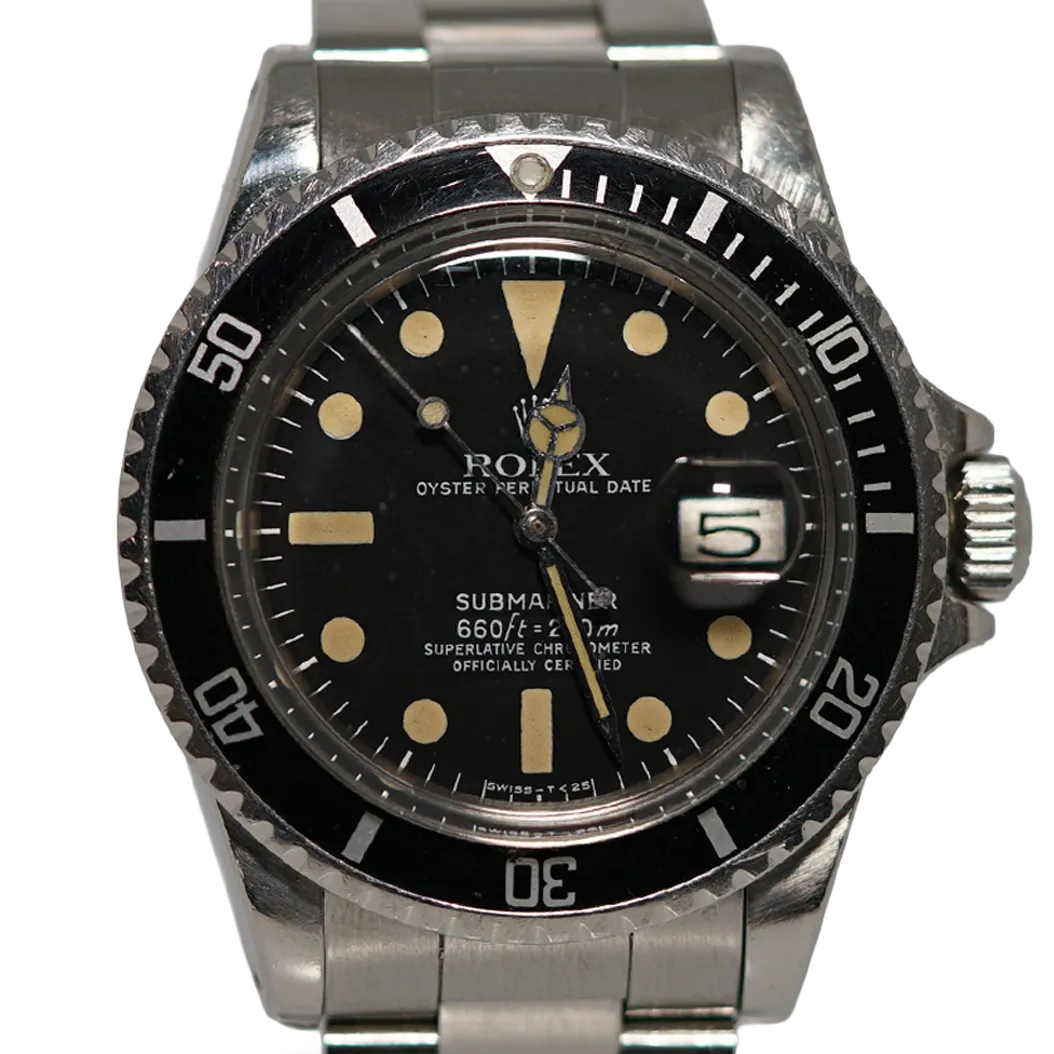
The <em>ref. 16800</em> arrived in 1979 as a technical watershed, the first <em>Submariner Date</em> with sapphire crystal and high-beat movement, yet still dressed in the matte dial uniform of the tool watch era. It is a bridge piece in the truest sense, and the market has begun to notice.
The Rolex Submariner Date ref. 16800 occupies a curious position in the lineage of what is arguably the most recognised wristwatch silhouette of the twentieth century. Introduced in 1979, it arrived at a moment when Rolex was beginning to recalibrate the Submariner from purpose-built dive instrument to luxury sports watch, yet the ref. 16800 retains enough of the old guard, matte dials, painted surrounds, unadorned typography, to feel rooted in the model's utilitarian origins. It is the last Submariner Date to wear that aesthetic convincingly, and the first to incorporate the technical improvements that would carry the reference into the modern era. For collectors, it represents transition as legacy, a model that straddles two worlds and belongs fully to neither, which is precisely why it matters.
A Short History of the Reference
The ref. 16800 entered production in 1979, a successor to the ref. 1680 that had defined the Submariner Date for over a decade. The most immediately visible change was the adoption of a scratch-resistant sapphire crystal in place of the domed acrylic that had characterised every Submariner since 1953. This was no small shift. Acrylic had been part of the watch's identity, warm, slightly imperfect, prone to crazing with age, but also forgiving of impact and easily polished. Sapphire was modern, clinical, and spoke to a different set of priorities. It signalled that Rolex was serious about positioning the Submariner as a luxury object, not merely a tool.
Beneath the dial, the ref. 16800 housed the Calibre 3035, a movement introduced in 1977 that marked Rolex's entry into the high-beat era. Running at 28,800 vibrations per hour, an increase from the 19,800 vph of the Cal. 1575, the 3035 offered improved timekeeping stability and incorporated a quickset date function, allowing the wearer to advance the date independently of the hour hand. It was Rolex's first chronometer-certified movement with the Microstella regulating system, and it arrived with 27 jewels and a power reserve of approximately 42 hours. Technically, it was a significant leap forward. Visually, however, the watch remained conservative.
Early examples of the ref. 16800 continued the matte dial tradition of the preceding ref. 1680, with painted hour markers and surrounds that gave the dial a flat, military-spec appearance. This was a deliberate choice. Rolex understood that the Submariner had built its reputation on legibility and functionality, and the company was not yet ready to sacrifice that identity entirely. By the mid-1980s, however, production had transitioned to gloss dials with white-gold-framed indices, an aesthetic shift that would become standard across the Submariner range. The ref. 16800 thus exists in two distinct phases: matte and gloss, each appealing to a different sensibility within the collecting community.
The reference remained in production until approximately 1988, when it was succeeded by the ref. 168000 and, shortly thereafter, the ref. 16610. Its nine-year run was long enough to establish the sapphire-crystal Submariner as the new normal, but brief enough that it retains a certain scarcity today. The ref. 16800 was never the most glamorous Submariner, but it was the one that made everything that followed possible.
The Piece in Front of You
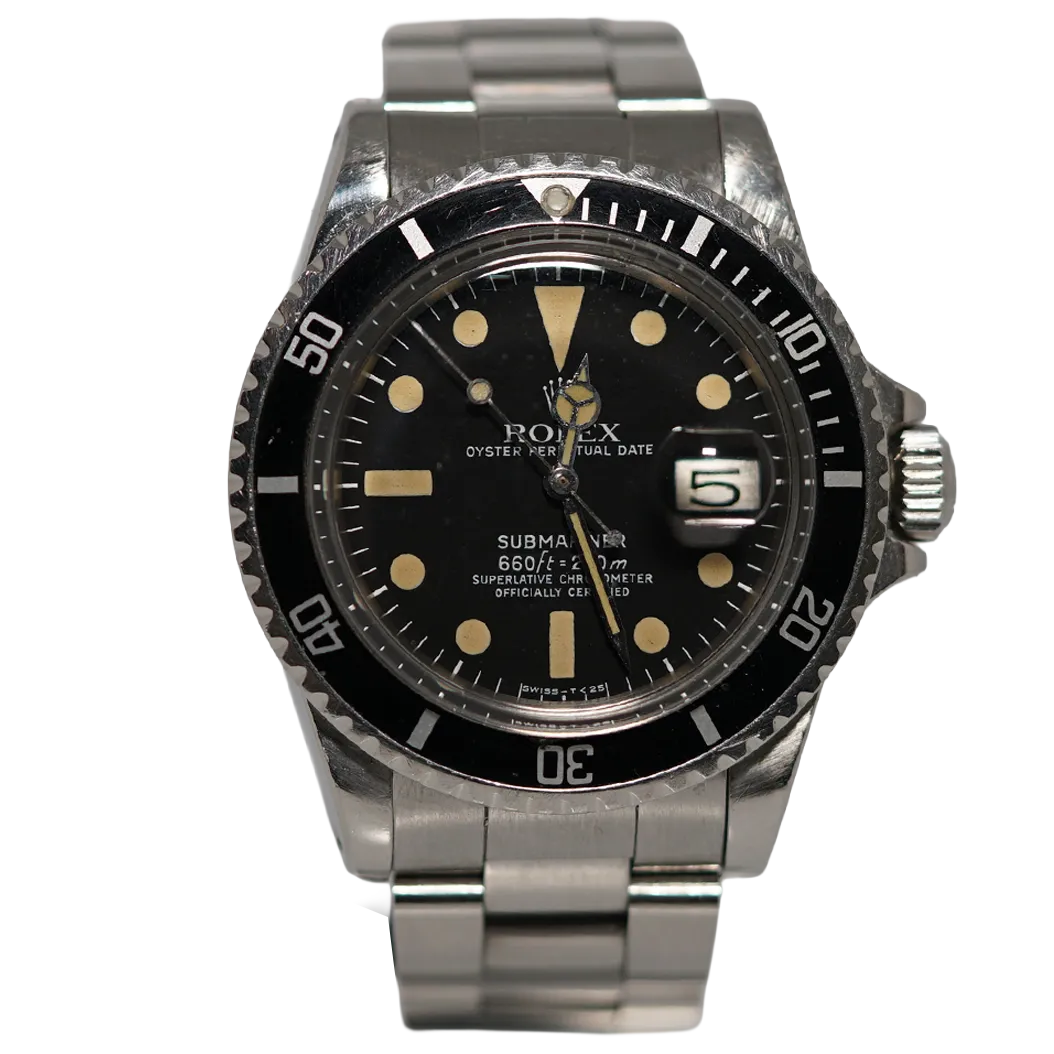
Without detailed inspection, it is difficult to speak authoritatively about the specific condition of this example, but certain qualities of the ref. 16800 as a reference are worth noting. The 40mm oyster case, rated to 300 metres, adheres to the proportions established in the 1960s, with straight lugs and a crown guard that frames the screw-down Triplock crown. The bezel, bidirectional and fitted with an aluminium insert, shows the expected wear patterns of a watch designed to be worn and used. Rolex would not introduce the unidirectional bezel until the ref. 16610, and collectors have come to appreciate the bidirectional assembly as a marker of this transitional period.
The dial, whether matte or gloss, is central to the ref. 16800's identity. Matte examples, particularly those with metres-first depth ratings and early tritium plots, are the most sought-after by purists who value the continuity with earlier references. Gloss dials, by contrast, appeal to those who prefer a cleaner, more modern presentation. Both have merit; both have devotees. The condition of the luminous material is a key consideration. Tritium-dialled examples will have aged to various shades of cream or tan, and uniform patination across hour markers and hands is a marker of originality. Later examples with Swiss-made designations and consistent luminous material may lack the romance of early matte dials but offer a more stable ownership proposition.
The absence of box and papers is not uncommon for a watch of this vintage, and while their presence adds provenance and value, the ref. 16800 is well-documented enough that authenticity can be verified through case and dial details. Prospective purchasers would do well to request photographs of the caseback engravings, the condition of the bracelet end links, and evidence of service history. The Calibre 3035 is robust, but four decades is long enough that parts availability and service competence become relevant factors.
On the Wrist
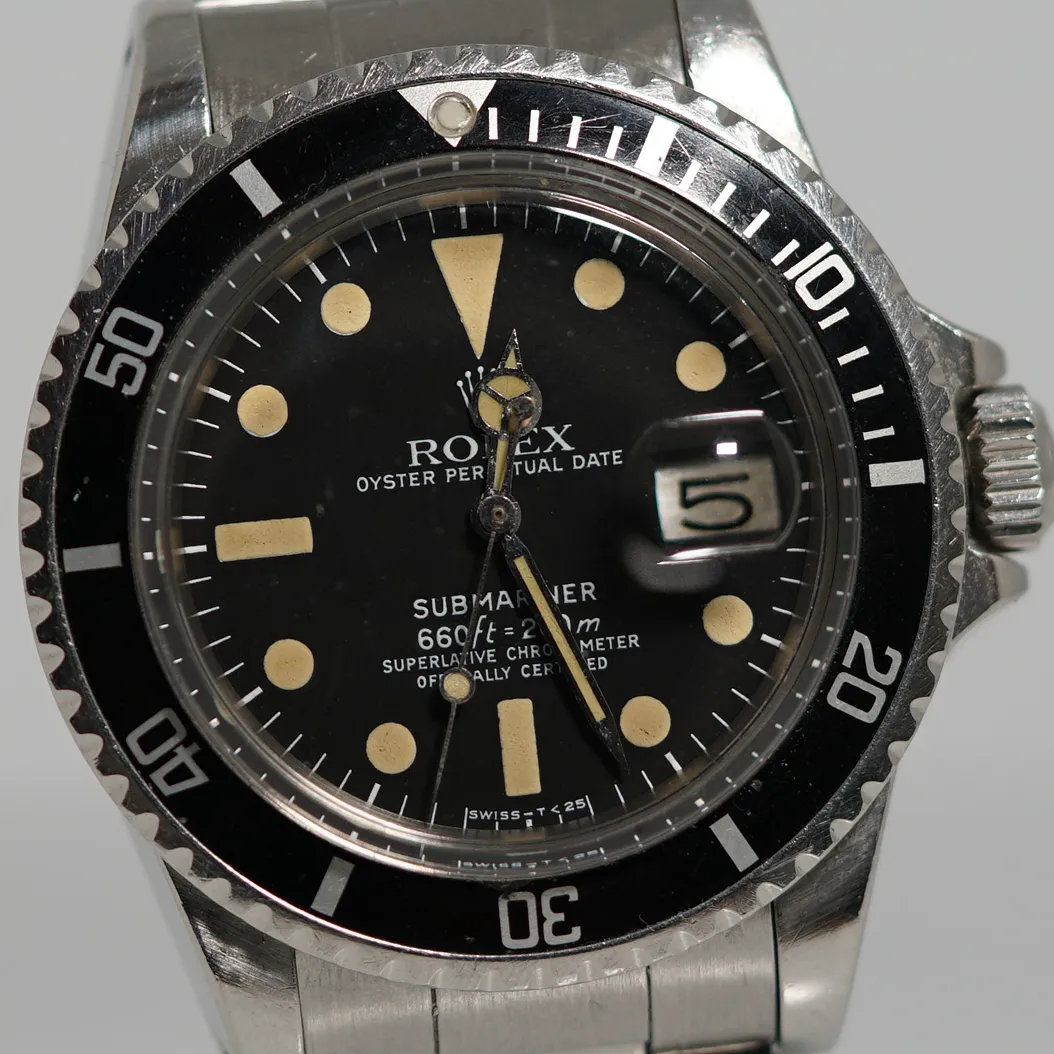
The ref. 16800 wears with the same restrained presence that characterises all Submariners of this generation. At 40mm, it feels compact by contemporary standards but remains eminently legible. The case profile is slimmer than the modern Submariner Date, and the absence of the broader lugs and thicker case introduced with the ref. 116610 gives it a more understated wrist presence. This is not a watch that announces itself from across a room. It earns its authority quietly, through proportion and balance rather than size.
The sapphire crystal, flat and unadorned, sits flush with the bezel, and while it lacks the warmth of acrylic, it brings a clarity to the dial that enhances legibility in changing light. The bezel action, bidirectional, as mentioned, has a tactile quality that differs from modern unidirectional assemblies. It feels looser, less deliberate, but also more forgiving in daily use. The Oyster bracelet, typically a later-generation folded-link or early solid-link configuration depending on production year, tapers to 20mm at the case and wears comfortably, though stretch over time is to be expected.
On the wrist, the ref. 16800 functions as both a historical artefact and a functional timepiece. It is a watch you can wear to a client meeting or a weekend on the coast without feeling either underdressed or overly precious. It does not demand attention, but it rewards scrutiny. Those who know will recognise the reference; those who do not will simply see a well-proportioned dive watch. That discretion is part of its appeal.
The Movement and Build
The Calibre 3035, introduced in 1977, was Rolex's first high-beat chronometer movement and remained in production until the early 1990s, when it was succeeded by the Cal. 3135. It runs at 28,800 vph with 27 jewels, incorporating a quickset date function and the Microstella regulating system for fine adjustment. The movement is self-winding via a bidirectional rotor, with a power reserve of approximately 42 hours. It is a solid, dependable calibre, and while it lacks the refinements of the Cal. 3135, most notably the full balance bridge and improved shock resistance, it has proven durable across decades of use.
The case construction follows Rolex's established oyster architecture, with a screw-down caseback, screw-down crown with Triplock sealing system, and a bezel assembly that, while bidirectional, maintains water resistance to 300 metres. The introduction of sapphire crystal required subtle changes to the bezel and crystal retention system, and these differences are visible when comparing the ref. 16800 to its predecessor, the ref. 1680. The crystal itself is thicker and more resistant to impact, though it lacks the cyclops magnification over the date window, a detail that would arrive with later references.
From a service perspective, the Cal. 3035 is well-supported by independent watchmakers, and parts remain available through Rolex service centres, though the company's policy on vintage references can be unpredictable. A full service typically includes movement disassembly, cleaning, lubrication, and pressure testing, and should be undertaken every five to seven years to maintain optimal performance. The robustness of the 3035 means that well-maintained examples continue to keep time within COSC chronometer specifications.
Why It Matters Now
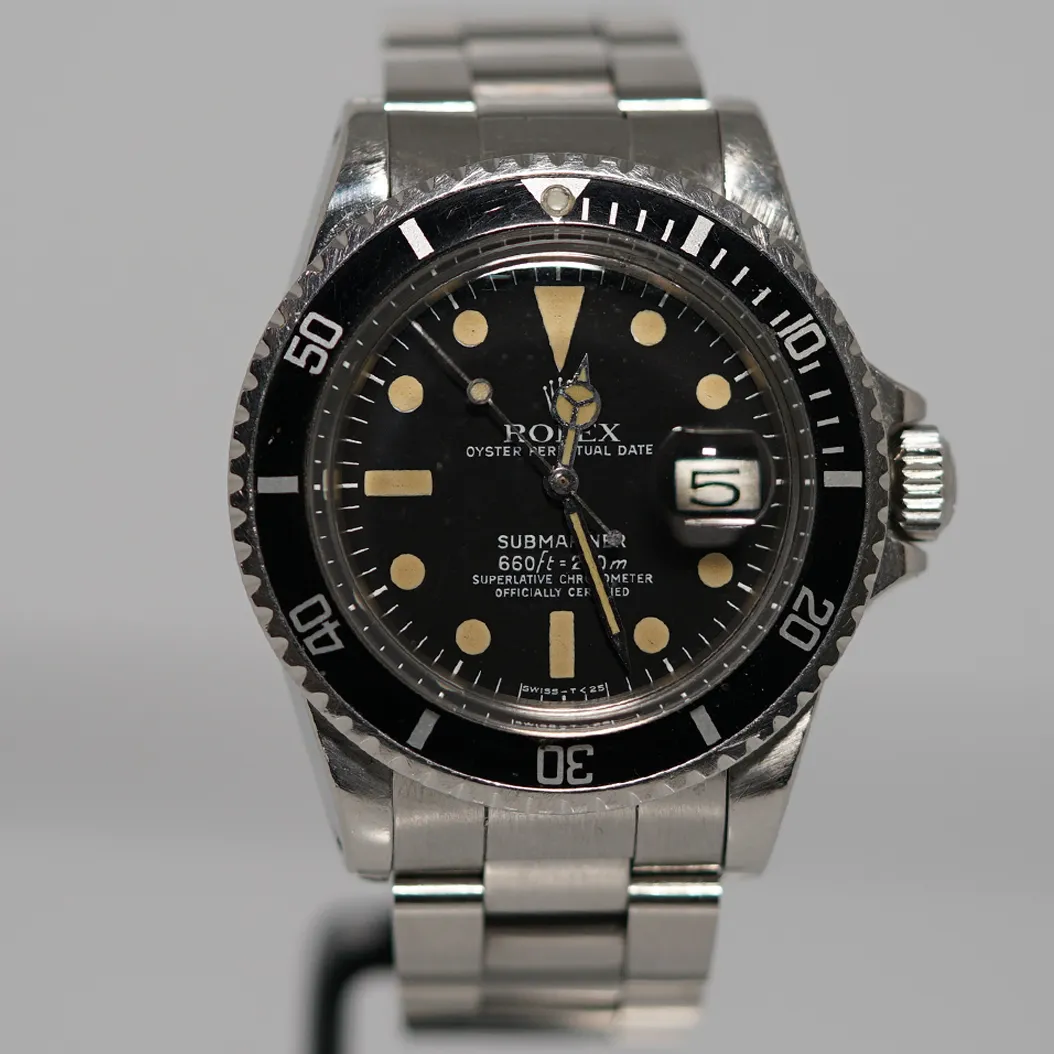
The ref. 16800 has spent much of its existence in the shadow of more celebrated references, the 5513, the 1680, the 16610, but the market has begun to reassess its position. It is the last Submariner Date to carry forward the matte dial aesthetic of the tool watch era, and the first to incorporate the technical improvements that define the modern Submariner. That duality gives it a unique appeal. For collectors who value historical continuity but also require a watch robust enough for daily wear, the ref. 16800 offers an elegant compromise.
Prices for well-preserved examples, particularly early matte-dial variants, have risen steadily over the past five years as collectors have come to appreciate the reference's transitional status. It remains more accessible than a ref. 1680 or 5513, yet it offers a technical specification that makes it more practical for regular use. The sapphire crystal alone eliminates a significant vulnerability of earlier references, and the quickset date function is a convenience that should not be underestimated.
The ref. 16800 also benefits from the broader reappraisal of 1980s Rolex sports watches. Once dismissed as too recent to be vintage and too old to be modern, references from this decade are now understood as the last generation before the brand's full pivot to luxury. They retain a rawness, a utilitarian honesty, that later references lack. The ref. 16800 embodies that quality. It is a watch built to be used, not displayed, and that unpretentious functionality has aged remarkably well.
For those considering acquisition, the key is to understand what variant appeals most. Matte dials with metres-first depth ratings and early tritium plots command the highest premiums and offer the strongest continuity with earlier Submariner references. Gloss dials, while less romantically linked to the tool watch era, offer a cleaner aesthetic and often present in better condition due to their later production. Both are legitimate expressions of the reference, and both have constituencies within the collecting community. The absence of box and papers need not be disqualifying; the watch itself, if original and well-preserved, carries the story.
The Rolex Submariner Date ref. 16800 will never be the most celebrated Submariner, nor the most expensive. But it is, in many respects, the most honest, a watch that bridges eras without pretending to be something it is not. It advanced the Submariner technically while preserving its visual identity, and in doing so, it secured the model's relevance for another generation. That is legacy enough.
This piece is currently available through Wasting Time. View the listing or enquire for full provenance and pricing.