
27 May 2026 · 6 min read
Rolex Submariner Perpetual: The Archetype of the Modern Dive Watch
By Wasting Time
The Rolex Submariner Perpetual stands as the reference against which all dive watches are measured. This is the story of how a functional tool became an icon.
Few wristwatches command the cultural weight of the Rolex Submariner. Introduced in 1953 and formally presented to the world at Basel in 1954, the Submariner was neither the first dive watch nor the deepest-rated, yet it became the template from which an entire genre would be cast. The Submariner Perpetual designation, appearing across countless references throughout the model's seven-decade evolution, speaks to Rolex's philosophy of incremental refinement rather than radical reinvention. Where other manufacturers chased depth ratings and complications, Rolex pursued legibility, reliability, and that elusive quality the brand has always excelled at: presence.
The Submariner emerged from post-war optimism and the dawn of recreational diving. Jacques Cousteau's Le Monde du Silence had captivated audiences, and the underwater realm was newly accessible to civilians. Rolex had already established credentials in hostile environments, Everest in 1953 with the Explorer, the depths with experimental prototypes strapped to the hulls of Trieste-class bathyscaphes. The Submariner distilled these learnings into a watch that could be worn daily, yet trusted at depth. The rotating bezel, the luminous indices, the Oyster case, each element served a purpose, but together they created something greater: an aesthetic language that would define sports watches for generations.
What distinguished the Submariner from contemporaries like the Blancpain Fifty Fathoms was Rolex's distribution and marketing acumen. The brand placed Submariners on the wrists of military units, commercial divers, and, crucially, on cinema screens. By the time Sean Connery wore a ref. 6538 in Dr. No, the Submariner had transcended its utilitarian origins. It became a symbol, and symbols sell in ways that specifications never can.
A Short History of the Reference
The Submariner Perpetual lineage encompasses dozens of references, each marking subtle evolutions in Rolex's relentless pursuit of perfection. Early four-digit references, 6204, 6205, 6536, 6538, established the archetype: a rotating timing bezel, luminous markers, and water resistance initially rated to 100 metres, quickly improved to 200. These were tool watches in the truest sense, issued to military units and professional divers who needed instruments, not jewellery.
The introduction of crown guards with the ref. 5512 and 5513 in the late 1950s and early 1960s represented a pivotal moment. The crown, that vulnerable protruding element, was now shielded, a recognition that dive watches faced lateral impacts, not just hydrostatic pressure. The 5513, produced from 1962 to 1989, became perhaps the most iconic Submariner of all: no chronometer certification, no date complication, just a time-only tool watch that did one thing supremely well. Its 27-year production run speaks to the design's rightness.
Five-digit references brought calibre upgrades and refinements. The ref. 14060, introduced in 1990, inherited the 5513's no-date purity but gained a sapphire crystal and the robust Cal. 3000. The ref. 16610, with its date function and Cyclops lens, served those who wanted additional utility. Aluminium bezels gave way to Cerachrom ceramic inserts in the 2000s, scratchproof, fadeproof, and somewhat soulless to purists who valued the patina of aged aluminium.
Modern six-digit references have grown in diameter and sophistication. The current ref. 124060 measures 41mm, houses the Cal. 3230 with 70-hour power reserve, and represents Rolex's most advanced iteration. Yet the silhouette remains unmistakable. From across a room, a 1960s 5513 and a 2024 124060 are siblings, separated by technology but united by design.
The Piece in Front of You
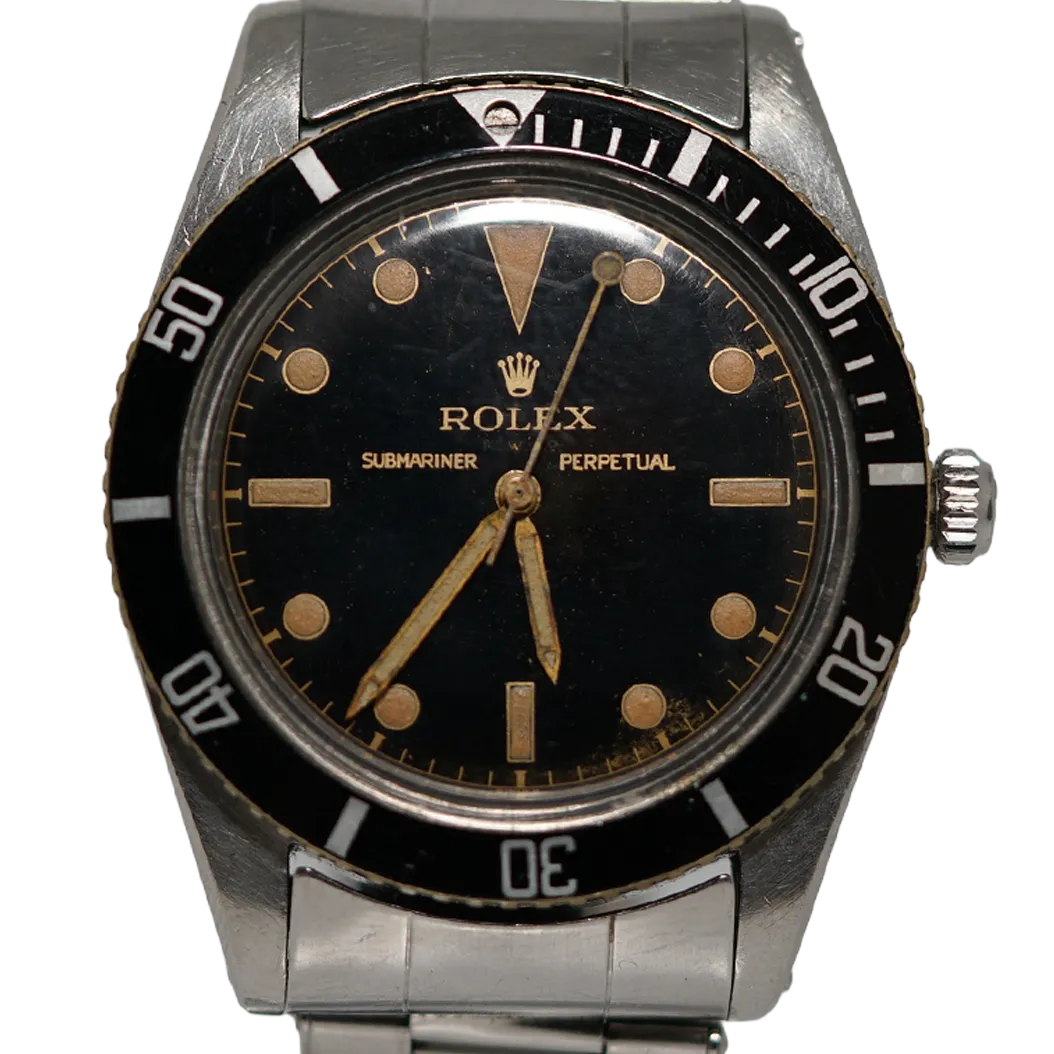
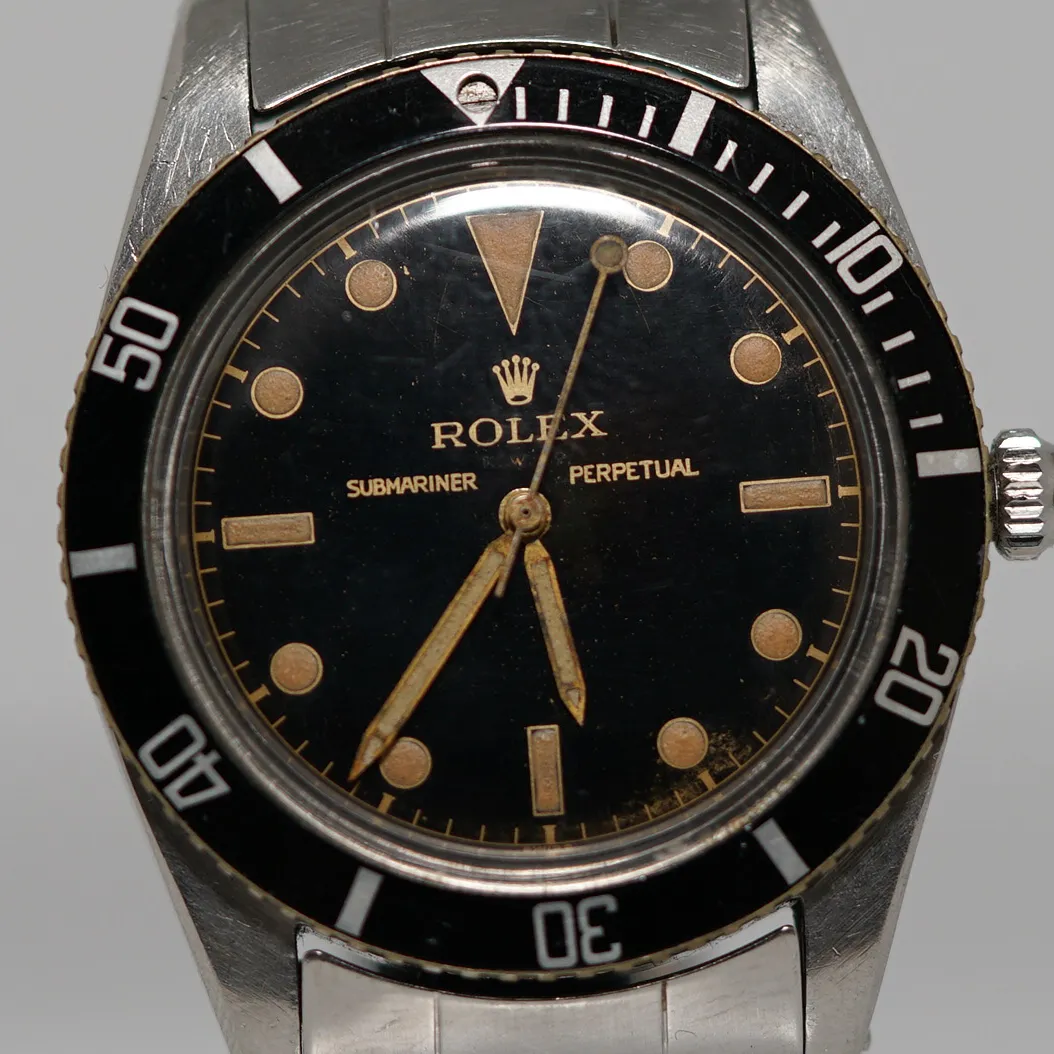
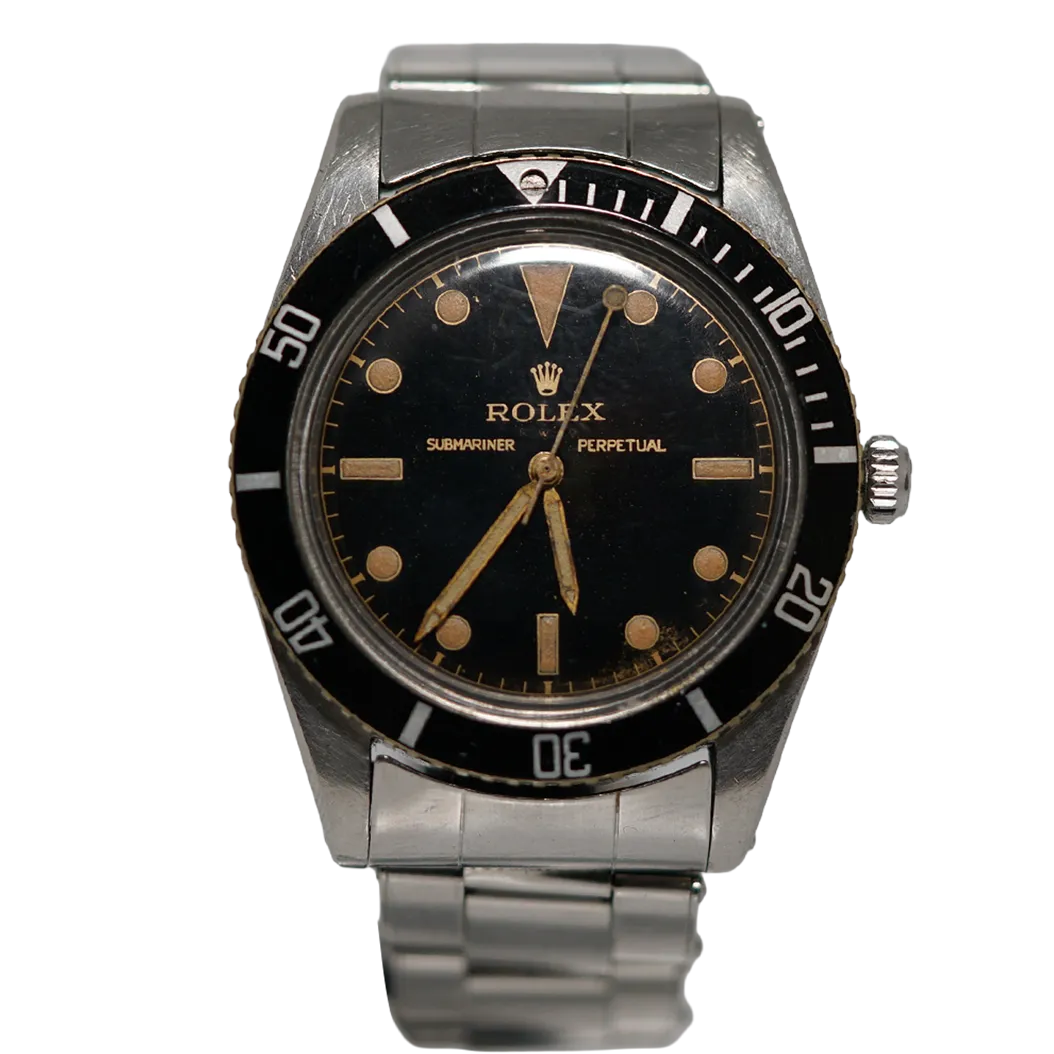
Without specific details of production year or reference, this Submariner Perpetual must be considered in its essence rather than its particulars. What can be said with certainty is that any Submariner bearing the Perpetual designation houses a self-winding movement, Rolex's proprietary rotor system that has powered the brand's automatic watches since the 1930s. The term appears on the dial as both technical descriptor and promise: this watch winds itself through the motion of life.
The Submariner case, regardless of generation, follows Rolex's Oyster architecture. The middle case is typically machined from a solid block of stainless steel (or precious metal in certain references), with a screw-down caseback and crown ensuring water resistance. The triplock crown system, recognisable by three dots beneath the coronet symbol, provides triple sealing, a design so effective that Rolex continues to use it across the professional range.
The rotating bezel, whether aluminium or ceramic, features a 60-minute scale and clicks unidirectionally, a safety feature ensuring that timing errors can only underestimate elapsed time, never overestimate it. The pip at 12 o'clock, often lumed to match the dial, serves as the reference point. In use, a diver would align this pip with the minute hand at descent; the elapsed time could then be read at a glance. In practice, most Submariner owners use the bezel to time parking metres, but the functionality remains.
The dial itself adheres to Rolex's philosophy of legibility. Large indices, typically applied rather than printed, catch light from multiple angles. The Mercedes hands, so called for the circled three-pointed design of the hour hand, provide instant differentiation from the minute hand, even in murky conditions. Luminous material, whether radium in early examples, tritium in mid-period pieces, or modern Chromalight, ensures visibility in darkness. The Rolex coronet at 12 o'clock is restrained, surprisingly small for a brand with such presence. Confidence, it seems, needs no amplification.
On the Wrist and the Movement
The Submariner wears with a solidity that feels earned rather than engineered. The Oyster bracelet, with its three-piece links, has a suppleness that belies its robustness. The clasp, whether the older flip-lock or modern glidelock extension system, sits flush and secure. On the wrist, the watch feels centred, balanced. There is no top-heaviness, no sense that the watch might cant to one side. This is the result of decades of refinement, of microscopic adjustments to lug angle and bracelet taper.
The bezel action provides tactile satisfaction. Each click is audible and definite, with just enough resistance to prevent accidental rotation but not so much as to require two hands. This is engineering in service of experience, the mechanical equivalent of a car door that closes with a satisfying thunk. You don't need to look to know the bezel has engaged; you feel it.
Beneath the dial lies Rolex's commitment to chronometric excellence. Submariner movements vary by era and reference, but certain principles remain constant. The Perpetual rotor, visible through exhibition casebacks in some modern references (though not traditionally in the Submariner, which favours a solid back for additional water resistance), winds the mainspring through a ball-bearing system. The movement beats at 28,800 vibrations per hour in modern iterations, providing the smooth seconds hand sweep that signals mechanical refinement.
Calibres like the 3130, 3135, and more recently the 3230 incorporate Rolex's Parachrom hairspring, paramagnetic and more resistant to shocks and temperature variations than traditional hairsprings. The Paraflex shock absorption system further protects the balance assembly. These are not features visible to the wearer, yet they manifest in the watch's reliability. A properly serviced Submariner will run within COSC chronometer specifications year after year, requiring only periodic maintenance at intervals that would make a vintage car enthusiast weep with envy.
The power reserve has grown over generations. Early movements offered approximately 48 hours; modern calibres provide 70. This matters less for daily wearers than for collectors who rotate pieces. A Submariner set down on Friday evening will still be running on Monday morning, a small convenience that speaks to Rolex's understanding of how watches are actually used.
Why It Matters Now
In an era of micro-brands, direct-to-consumer disruptors, and smartwatches that can summon helicopters, the Submariner Perpetual remains relevant through sheer inevitability. It is the watch that invented its own category and then spent seven decades defending the crown. Every dive watch since 1954 is either a homage to the Submariner or a deliberate rejection of it; there is no neutral position.
The collector market for vintage Submariners reflects this centrality. Condition-appropriate examples of the ref. 5513 command prices that would have seemed fantastical a generation ago. Military-issued pieces, particularly those with documented provenance, trade at multiples of standard models. The presence of original components, correct hands, untouched dials, service-stamped casebacks, separates five-figure watches from six-figure ones. This is a market that rewards knowledge and punishes assumptions.
Modern Submariners, meanwhile, face the peculiar challenge of being simultaneously ubiquitous and unobtainable. Authorised dealers maintain waiting lists measured in years; grey market premiums evaporate as quickly as they materialise. Rolex produces hundreds of thousands of watches annually, yet demand consistently outstrips supply. The Submariner has become a victim of its own success, so desirable that wearing one risks cliché, yet too correct to dismiss.
For those who collect beyond mere accumulation, the Submariner Perpetual represents a fascinating study in evolutionary design. Comparing a 1960s 5513 to a contemporary 124060 reveals how much can change while the essential character remains intact. The modern watch is superior in every measurable way, more water-resistant, more shock-resistant, more chronometrically stable. Yet the vintage piece possesses a warmth, a humanity in its imperfections, that speaks to a different era of manufacturing. Neither is better; they serve different purposes in a collection.
The Submariner also offers accessibility in an increasingly rarefied market. While vintage examples appreciate and modern pieces command premiums, the watch remains, in theory, a production model. This distinguishes it from limited editions and discontinued references that exist only in the secondary market. A determined buyer can, eventually, acquire a new Submariner at retail. This ongoing availability prevents the model from becoming purely a collectible; it remains, fundamentally, a watch to be worn.
The Rolex Submariner Perpetual endures because it solved a problem so completely that the solution became definitive. It is both tool and icon, investment and instrument. In a world of complications and innovations, it persists by doing one thing perfectly: telling the time, anywhere, under any conditions. That this capability comes wrapped in one of horology's most recognisable silhouettes is not incidental, it is the entire point.
This piece is currently available through Wasting Time. View the listing or enquire for full provenance and pricing.