
27 May 2026 · 6 min read
Rolex Turn-O-Graph ref. 6202: The Rotating Bezel That Started It All
By Wasting Time
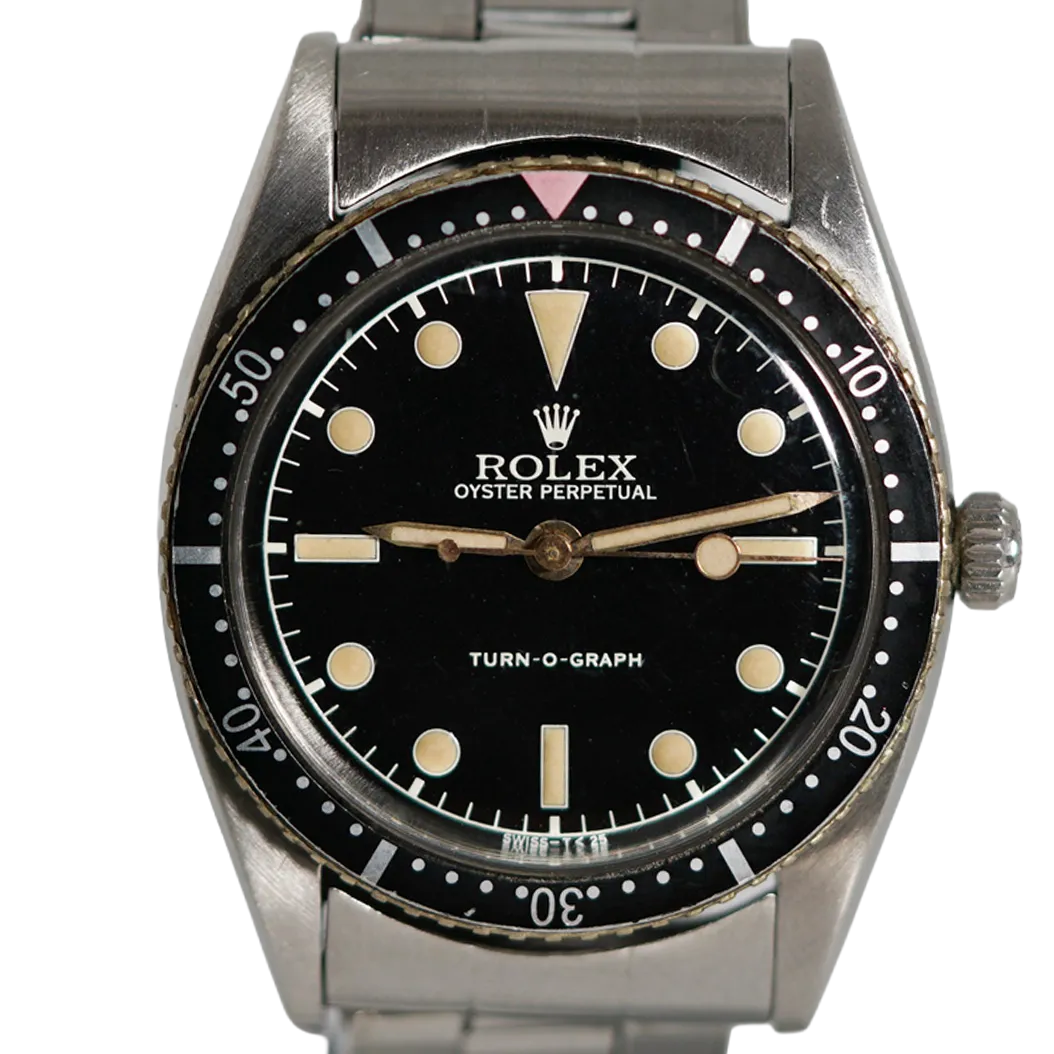
Launched in 1953, the <em>Rolex Turn-O-Graph ref. 6202</em> was the manufacture's first series-production wristwatch with a rotating timing bezel, the mechanism that would define the <em>Submariner</em>, <em>GMT-Master</em>, and the entire vocabulary of sports horology.
Before the Submariner became synonymous with dive watches, before the GMT-Master conquered aviation, there was the Turn-O-Graph. Introduced in 1953 as reference 6202, it represented Rolex's first experiment in marrying utilitarian function with wristwatch elegance, a rotating timing bezel operated by coin-edge grip, mounted on a case slim enough to slip beneath a dress shirt cuff. Though history has largely granted the laurels to its more celebrated siblings, the Turn-O-Graph established the architectural language from which modern sports watches emerged. This was the template, the proof of concept, the watch that answered a question Rolex had been quietly asking since the late 1940s: could a timing tool double as a gentleman's wristwatch?
A Short History of the Reference
The early 1950s marked a period of rapid innovation at Rolex, as the manufacture sought to expand beyond its core offering of Oyster Perpetual dress watches and chronographs. The Turn-O-Graph emerged from this environment of experimentation, its name derived from the rotating bezel's function, turn to mark time, turn to calculate elapsed minutes. Launched in 1953, the same year as the Submariner ref. 6204, the ref. 6202 shared fundamental DNA with its dive-watch counterpart but diverged in philosophy. Where the Submariner would be marketed explicitly for underwater use, the Turn-O-Graph remained intentionally ambiguous, a tool for timing anything from parking meters to laboratory processes to, yes, recreational diving.
Mechanically, early Turn-O-Graph examples employed Rolex's proven automatic calibres, typically from the Cal. 1530 family, robust, self-winding movements equipped with the manufacture's proprietary Superbalance wheels and, in later iterations, Paraflex shock absorption. These calibres delivered chronometer-grade performance within the watch's 36mm case, a dimension that today reads as modest but was entirely conventional for the era. The rotating bezel itself operated via a 60-minute scale, bidirectional in early examples, allowing wearers to track elapsed time with a tactile twist of the coin-edge grip.
Aesthetically, the Turn-O-Graph occupied a middle ground. Dial treatments varied, some featured applied indices and Dauphine hands, others adopted more utilitarian configurations, but the overall impression remained one of restraint. This was not a watch designed to announce itself. Engine-turned bezels on certain variants added textural interest without ostentation, while the slim case profile ensured the watch could transition seamlessly from weekend pursuits to weekday formality. Cultural adoption came selectively; the Thunderbird variants, produced for the United States Air Force aerobatic team, represent the model's most storied chapter, though standard civilian examples retained their own quiet appeal among those who appreciated mechanical ingenuity over marketing narratives.
The Piece in Front of You
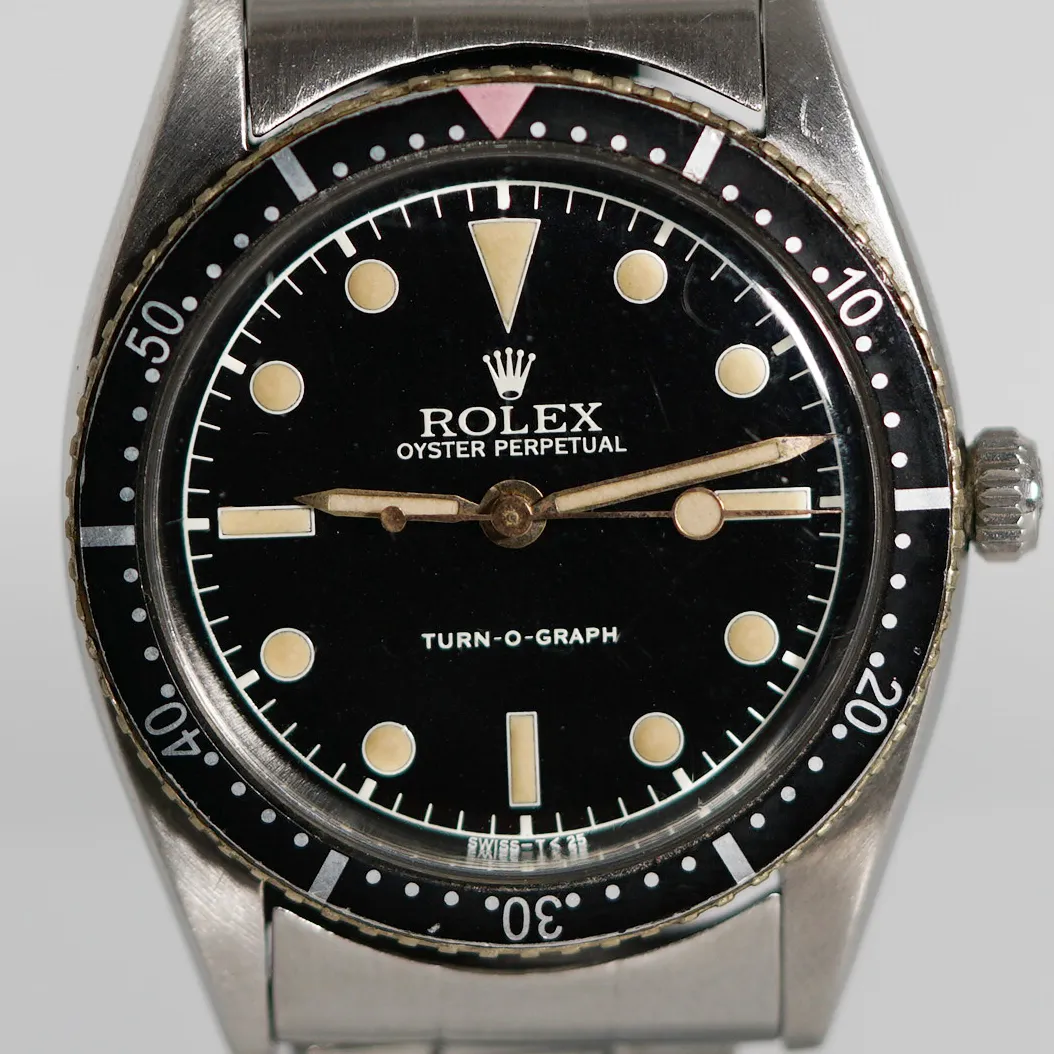
Without access to comprehensive photography or detailed condition documentation, we approach this ref. 6202 with the caution such watches demand. Originality is everything in early Rolex sports references, and the Turn-O-Graph presents particular vulnerabilities: bezels that have been swapped, dials that have been refinished, cases that have suffered over-polishing. Prospective collectors must examine case integrity with particular attention to lug profile and hallmark clarity, ensuring that decades of servicing have not eroded the architecture. The bezel mechanism, bidirectional on the ref. 6202, should rotate with controlled resistance, the action smooth but not loose, the numerals legible without excessive wear.
Dial authenticity demands scrutiny. Early Turn-O-Graph dials can present in various configurations, and the collector must verify period-correct printing, lume plots, and handset compatibility. Tropical aging, where radium lume has discoloured the dial surface to warm browns or creams, adds desirability when genuine, but distinguishes itself from simple dirt or moisture damage only under magnification and informed inspection. The hands themselves, whether original Dauphine or sword-style depending on production batch, should exhibit lume that matches the dial plots in colour and patina, a harmony that cannot be faked convincingly over the long term.
Case condition reveals the watch's life story. A ref. 6202 that has escaped heavy polishing will retain crisp bevels between case flanks and lugs, with hallmarks, typically Rolex coronet, case reference, and serial number between the lugs, remaining sharp and legible. Over-polishing manifests in rounded lug edges, thinned case walls, and hallmarks reduced to ghostly impressions. The case back, bearing additional reference engravings, should close with proper thread engagement, and the winding crown, whether original or service replacement, must seal effectively to preserve the Oyster case's water resistance, even if the watch will never see submersion.
On the Wrist and the Movement
At 36mm, the Turn-O-Graph ref. 6202 wears with a dignity that larger modern sports watches cannot replicate. The case sits close to the wrist, its slim profile, typically under 12mm in height, allowing it to slip beneath cuffs without the aggressive presence of contemporary dive watches. The rotating bezel adds visual interest without bulk, its coin-edge grip catching light as the wrist moves. On period-appropriate bracelets, rivet Oyster or leather straps being historically accurate, the watch balances formality and function, equally at home with flannel trousers as with a wetsuit, though few buyers today will test the latter proposition.
The wearing experience speaks to an era when tool watches had not yet become fashion statements. There is no ceramic insert to scratch, no helium escape valve to explain at dinner parties, no date complication to set. The watch simply runs, its calibre ticking at the traditional frequency of earlier automatic movements, typically 18,000 vibrations per hour in Cal. 1530 variants, with a beat rate that suggests mechanical patience rather than frantic modernity. Hand-winding capability, standard in these calibres, allows the wearer to engage directly with the movement, feeling the mainspring tension build through the crown.
Inside, the movement architecture reflects Rolex's post-war confidence. The Cal. 1530 series, based on the earlier Cal. 1030 but refined through years of incremental improvement, featured the manufacture's automatic winding system with reversing wheels, efficient, reliable, and capable of maintaining power reserve through moderate daily wear. The Superbalance wheel, with its complex spoke pattern and adjustment screws, allowed watchmakers to regulate timekeeping with precision, while the Kif shock protection system (later superseded by Paraflex) guarded against the impacts of active use. Service history becomes paramount with movements of this age; a well-maintained example will exhibit clean jewels, unscratched bridges, and the smooth amplitude that indicates proper lubrication and adjustment.
Why It Matters Now
The collector landscape has evolved. Where once the Submariner and Daytona monopolised attention, and capital, knowledgeable buyers have begun exploring Rolex's secondary narratives, the references that pioneered technologies without achieving household recognition. The Turn-O-Graph occupies precisely this territory: mechanically significant, historically foundational, yet refreshingly accessible compared to its famous siblings. Production numbers remained modest across all Turn-O-Graph references, and the model's various discontinuations and reintroductions over the decades mean that surviving examples, particularly early ref. 6202 specimens, represent genuine scarcity.
Market dynamics favour originality above all else. A ref. 6202 with unmolested dial, intact bezel mechanism, and sympathetically preserved case will command serious attention, particularly if accompanied by documentation establishing provenance. The absence of box and papers, increasingly common with watches of this vintage, matters less than the watch's intrinsic integrity, though their presence naturally enhances value. Collectors seek examples that tell honest stories, watches that have aged gracefully rather than been restored into sterility. Tropical dials, when genuine, add considerable premiums; service replacements, conversely, diminish value significantly.
Beyond investment calculus lies the Turn-O-Graph's cultural position. This was the watch that established rotating bezels as a viable complication, the mechanism that would define Rolex sports watches for decades and inspire countless competitors. To wear a ref. 6202 is to engage with horology's pivot point, the moment when watchmaking shifted from pure timekeeping toward integrated functionality. It represents Rolex before the brand became synonymous with status signalling, when innovation drove design and tool watches remained tools first, statements second.
The watch's relative anonymity outside collector circles works in its favour. Where a Submariner invites immediate recognition, and the assumptions that accompany it, the Turn-O-Graph operates quietly, revealing itself only to those who understand its significance. It is a watch for the informed, for those who appreciate mechanical primacy over marketing mythology, for collectors building narratives rather than following trends. As the vintage Rolex market matures and buyers exhaust patience with inflated pricing on obvious references, the Turn-O-Graph offers substance, rarity, and the satisfaction of wearing a watch that changed everything while asking for nothing in return.
In an era of reissues and homages, the original ref. 6202 stands as irreplaceable, a document of innovation, a wearable archive, and a reminder that the most influential watches need not be the loudest.
This piece is currently available through Wasting Time. View the listing or enquire for full provenance and pricing.