
27 May 2026 · 6 min read
Rolex Explorer ref. 1016: The Summit Watch That Defined an Era
By Wasting Time
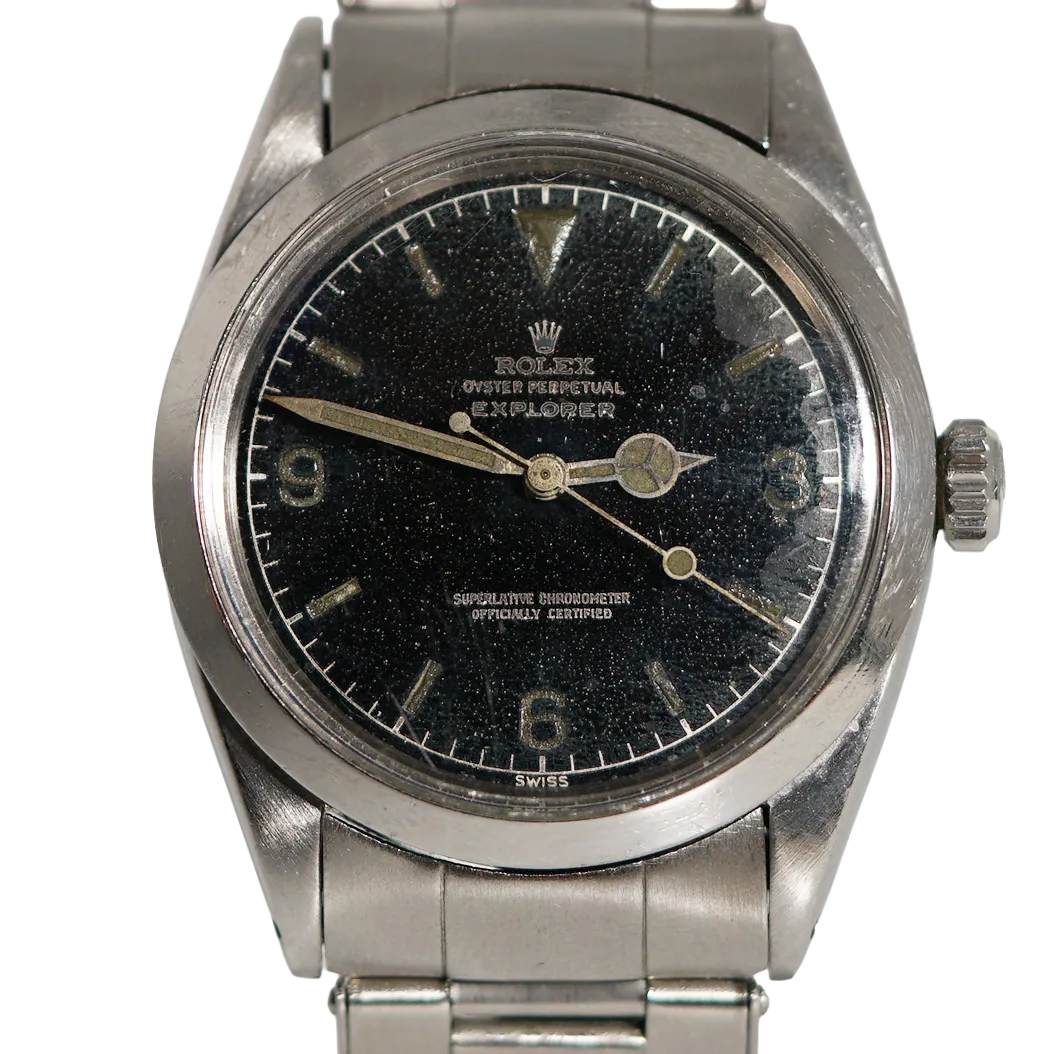
Produced largely unchanged from 1963 to 1989, the <em>Rolex Explorer ref. 1016</em> distilled mid-century tool-watch design into its purest form: a 36mm Oyster case, black dial with applied Arabic numerals, and a movement built for the world's harshest environments.
The Rolex Explorer ref. 1016 occupies a singular position in horological history, not merely as a successor to the original summit watch, but as the distilled expression of Rolex's mid-century design philosophy. Introduced in the early 1960s following the short-lived transitional models, this reference refined the proportions established by the ref. 6610 into what would become the definitive Explorer form: a 36mm Oyster case, glossy black dial with applied Arabic numerals at 3-6-9, and Mercedes hands offering maximum legibility in the most demanding environments.
Though the Submariner and GMT-Master enjoyed cinematic fame, the Explorer 1016 became the choice of genuine expeditionaries, worn by Ranulph Fiennes during his Transglobe Expedition and countless alpinists who valued function over flash. Its restrained aesthetic found favour beyond mountaineering circles: the watch appeared on the wrists of urban professionals who appreciated its versatility and understated elegance. The 1016 never courted celebrity; it simply performed.
A Short History of the Reference
The ref. 1016 emerged in 1963 as the refinement of nearly a decade of field testing. Its predecessor, the ref. 6610, had accompanied Sir Edmund Hillary and Tenzing Norgay to Everest's summit in 1953, but Rolex engineers recognised opportunities for improvement in both case architecture and movement robustness. The 1016 addressed these considerations with a redesigned Oyster case featuring straighter lugs and a more integrated crown guard profile, alongside the introduction of the Calibre 1560, a 26-jewel automatic movement beating at 19,800 vph with Rolex's proprietary Microstella regulating system.
Early examples featured gilt dials with golden text and surrounds, a holdover from 1950s production techniques that would persist into the mid-1960s. As manufacturing processes evolved, Rolex transitioned to matte black dials with white printing, followed by glossy dials in the 1970s. Each iteration maintained the reference's core design language: applied luminous Arabic numerals at 3-6-9, Mercedes handset, and the single line of red Explorer text above six o'clock on certain variants.
The movement architecture prioritised reliability over complication. The Cal. 1560 introduced improved shock resistance through an enhanced Kif Flector system and a more robust escapement, advancements born from decades of polar expeditions and high-altitude mountaineering. Around 1970, Rolex upgraded the reference to the Cal. 1570, incorporating a new balance bridge design and improved winding efficiency. Both movements shared the brand's commitment to precision: COSC-certified chronometer performance in a package designed to function at altitude, in extreme cold, and under the stresses of expedition life.
The reference's remarkable production longevity, virtually unchanged across twenty-six years, speaks to the rightness of its original design. Whilst contemporaries evolved through multiple iterations, the 1016 required no fundamental revision because it had already achieved its purpose: a watch legible in darkness, reliable in adversity, and modest enough to wear anywhere.
The Piece in Front of You
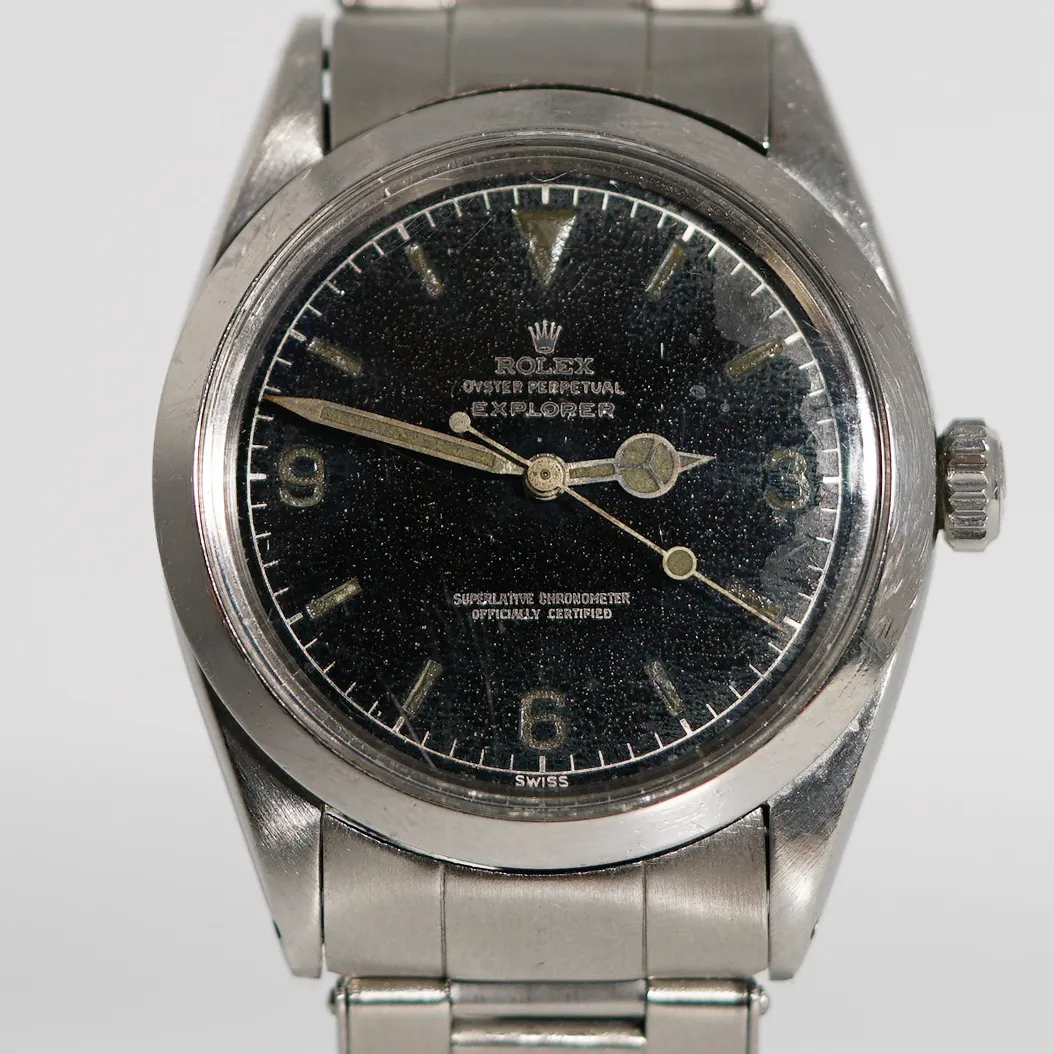
This example represents the archetypal Explorer form that collectors seek: the quintessential 36mm Oyster case with 19mm lug width, glossy black dial with applied luminous Arabic numerals, and the characteristic Mercedes handset that defines the Explorer lineage. The case proportions, unchanged throughout the reference's production, demonstrate Rolex's mastery of wearability. At 36mm, the 1016 sits comfortably beneath a shirt cuff yet maintains commanding wrist presence through its architectural lug design and domed acrylic crystal.
Without physical examination, Wasting Time cannot offer specific assessment of this watch's condition or dial variant. The ref. 1016 was produced across multiple dial iterations, gilt, matte, and glossy, each with subtle variations in printing, lume plots, and text configuration. Early gilt dials command premiums for their rarity and warmth of tone, whilst matte dials appeal to collectors seeking the aesthetic of 1960s and early 1970s production. Later glossy examples, such as this appears to be, represent the final evolution of the reference before its retirement in 1989.
Prospective collectors should request detailed photographs of the dial surface under magnification to evaluate printing sharpness, lume consistency, and originality of hands. The 1016 suffered from extensive service replacements during its working life, and completely original examples, dial, hands, and tritium plots matching in patina, represent a fraction of surviving pieces. Case flanks warrant equal scrutiny: over-polishing erodes the crisp transitions between brushed and polished surfaces that characterise proper Oyster case architecture. Lug thickness, crown guard definition, and caseback edge sharpness all provide evidence of the watch's service history and preservation.
Original bracelets, whether rivet-link ref. 7206, folded-link ref. 7205, or later solid-link Oyster configurations, add both value and authenticity to any 1016. Period strap presentation, however, often reveals the watch's design purity more effectively, particularly on leather where the 19mm lug width creates elegant proportions. Box and papers, absent with this example, remain secondary considerations for a reference whose production spanned manufacturing facilities and documentation practices.
On the Wrist and the Movement
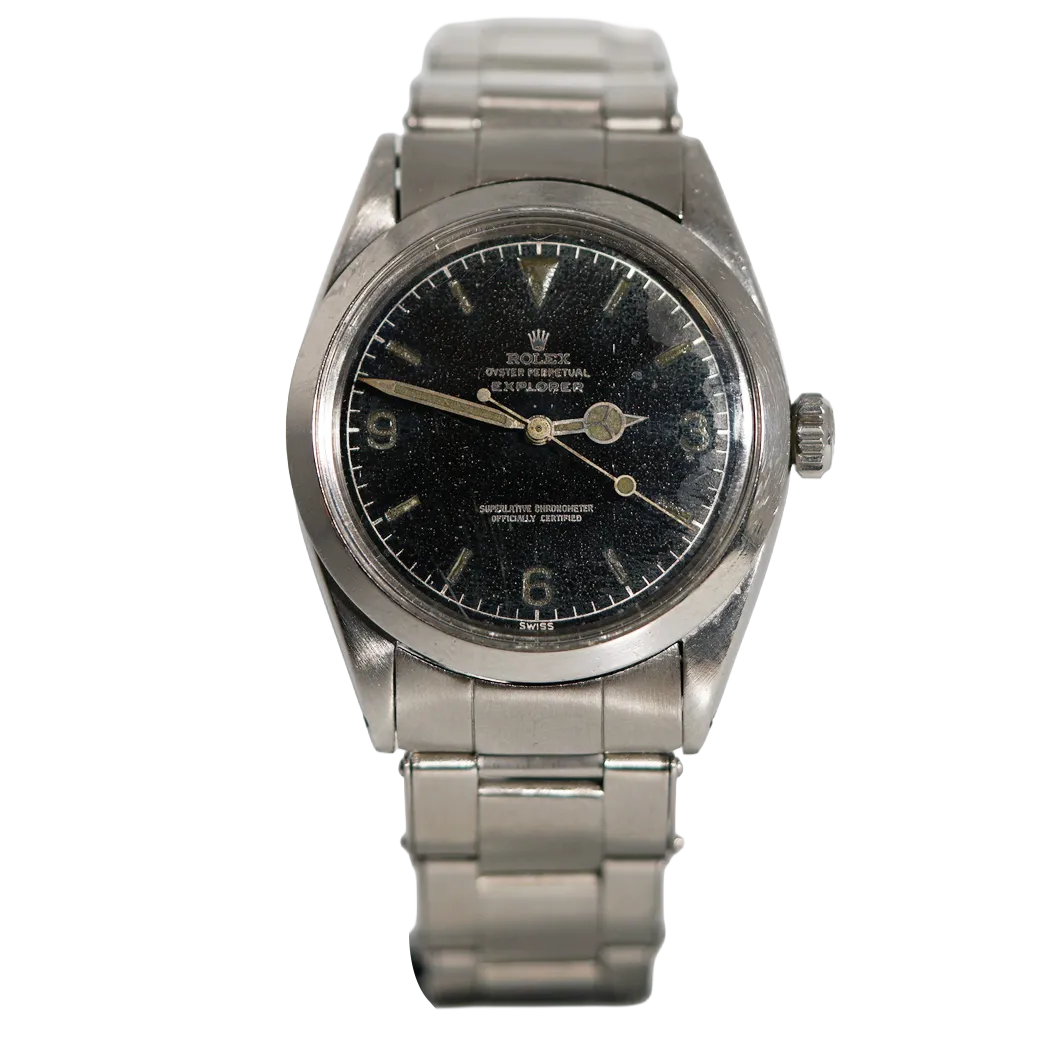
The Explorer 1016 wears with a fluency that modern sports watches seldom achieve. Its 36mm diameter and short lug-to-lug measurement suit wrists from 6.5 to 7.5 inches without compromise, sitting flat against the skin through a combination of case curvature and bracelet articulation. The domed acrylic crystal, a hallmark of pre-sapphire Rolex production, plays with light in ways that flat sapphire cannot replicate, creating depth and legibility from oblique angles whilst developing a gentle patina of microscopic scratches that tool-watch enthusiasts consider evidence of proper use.
Dial legibility remains exceptional under all lighting conditions. The applied Arabic numerals at 3-6-9 create visual hierarchy, whilst the quarter-hour indices maintain temporal precision. Mercedes hands, broader than those fitted to contemporary Submariners, offer maximum surface area for luminous material, a design choice optimised for pre-dawn alpine starts and emergency navigation after dark. The glossy dial surface reflects available light effectively, maintaining contrast even in failing conditions where matte finishes would lose definition.
Beneath the dial, the Calibre 1560 or 1570, depending on production year, operates with the mechanical authority that defined Rolex during its golden era of movement development. Both calibres share fundamental architecture: a full-diameter rotor providing bidirectional automatic winding, Microstella regulating screws for precise rate adjustment, and the Kif Flector shock protection system that replaced earlier Incabloc assemblies. The movements beat at 19,800 vph, a frequency that balances precision with robustness, high enough for accurate timekeeping, conservative enough for reliable long-term operation without excessive wear.
Service intervals for these calibres typically extend to five to seven years under normal use, though expedition watches often exceeded recommended intervals without catastrophic failure. The movements tolerate position variation well, maintaining chronometer specification across positions despite exposure to shock and temperature fluctuation. Power reserve reaches approximately 42 hours from full wind, sufficient for weekend rest without stopping, inadequate for extended neglect. The hack-seconds feature, standard on both calibres, allows precise time-setting to the second, a functionality that mountaineers relied upon for coordinating rope teams and navigation checkpoints.
Winding the crown reveals the movement's character: smooth engagement, progressive resistance, and a firm stop at full wind that communicates mechanical health. The screw-down crown, fitted to a thread pitch optimised for gloved operation, ensures water resistance to 100 metres, though few Explorers saw aquatic service given the model's terrestrial focus.
Why It Matters Now
The Explorer ref. 1016 represents the last of an era, the final Explorer to feature acrylic crystal, painted indices on early examples, and movement architecture predating the high-frequency Cal. 3000 series. For collectors navigating a market increasingly dominated by oversized cases and complicated dial designs, the 1016 offers clarity: a watch conceived for purpose, refined through decades of field use, and untouched by marketing considerations.
Market dynamics reflect this appeal. Gilt-dial examples in original condition command significant premiums, often exceeding values of contemporary sports references due to their scarcity and visual warmth. Matte-dial variants from the late 1960s and early 1970s appeal to collectors seeking military aesthetic without the complications of genuine military-issued pieces. Glossy-dial examples, produced throughout the 1970s and 1980s, offer accessible entry to 1016 ownership whilst maintaining the reference's essential character.
Authentication remains critical. The 1016's long production run saw countless service replacements, redials, and component swaps, some performed by Rolex service centres, others by independent watchmakers of varying skill. Serious collectors prioritise dial originality above case condition, recognising that proper cases can be restored through careful polishing whilst incorrect dials compromise the watch's integrity permanently. Serial number research through Rolex databases and expert consultation helps establish production year and original configuration, though gaps in factory records leave some examples incompletely documented.
The reference's versatility extends its appeal beyond vintage specialists. Unlike the Submariner's diving heritage or the GMT-Master's aviation associations, the Explorer carries no professional baggage, it functions equally well in board rooms and base camps. This chameleon quality, combined with 36mm proportions that suit formal and casual contexts, positions the 1016 as perhaps the most wearable vintage Rolex sports watch for contemporary collectors.
As Rolex reintroduces 36mm proportions in modern Explorer production, interest in original 1016 examples intensifies. The reference represents not merely a vintage alternative but the template against which successors are measured, a watch that required no improvement because it had already achieved perfection within its narrow brief. For collectors seeking a single vintage sports watch capable of daily wear, the Explorer ref. 1016 remains the most convincing argument for restraint in design and commitment to purpose.
This example presents an opportunity to acquire the archetypal mid-century tool watch, a reference that accompanied expeditionaries to the world's extremes and returned home to wear with equal authority beneath a business suit. Proper due diligence regarding condition and originality will reveal whether this particular watch merits the investment that distinguished examples increasingly command.
This piece is currently available through Wasting Time. View the listing or enquire for full provenance and pricing.