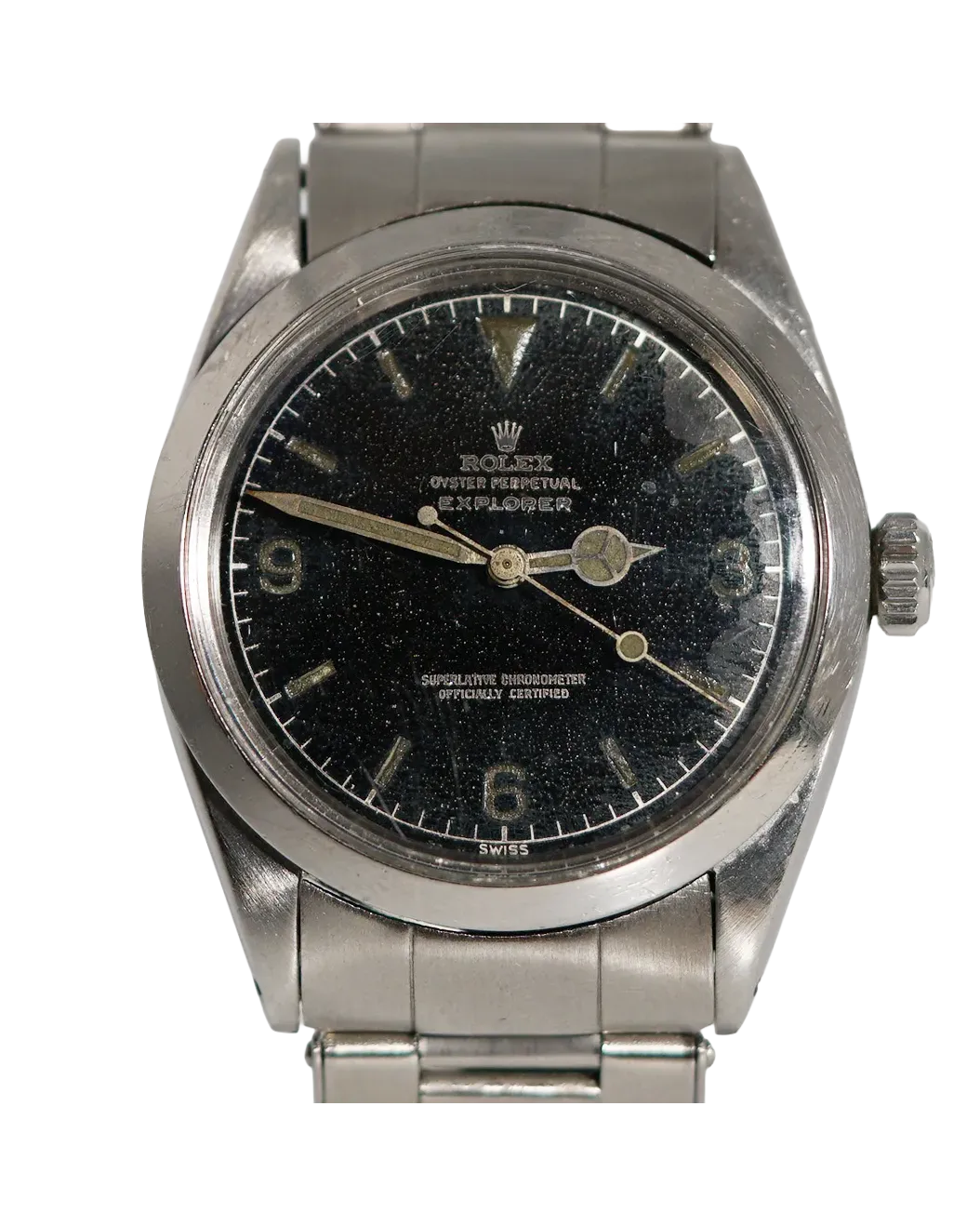
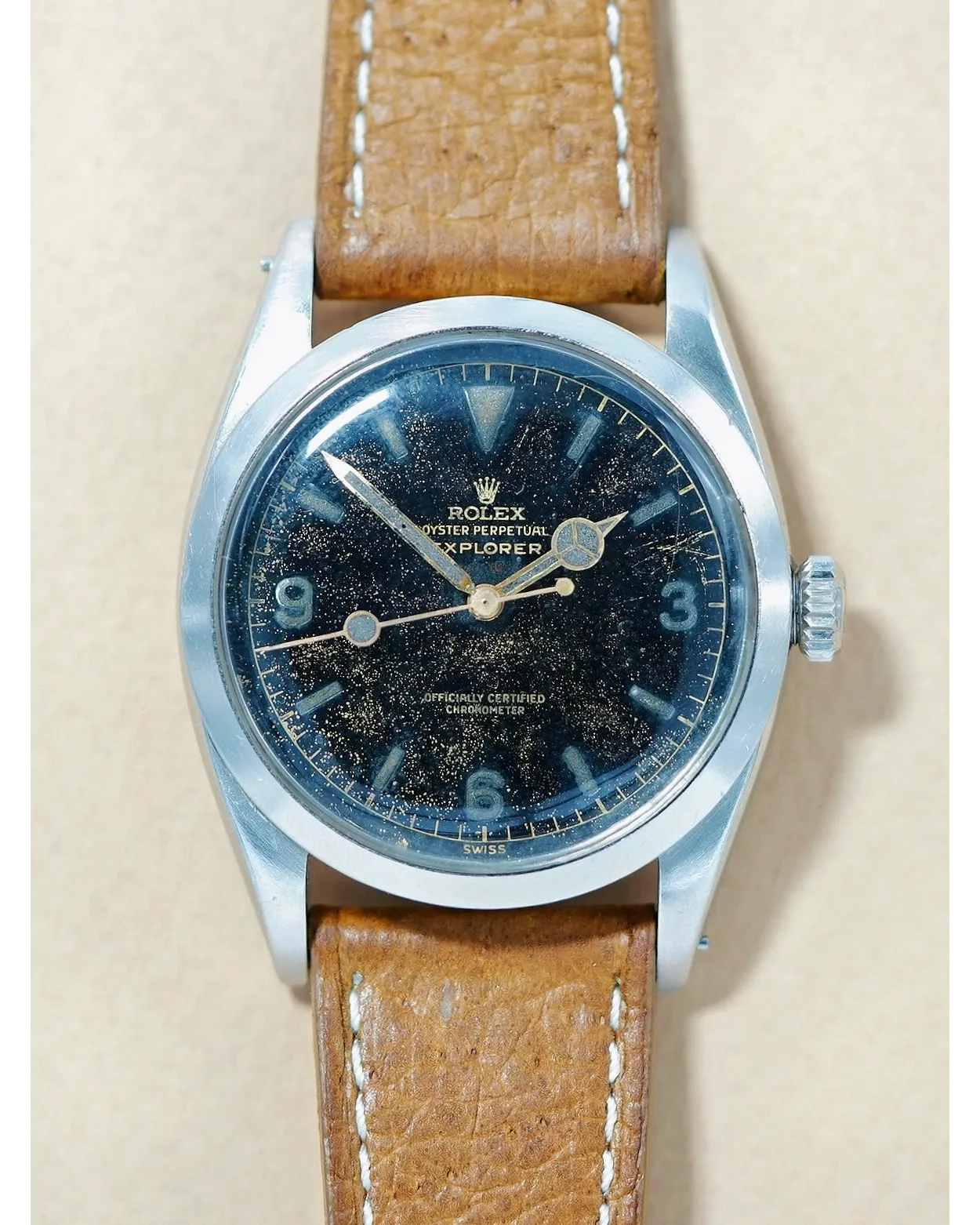
The Explorer ref. 1016 occupies a singular position in horological history, not merely as a successor to the original summit watch, but as the distilled expression of Rolex's mid-century design philosophy. Introduced in the early 1960s following the short-lived ref. 1016 transitional models, this reference refined the proportions established by the 6610 into what would become the definitive Explorer form: a 36mm Oyster case, glossy black dial with applied Arabic numerals at 3-6-9, and Mercedes hands offering maximum legibility in the most demanding environments.\n\nBeneath the dial sits Rolex's workhorse Calibre 1560 (later succeeded by the 1570), a 26-jewel automatic movement beating at 19,800 vph with the brand's proprietary Microstella regulating system. The 1560 introduced improved shock resistance and a more robust escapement, advancements born from decades of field testing in polar expeditions and high-altitude mountaineering. The movement's architecture prioritised reliability over complication, a philosophy that would define Rolex sports watches throughout the latter half of the twentieth century.\n\nWhough the Submariner and GMT-Master enjoyed cinematic fame, the Explorer 1016 became the choice of genuine expeditionaries, worn by Ranulph Fiennes during his Transglobe Expedition and countless alpinists who valued function over flash. Its restrained aesthetic found favour beyond mountaineering circles: the watch appeared on the wrists of urban professionals who appreciated its versatility and understated elegance. The 1016 never courted celebrity; it simply performed.\n\nFor collectors today, the ref. 1016 represents the last of the gilt-dial Explorers and the purest interpretation of the model before the introduction of sapphire crystals and white-gold surrounds in the 1980s. Examples span nearly three decades of production, with early gilt dials, matte dials, and later glossy iterations each commanding devoted followings. The reference's remarkable production longevity, virtually unchanged across twenty-six years, speaks to the rightness of its original design, a watch that needed no improvement because it had already achieved its purpose.