
27 May 2026 · 6 min read
Rolex Explorer II Ref. 1655 'Freccione', The Orange-Handed Iconoclast
By Wasting Time
Launched in 1971 for speleologists and polar explorers, the <em>Rolex Explorer II ref. 1655</em> polarised opinion with its orange twenty-four-hour hand and utilitarian bulk. Today, it stands as one of the Crown's most characterful tool watches.
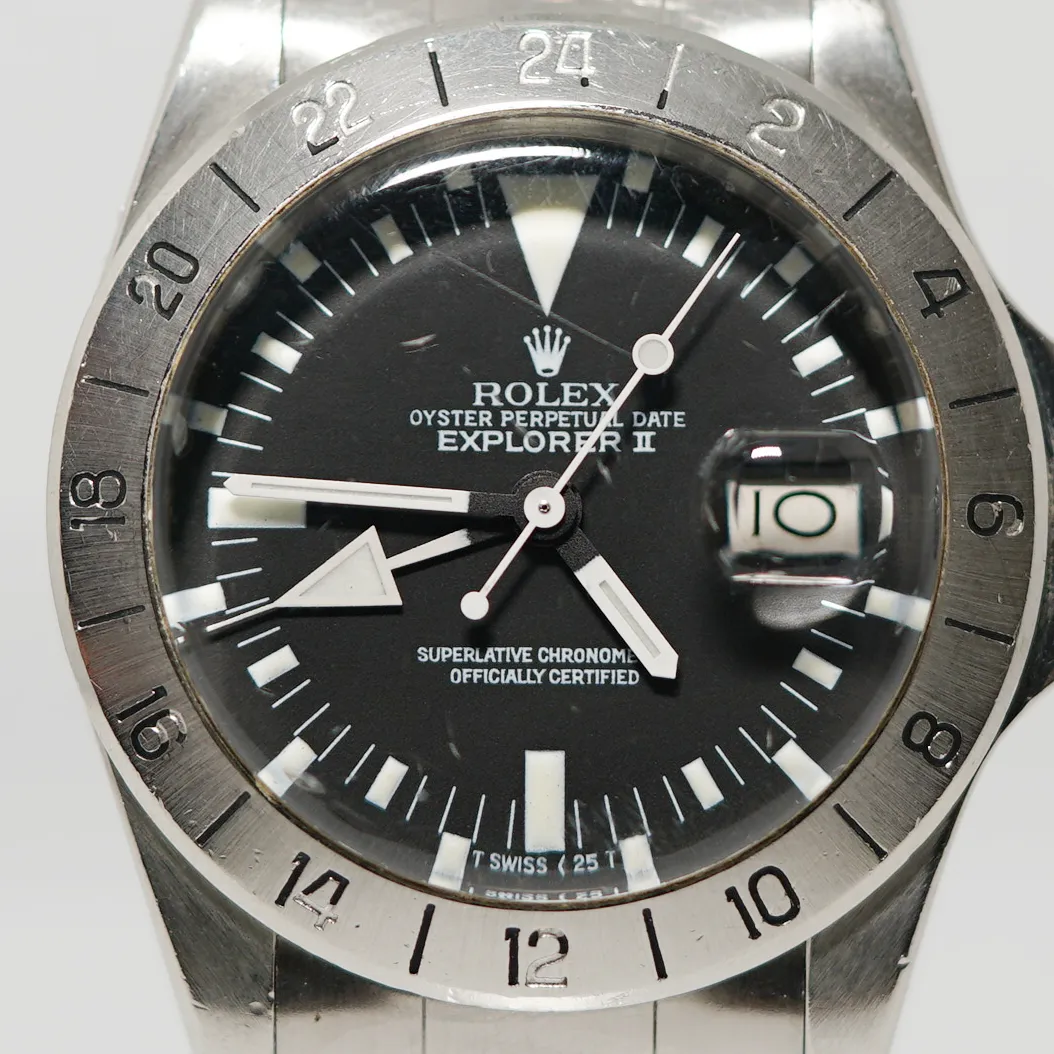
When Rolex introduced the Explorer II ref. 1655 in 1971, it represented a bold departure from the elegant restraint of its Explorer predecessor. Designed explicitly for speleologists and polar explorers operating in perpetual darkness, the watch featured a bright orange twenty-four-hour hand, an unmistakable visual signature that allowed wearers to distinguish day from night underground or in the Arctic's prolonged twilight. Its fixed bezel, engraved with twenty-four divisions, worked in concert with this hand to provide secondary time zone reading, though the model's primary mission was always temporal orientation in darkness.
The ref. 1655 housed Rolex's Cal. 1575, a twenty-six-jewel movement based on the proven 1570 architecture but modified to drive the additional twenty-four-hour complication. Running at 19,800 vibrations per hour, the movement featured hacking seconds, a quickset date, and Rolex's proprietary Microstella regulating system. The forty-millimetre Oyster case, whilst modest by contemporary standards, wore substantially on the wrist thanks to its straight lugs and prominent crown guards, a proportional confidence that distinguished it from the more conservative Explorer 1016 it sat alongside in the catalogue.
A Short History of the Reference
The early 1970s found Rolex at a creative crossroads. Whilst the Submariner and GMT-Master had established themselves as commercial successes, the Explorer line remained comparatively restrained, serving mountaineers and adventurers with understated three-hand simplicity. The ref. 1655 was conceived as a specialist instrument for environments where conventional day-night cycles ceased to exist: cave systems extending kilometres underground, Arctic research stations during polar night, or deep-sea habitats where natural light never penetrated.
Unlike the GMT-Master, which addressed the needs of commercial aviators crossing time zones, the Explorer II solved a more fundamental problem, temporal disorientation in absolute darkness. The orange twenty-four-hour hand, rotating once per day, provided an instant visual reference when paired with the fixed bezel's hour markings. This was not a travel watch in the conventional sense but a survival tool, its bold colour chosen for maximum legibility under torchlight or the glow of a headlamp.
Commercial reception proved mixed. The watch's utilitarian bulk and unconventional aesthetic sat uneasily alongside Rolex's more refined offerings, and the bright orange hand, so purposeful in its intended environment, struck many as garish in civilian contexts. Production numbers remained modest throughout the reference's fourteen-year lifespan, with the model quietly discontinued in 1985 as Rolex shifted focus to the more commercially palatable ref. 16550 and subsequent iterations.
The nickname 'Freccione', Italian for 'big arrow', emerged organically among collectors, reflecting both the distinctive orange hand and the model's cult following in Continental Europe. For decades, the 1655 was erroneously linked to Steve McQueen, a myth that nevertheless underscored the watch's anti-establishment appeal. More credibly, it found favour among mountaineers and serious adventurers who valued function over refinement, its ungainly proportions marking it as a true professional instrument rather than a gentleman's timepiece.
The Piece in Front of You
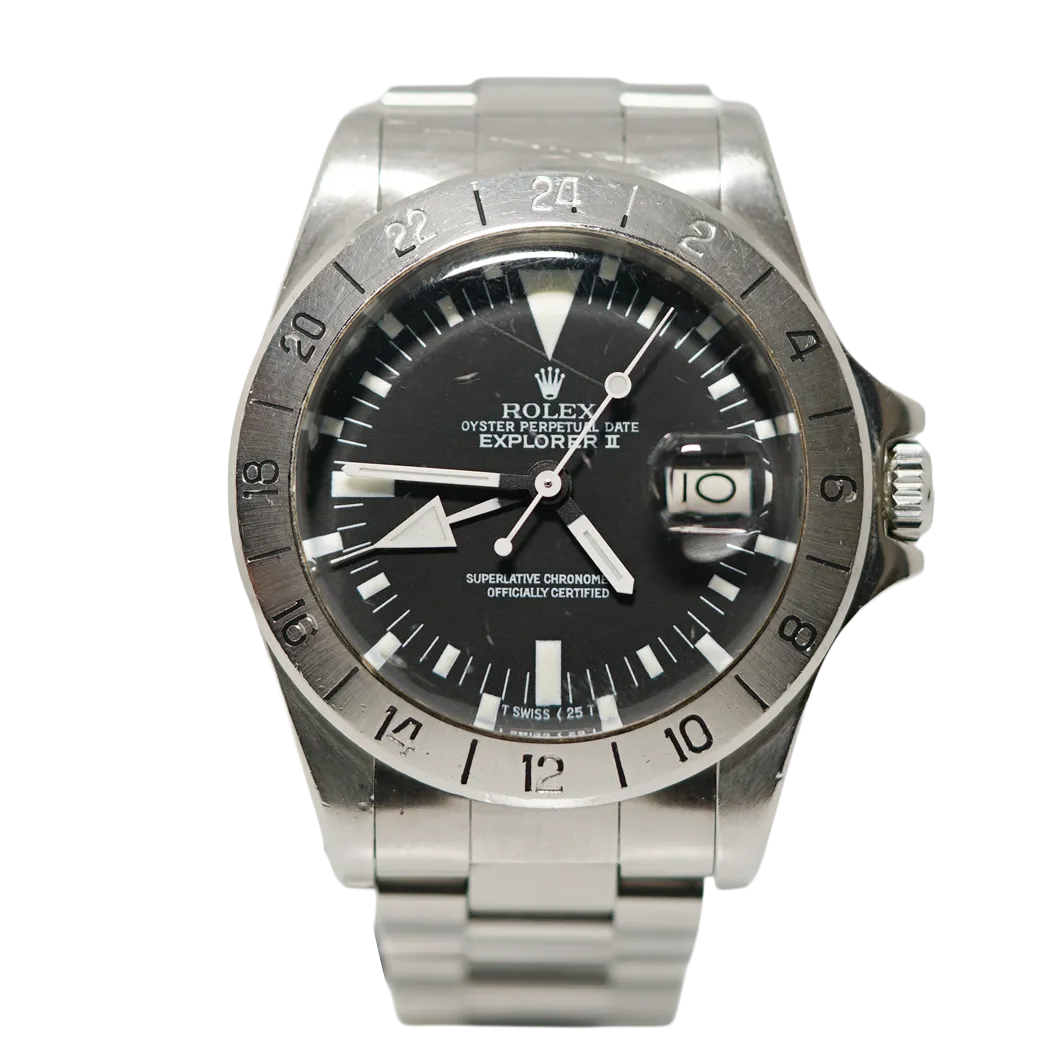
Without examination, Wasting Time cannot provide specific condition commentary on this example, though certain observations about the ref. 1655 as a collecting category warrant attention. Prospective buyers should focus on three critical areas: case sharpness, dial originality, and the integrity of luminous material. The 1655's straight lugs and bevelled edges are particularly vulnerable to over-polishing, which erodes the angular geometry that defines the reference's visual character. Original, unrefined examples exhibit crisp transitions between brushed and polished surfaces, with crown guards retaining their pronounced definition.
Dial variants remain a subject of scholarly attention within the collector community. Early examples feature so-called 'rail dials', where the minute track runs parallel to the hour markers rather than sitting beneath them, a configuration that lasted only briefly into production. Later dials, more commonly encountered, position the minute track conventionally. Both the main hour hand and the orange twenty-four-hour hand evolved subtly over the production run, with early 'straight hand' variants differing from the later 'bent hand' configuration that slightly curves at the tip.
The orange hand itself, officially termed the twenty-four-hour indicator, presents particular challenges for authentication. Original examples exhibit a specific shade and finish that differs markedly from service replacements or later repaints. Under magnification, the luminous material at the hand's tip should correspond in colour and texture to the dial's hour markers, though natural ageing means perfect uniformity is neither expected nor desirable. Dial patina, when authentic, enhances rather than diminishes value, particularly when it develops evenly across the surface without water damage or excessive fading.
Given the 1655's fourteen-year production span, dating an example requires attention to case reference engravings, serial number ranges, and dial printing styles. Transitional pieces, those manufactured during periods when Rolex modified specifications, command particular collector interest, as do fully matching sets retaining original bracelets, often the ref. 7836 or later 78360 Oyster variants with folded links.
On the Wrist and the Movement
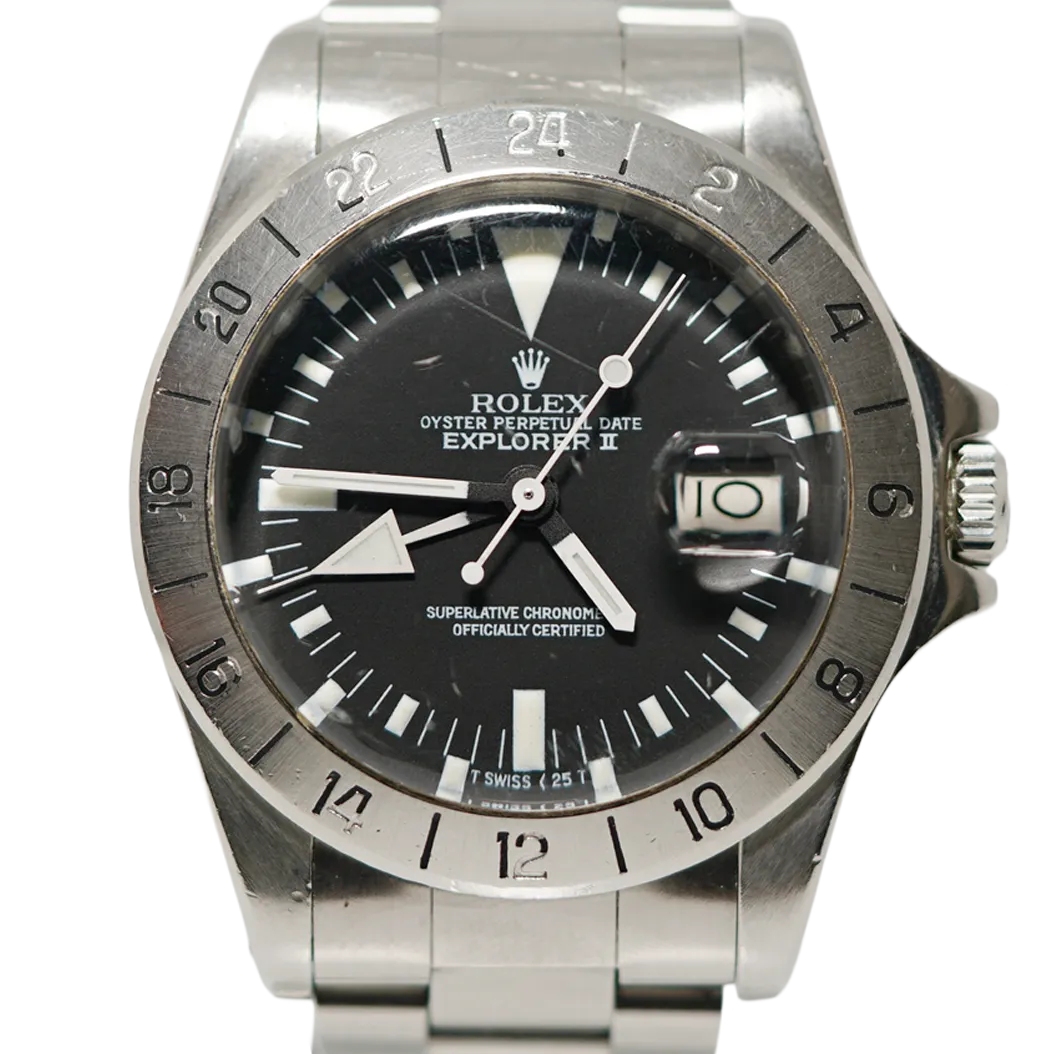
The ref. 1655 wears larger than its forty-millimetre diameter suggests, a function of its case architecture and visual mass. The straight lugs extend assertively from the case body, whilst the prominent crown guards, introduced to protect the Twinlock crown system, add visual heft at three o'clock. On period-correct bracelets, particularly the earlier folded-link references, the watch sits high on the wrist with a certain mechanical frankness. This is not a watch that seeks to disappear beneath a cuff; it announces itself with the confidence of purpose-built professional equipment.
The dial's legibility remains extraordinary. The orange twenty-four-hour hand provides an instant visual anchor, its bright enamel finish contrasting sharply against the matte black surface. In low light, the conditions for which the watch was designed, the tritium luminous material on the hour markers, hands, and twenty-four-hour indicator tip glows with the warm patina characteristic of vintage Rolex professional models. The date window at three o'clock, framed by a simple aperture without cyclops magnification, integrates cleanly without disrupting the dial's utilitarian balance.
Beneath the screw-down caseback lies the Cal. 1575, a movement representing incremental refinement of Rolex's workhorse automatic architecture. The twenty-six-jewel calibre runs at 19,800 vph, or 2.75 Hz in modern terminology, providing a smooth seconds hand sweep that balances precision with robustness. The movement's modification to accommodate the twenty-four-hour hand involves an additional wheel in the gear train, a complication executed with the mechanical simplicity that characterised Rolex's approach to professional instruments during this era.
The hacking seconds function, which stops the seconds hand when the crown is pulled to the time-setting position, facilitates precise synchronisation, a feature particularly valued in expedition contexts where coordinated timekeeping mattered operationally. The quickset date, operated via the first crown position, represents a practical advancement over earlier Explorer references. The Microstella regulating system, using adjustable weights on the balance wheel rather than a traditional regulator arm, allows for finer rate adjustment and improved long-term stability.
Why It Matters Now
The collector market's reassessment of the ref. 1655 represents one of vintage horology's more remarkable reversals. What sold modestly in its own era, overshadowed by the GMT-Master's traveller credentials and the Submariner's dive pedigree, has since achieved canonical status as one of the most characterful designs the Crown ever produced. This shift reflects broader changes in collector priorities: a movement away from condition perfection towards originality, from conventional elegance towards purposeful idiosyncrasy.
Early examples with rail dials now command significant premiums, as do unpolished cases retaining sharp bevels and crisp crown guard definition. The 'Steve McQueen' mythology, though historically unfounded, cemented the reference's countercultural credentials during the 2000s, attracting collectors who valued anti-establishment authenticity over boardroom polish. More recently, scholarly attention has focused on production variants and transitional specifications, with serious collectors seeking out specific dial configurations and hand styles that document the reference's evolution.
The 1655's relatively short production run, fourteen years versus decades for core professional models, creates natural scarcity, though not to the degree that places examples beyond reach for committed collectors. What matters more than rarity is condition integrity and specification correctness. The market increasingly distinguishes between preserved examples and those compromised by over-restoration, with original patina and honest wear preferred to aggressive refinishing that erases the watch's history.
In contemporary wearing contexts, the ref. 1655 offers something increasingly rare: a vintage Rolex professional model with genuine functional purpose beyond time-only display, yet without the overexposure that has turned certain references into cultural clichés. The orange hand remains as visually arresting today as it was polarising in 1971, a detail that demands commitment from its wearer whilst rewarding that commitment with mechanical honesty and purposeful design.
For collectors building comprehensive Rolex sport watch collections, the 1655 represents an essential reference, the Crown's most uncompromising statement of utilitarian design during the 1970s. For those simply seeking a vintage tool watch with genuine character, it offers an alternative to more obvious choices, a reference that endures not despite its idiosyncrasies but because of them. The Explorer II ref. 1655 was conceived for explorers operating beyond the reach of daylight; it has become, instead, a watch for collectors operating beyond the reach of conventional taste.
This piece is currently available through Wasting Time. View the listing or enquire for full provenance and pricing.