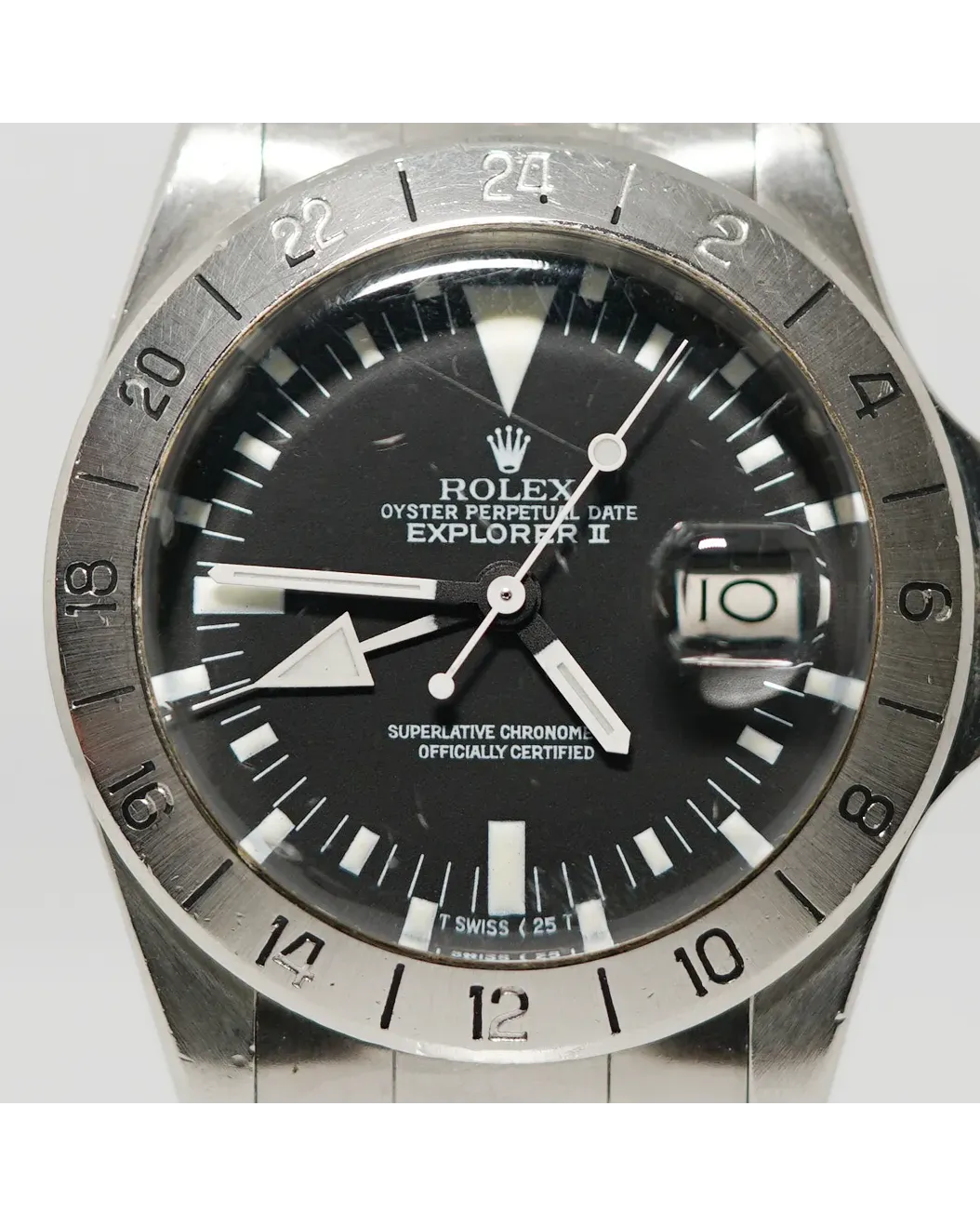
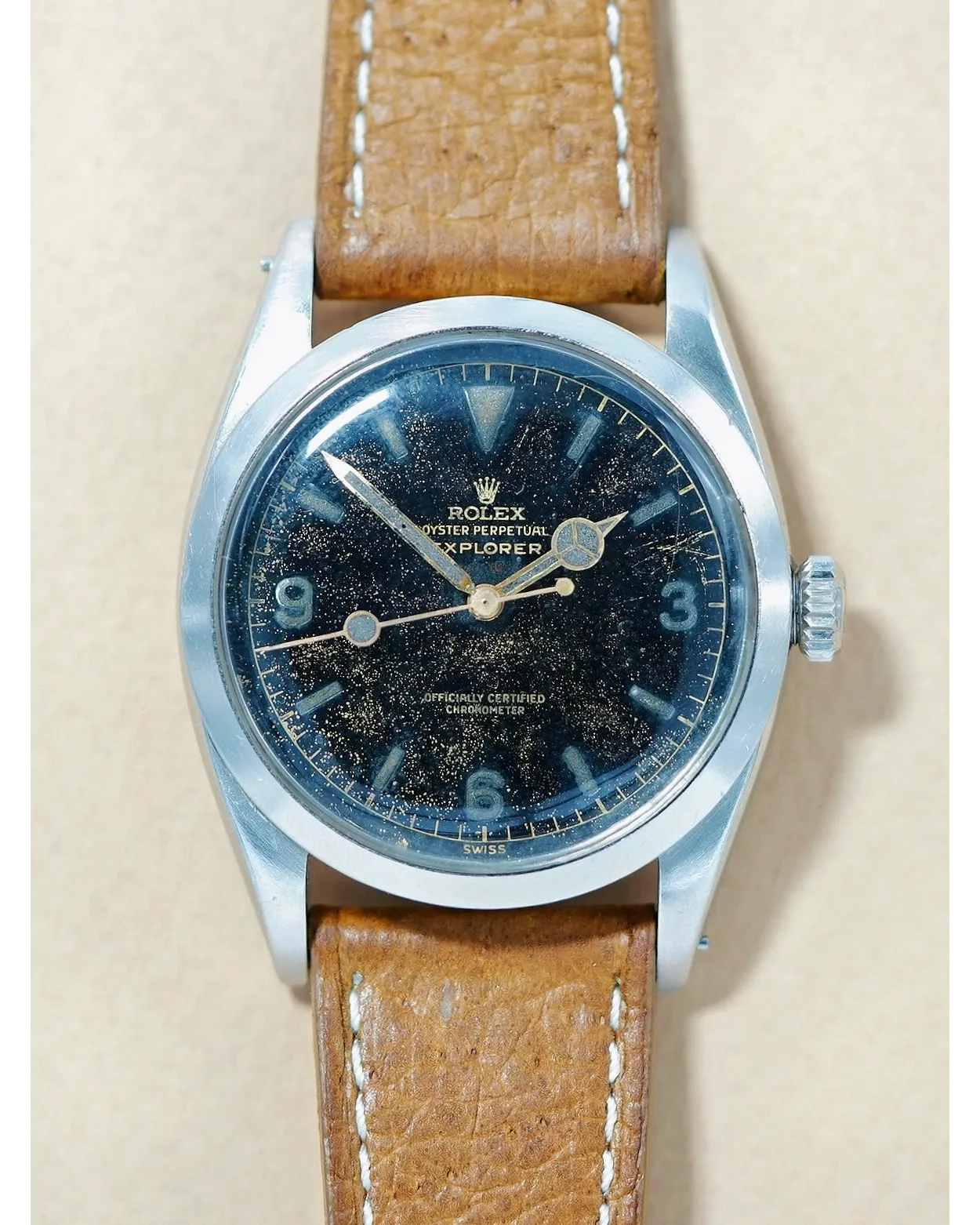
When Rolex introduced the Explorer II ref. 1655 in 1971, it represented a bold departure from the elegant restraint of its Explorer predecessor. Designed explicitly for speleologists and polar explorers operating in perpetual darkness, the watch featured a bright orange twenty-four-hour hand, an unmistakable visual signature that allowed wearers to distinguish day from night underground or in the Arctic's prolonged twilight. Its fixed bezel, engraved with twenty-four divisions, worked in concert with this hand to provide secondary time zone reading, though the model's primary mission was always temporal orientation in darkness.\n\nThe ref. 1655 housed Rolex's Cal. 1575, a twenty-six-jewel movement based on the proven 1570 architecture but modified to drive the additional twenty-four-hour complication. Running at 19,800 vibrations per hour, the movement featured hacking seconds, a quickset date, and Rolex's proprietary Microstella regulating system. The forty-millimetre Oyster case, whilst modest by contemporary standards, wore substantially on the wrist thanks to its straight lugs and prominent crown guards, a proportional confidence that distinguished it from the more conservative Explorer 1016 it sat alongside in the catalogue.\n\nThe nickname 'Freccione', Italian for 'big arrow', emerged organically among collectors, reflecting both the distinctive orange hand and the model's cult following in Continental Europe. Steve McQueen was erroneously linked to the reference for decades, a myth that nevertheless underscored the watch's anti-establishment appeal during the 1970s. More credibly, the 1655 found favour among mountaineers and adventurers who valued function over refinement, its ungainly proportions and unorthodox colour scheme marking it as a true professional instrument rather than a gentleman's timepiece.\n\nProduction ceased in 1985 after only fourteen years, making the ref. 1655 one of the shorter-lived references in Rolex's professional line. What had seemed commercially uncertain in its own era, overshadowed by the GMT-Master's traveller credentials and the Submariner's dive pedigree, has since achieved canonical status. Collectors today prize early examples with rail dials, straight-hand variants, and unpolished cases that retain the angular geometry Rolex intended. The 1655 endures not despite its idiosyncrasies but because of them: a tool watch uncompromising in its original purpose, now recognised as one of the most characterful designs the Crown ever produced.