
27 May 2026 · 8 min read
The Rolex Ref. 6062 'Stelline', a moonphase that never returned
By Wasting Time
Produced for just three years in the early 1950s, the <em>Rolex</em> <em>ref. 6062</em> remains the firm's only serially manufactured triple calendar with moonphase, a complexity the brand has never revisited.
The Rolex ref. 6062 occupies a curious place in horological history. It is not the watch that defined the brand, nor the one that secured its commercial triumph. It is, rather, the watch Rolex made once and never made again, a triple calendar with moonphase, produced in minuscule numbers between 1950 and 1953, then quietly discontinued. Fewer than 500 examples are believed to exist across all metal combinations, with the steel-and-gold variant among the scarcest configurations. For collectors, the 6062 represents both a technical anomaly and a memento of paths not taken, a reminder that even Rolex once entertained complications beyond the perpetual rotor and the date.
A short history of the reference
The ref. 6062 arrived at a peculiar juncture in Rolex's post-war development. The firm had spent the 1940s consolidating its reputation around the Oyster case and the automatic movement, but it had not yet pivoted decisively toward the professional tool watches that would come to define the marque. The Submariner was still three years away; the GMT-Master four. In this interregnum, Rolex experimented with complications that sat outside its core competencies, day-date calendars, moonphases, even a handful of chronographs. The 6062 was the apex of that brief flirtation.
Introduced circa 1950, the reference combined three calendar indications, day, date, and month, with a moonphase complication displayed in an aperture at six o'clock. Beneath the dial sat the automatic Cal. 740, a modified Valjoux ebauche finished and adjusted to chronometer standards by Rolex. The movement operated at 18,000 vph and incorporated a 59-tooth moonphase wheel, accurate to within one day every 122 years. The calibre's 17 jewels and Breguet overcoil hairspring spoke to the era's watchmaking conventions, though the architecture was not proprietary. Rolex relied on third-party base movements for its complications throughout this period, a common practice that would later be phased out in favour of in-house development.
The model was never aggressively marketed. It appeared in select retailers' windows for discerning clients, but buyers in the early 1950s favoured simpler tool watches, and the 6062 failed to gain commercial traction. By 1953, production had ceased. The firm turned its attention to the professional line, Submariner, GMT-Master, Milgauss, and the moonphase complication disappeared from the catalogue entirely. Rolex has never returned to it.
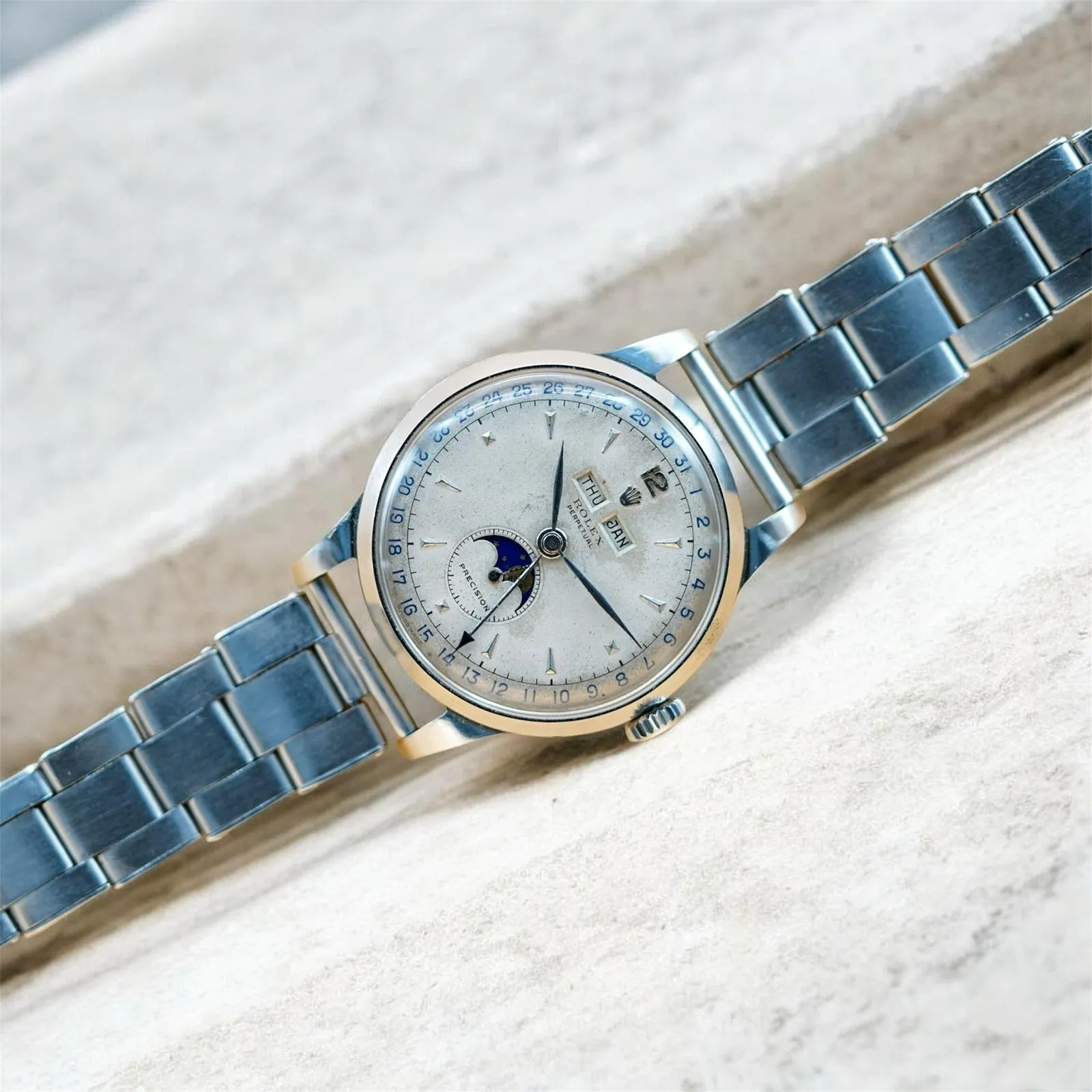
Collectors refer to the 6062 by the sobriquet 'Stelline', after the star-tipped hour indices that distinguish it from its closest sibling, the ref. 8171. Where the 8171 featured Arabic and baton markers, the 6062 adopted a more refined aesthetic vocabulary. The applied gold stars at each hour, paired with dauphine hands and a sector-style outermost track, lent the dial an architectural clarity that has aged remarkably well. The design choices feel more European dress watch than Oyster tool watch, a quality that perhaps explains the reference's limited appeal during its production run.
The piece in front of you
This example presents in two-tone configuration, pairing a stainless steel case with an 18-carat yellow gold bezel, crown, and bracelet centre links. The 36mm case diameter remains compact by contemporary standards, though it was typical of Rolex's mid-century output. The proportions are crisp, and the case flanks show surface wear consistent with decades of use, though free from the heavy polishing that often compromises vintage examples. The lugs retain their definition, and the case back's threading appears sound.
The dial has developed a warm, even patina across its silvered surface, champagne tones that suggest honest age rather than artificial treatment. The printed outer track and applied star indices remain intact, the latter catching light at oblique angles in the manner of all well-executed applied markers. Some oxidation is visible on the day and month discs when viewed under magnification, a common trait in Valjoux-based calendar movements of this vintage. The moonphase disc retains its original paint, though minor flaking at the periphery is noted. This is to be expected; moonphase discs from the 1950s rarely survive unscathed. The hands appear correct for the reference, showing age-appropriate toning that matches the dial's overall colour temperature.
The watch is offered without its original box or papers, as is frequently the case with Rolex complications from the early 1950s. Provenance traces to a European collection, though specific ownership history prior to the 1990s remains undocumented. Service records, if any exist, do not accompany the lot. The case back gasket and crystal would benefit from service attention prior to regular wear, a straightforward matter for any competent watchmaker familiar with vintage Rolex architecture.
On the wrist
The 6062 wears smaller than modern tastes might expect, though not uncomfortably so. The 36mm case diameter and relatively short lug-to-lug span suit a variety of wrist sizes, and the two-tone bracelet lends the watch a certain formality that distinguishes it from the steel sports models of the same era. The warmth of the yellow gold against the steel case creates a visual contrast that feels deliberately understated, never ostentatious.
On the dial, legibility remains excellent despite the density of information. The day and month windows at twelve o'clock are large enough to read at a glance, and the date track around the periphery is well spaced. The moonphase aperture at six o'clock balances the upper complications, lending the dial a symmetry that many triple calendars lack. The dauphine hands are slender but sufficiently luminous, or would have been, when fresh, and the printed Arabic numerals inside the date track provide a secondary reference for the hour.
There is an ease to wearing the watch that belies its complexity. The automatic winding removes the need for daily interaction with the crown, and the moonphase, once set, requires adjustment only every few months. The day and date advance crisply at midnight, a mechanical event that remains quietly satisfying even after decades. The watch feels neither fragile nor overwrought, qualities that speak to Rolex's engineering sensibility even in its least commercial ventures.
The movement and build
The Cal. 740 is not a Rolex movement in the strictest sense. It is a Valjoux base, modified and finished to the firm's chronometer standards, a practice common among Swiss manufacturers in the pre-quartz era. The calibre measures 12.5 lignes in diameter and operates at 18,000 vph, a frequency typical of the period. The 17-jewel count includes a shock-resistant balance assembly, and the Breguet overcoil hairspring provides isochronism across positions. Adjustment was carried out across five positions, and examples submitted for chronometer certification received a rating that met the stringent tolerances of the era.
The calendar mechanism is cam-driven, with separate wheels for the day, date, and month indications. The moonphase is actuated by a 59-tooth gear, advanced once per day by the date wheel. This configuration provides an accuracy of one day's error every 122 years, a respectable figure for a simple moonphase, though far short of the astronomical precision achieved by true perpetual calendars. Adjustment is performed via recessed pushers in the case band, one for the day, one for the month, and a third for the moonphase. The date is advanced via the crown at the first position.
The case construction follows Rolex's Oyster architecture, with a screw-down crown and case back. Water resistance, by the standards of 1950, was adequate for daily wear but not for immersion. The two-tone treatment required careful machining to ensure the gold bezel seated flush with the steel mid-case, a detail that speaks to the reference's intended market. This was not a tool watch. It was a dress complication for clients who valued mechanical ingenuity over ruggedness.
Why it matters now
The ref. 6062 has climbed steadily in collector estimation since the mid-2000s, driven in part by the broader market's appetite for rare Rolex references and in part by the reference's inherent scarcity. Auction records for steel-and-gold examples have reached significant multiples of their original retail prices, though the reference remains less well known than the Daytona or Submariner among casual enthusiasts. For serious collectors, this is part of the appeal. The 6062 is a watch that rewards knowledge, a reference that sits outside the mainstream narrative but is no less significant for it.
Culturally, the watch represents a road not taken. Rolex abandoned complications of this sort after the early 1950s, pivoting instead toward the professional line that would define the brand's identity for the next seventy years. The Submariner, GMT-Master, and Daytona followed; the moonphase did not. That single-generation experiment makes the 6062 among the most historically significant references in the pre-Explorer catalogue. It is a watch that could only have been made during a brief window, before Rolex became the Rolex we know today.
For the collector considering this example, the appeal lies not in rarity alone but in the watch's position within the broader arc of mid-century watchmaking. The 6062 belongs to an era when complications were still the province of high horology, when even Rolex looked to traditional calendar and moonphase displays as markers of sophistication. The firm's subsequent success with tool watches has overshadowed this chapter, but the chapter remains worth studying. The 6062 is proof that Rolex once made a moonphase, and made it well. That it chose never to make another only deepens the reference's mystique.
Wasting Time has handled a small number of 6062 examples over the years, and each has reinforced the reference's standing as one of the more compelling vintage Rolex complications. The steel-and-gold variant offers a balance of visual warmth and mechanical interest that few other references achieve. It is a watch that wears its complexity lightly, a quality that feels increasingly rare in an era of ever-larger, ever-more-complicated wristwatches.
This example, with its honest patina and unrestored dial, offers an opportunity to acquire a reference that remains scarce on the secondary market. The watch is ready for service and further enjoyment, a piece of early-1950s Rolex that sits at the intersection of technical ambition and commercial miscalculation, a combination that has proven, in hindsight, to be among the most collectible.
This piece is currently available through Wasting Time. View the listing or enquire for full provenance and pricing.