
27 May 2026 · 6 min read
Rolex Submariner ref. 5513: The Four-Decade Tool Watch Standard
By Wasting Time
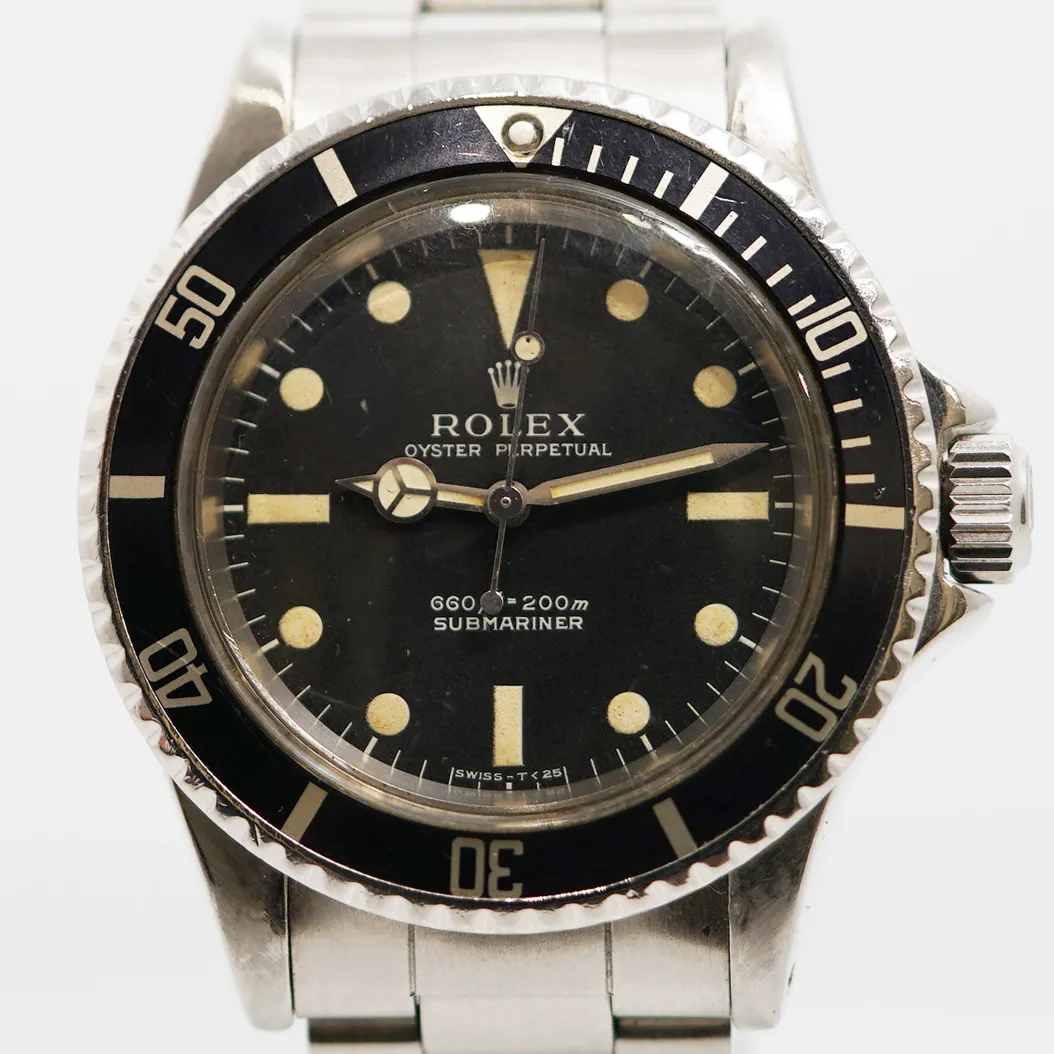
Produced from 1962 to 1989, the <em>Rolex Submariner ref. 5513</em> remains the most enduring dive watch ever made. Without chronometer certification or date complication, it distilled the tool watch philosophy into its purest form.
Introduced in 1962 and remaining in production until 1989, the Rolex Submariner ref. 5513 represents the purest expression of the tool watch philosophy. Unlike its ref. 5512 predecessor, which carried COSC chronometer certification, the 5513 was marketed as a robust professional instrument at a more accessible price point, omitting the gilt "Superlative Chronometer Officially Certified" designation in its earliest iterations. Over its twenty-seven-year lifespan, the reference evolved through numerous dial variants, from gilt chapter rings and exclamation-point lume plots to matte dials and the glossy white-gold surrounds of the 1980s, making it one of the most extensively documented references in Rolex's archive.
This longevity was no accident. Where other references came and went, responding to shifts in taste or advances in materials science, the 5513 endured precisely because it refused to evolve too quickly. It retained its acrylic crystal when sapphire became available. It maintained a 40mm case diameter when competitors pushed towards 42mm and beyond. It beat at 19,800 vph when higher frequencies became fashionable. This conservatism, often mistaken for stagnation, was in fact Rolex's understanding that professional users valued consistency over novelty. A diver who wore a 5513 in 1965 could service it with parts from a 1985 example. Few references can claim such enduring mechanical continuity.
The 5513 also gained cultural weight through its association with military units, notably the British Royal Navy and various Special Forces, who issued the watch in modified "MilSub" configurations. On screen, it appeared in Live and Let Die (1973) and Licence to Kill (1989), cementing its place in the popular imagination as the quintessential Bond Submariner. Its accessibility relative to earlier gilt examples and COMEX variants has made it a perennial favourite among emerging collectors, though early gilt examples, unpolished cases retaining full lug definition, and military-issued variants now command significant premiums.
A Short History of the Reference
The ref. 5513 emerged at a pivotal moment in Rolex's professional watch development. The preceding ref. 5512, launched in 1959, had introduced crown guards to the Submariner line and carried COSC chronometer certification, a designation that added cost and complexity to production. Rolex recognised an opportunity to offer a similarly capable dive watch without the chronometer premium, thus broadening the reference's appeal to both professional and recreational divers. The 5513 debuted in 1962 with a gilt dial bearing the simple "Submariner" script, omitting any mention of chronometer status. These early examples, produced until approximately 1966, are now among the most sought-after variants, prized for their warm gilt text and chapter rings that developed a honeyed patina over decades.
From 1963, Rolex introduced crown guards to the 5513, initially in a pointed configuration that was soon softened into the rounded profile that would persist through the 1980s. The transition from gilt to matte dials occurred around 1966-1967, coinciding with a broader industry shift towards higher-contrast, tool-oriented aesthetics. These matte dials featured white printing on a black base, often with small radium or tritium plots at the hour markers. By the late 1960s, the exclamation-point lume configuration, a single round plot above the six o'clock marker, appeared on certain batches, a quirk that has since become a collector obsession. Identification of these micro-variants requires close study of fonts, lume shapes, and the presence or absence of underlines beneath the depth rating, turning the 5513 into an archaeological field unto itself.
Mechanically, the reference transitioned through three calibres during its lifespan. Early examples housed the Cal. 1530, a 17-jewel movement beating at 18,000 vph. Around 1964, this gave way to the Cal. 1520, which shared the same architecture but incorporated refinements in shock protection and lubrication. From the early 1970s onward, the Cal. 1530 (a different movement despite sharing the earlier designation) took over, now running at 19,800 vph and offering improved timekeeping stability. The final evolution came in the 1980s, when glossy dials with white-gold surrounds replaced the matte finishes, anticipating the aesthetic direction Rolex would pursue into the 1990s. Production ceased in 1989, by which point the 5513 had become the longest-running Submariner reference in history.
The Piece in Front of You
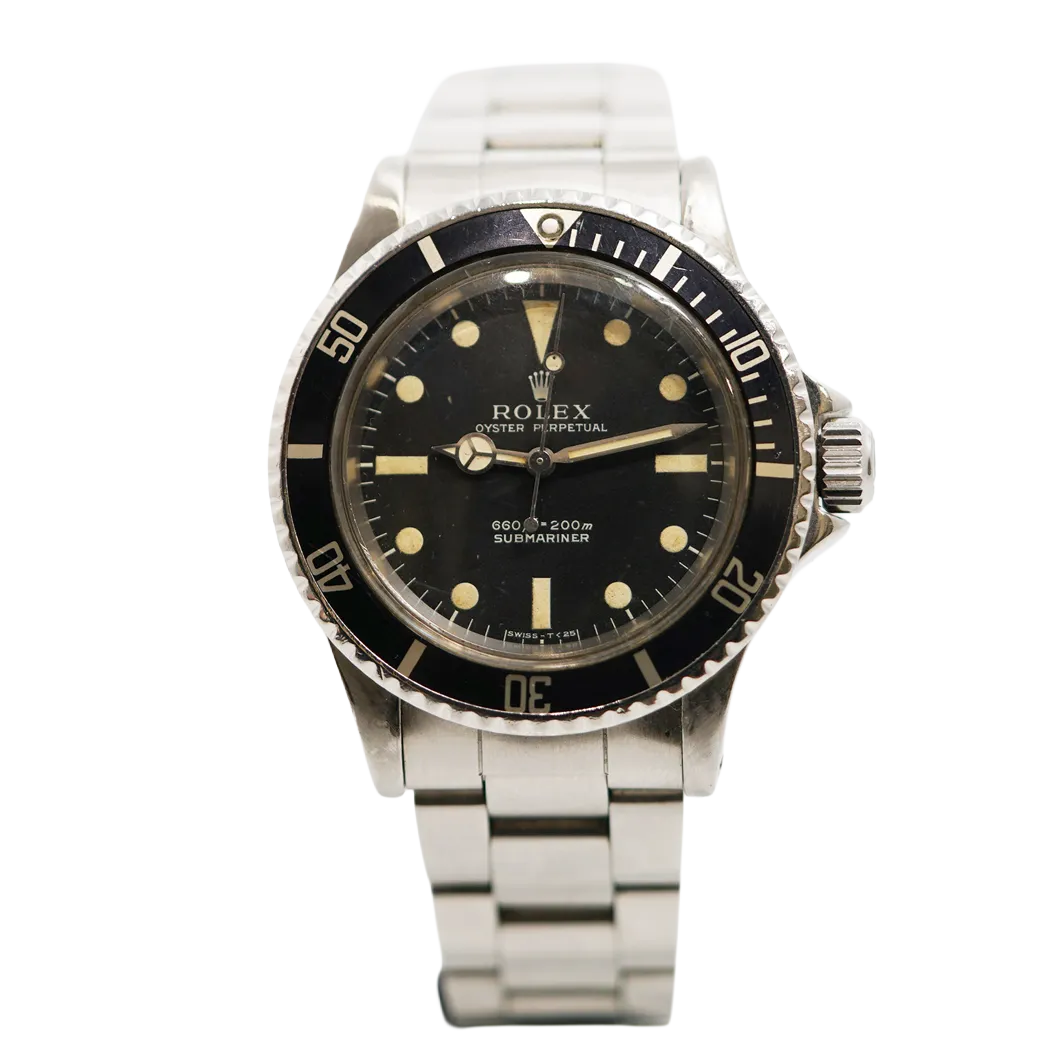
This example awaits full assessment, and prospective collectors should approach it with the same rigour they would apply to any vintage Rolex Submariner. The ref. 5513 encompasses dozens of dial configurations, hand replacements, and service interventions, each of which can dramatically affect both the watch's historical integrity and its market value. Without a detailed examination, it remains impossible to determine whether this piece retains its original gilt dial from the early 1960s, a desirable matte variant from the 1970s, or a later glossy iteration from the final decade of production. Each period carries its own collector appeal, but the distinctions are meaningful.
Case condition will be paramount. The 5513 was designed as a tool, and many examples saw hard use in marine environments, leading to corrosion, heavy polishing, or both. Collectors prize unpolished cases that retain sharp lug definition and crisp bevels along the case flanks, as these details are easily lost during over-zealous refinishing. The thickness of the lugs at their termination points, measurable with a calliper, offers the most reliable evidence of a case's polishing history. Similarly, the bezel insert's condition and originality matter considerably. Faded inserts that have turned from black to grey or brown are often preferred over replacements, provided the numerals remain legible and the insert itself is period-correct.
Dial authenticity presents its own challenges. The 5513 was in production long enough that service dials are common, and Rolex itself replaced dials during routine maintenance if the original showed signs of moisture ingress or lume deterioration. A service dial is not inherently problematic, but it should be disclosed and reflected in the watch's valuation. The condition of the luminous material, whether radium, tritium, or later Super-LumiNova, requires careful scrutiny. Lume that has aged consistently across the dial and hands suggests originality, while mismatched patina can indicate replaced components. The presence of spider-web cracking in the lume plots, while sometimes romanticised, often signals instability and may warrant professional conservation.
The bracelet, if present, adds another layer of evaluation. Period-correct bracelets, such as the ref. 9315 Oyster with 580 end links, are increasingly scarce and command premiums when fitted to early examples. Stretch in the links and clasp wear are inevitable on a watch of this age, but excessive play suggests heavy use or deferred maintenance. In the absence of original papers or box, provenance becomes circumstantial, relying on the watch's internal coherence, matching serial ranges, consistent aging across components, and a service history that aligns with expected wear patterns. This example, awaiting its formal appraisal, will require exactly this kind of forensic attention.
On the Wrist and the Movement
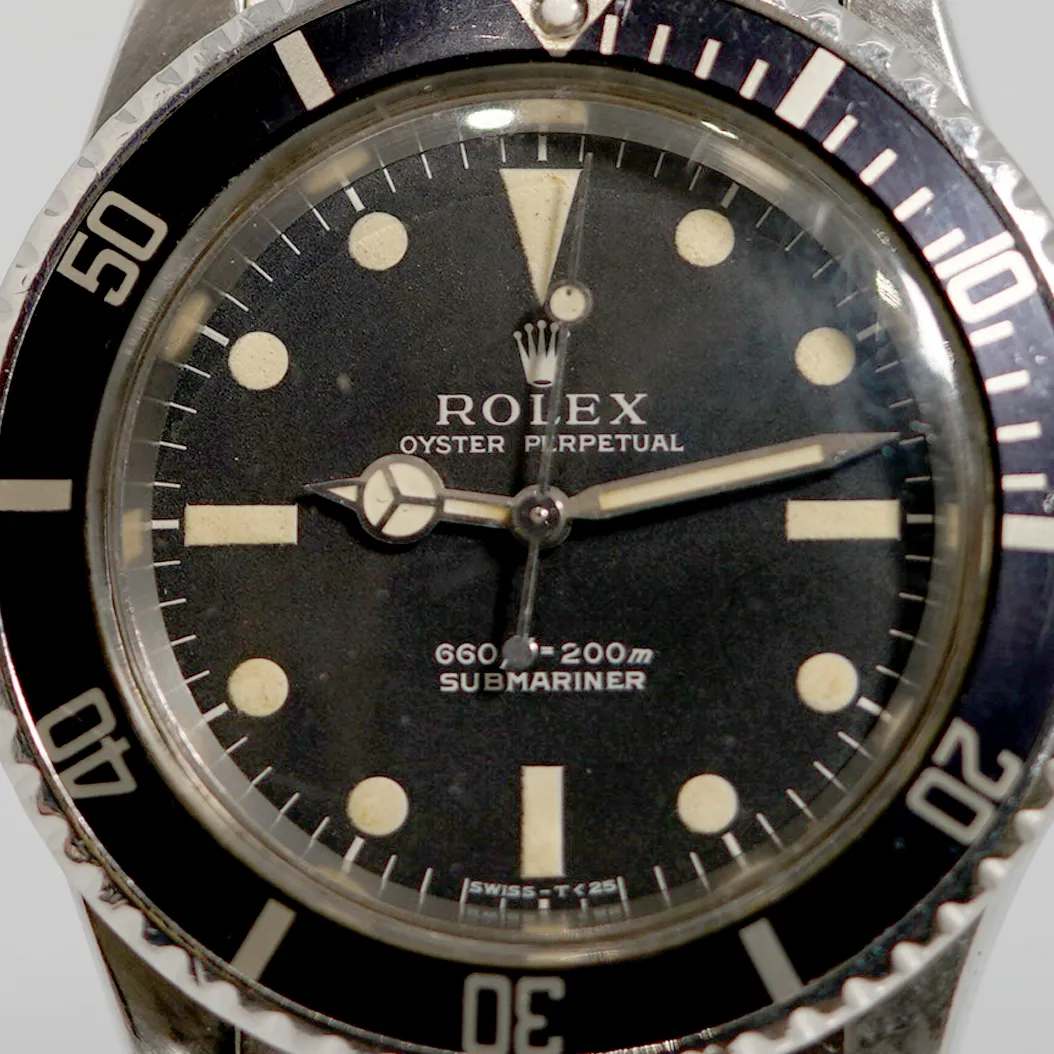
The 5513 wears with a directness that modern dive watches, for all their technical sophistication, often lack. The 40mm case sits low on the wrist, aided by relatively short lugs and a thin case profile made possible by the non-chronometer movement inside. There is no date cyclops to catch the light, no ceramic bezel to deflect fingerprints, just brushed steel, a rotating aluminium insert, and an acrylic crystal that domes gently above the dial. This simplicity translates to wearability. The watch disappears under a cuff more readily than its ref. 5512 or ref. 1680 siblings, and its lack of modern heft makes it comfortable during extended wear. On a NATO strap, it becomes the archetypal military tool watch; on the Oyster bracelet, it retains a formality that belies its utilitarian origins.
The rotating bezel, unidirectional from the late 1970s onward, turns with a satisfying firmness, though the action varies depending on the age and service history of the spring beneath the insert. Early examples with bidirectional bezels require a more deliberate touch, as the mechanism lacks the ratcheting precision of later iterations. The crown, large and unsigned in early variants, screws down with multiple threads, reinforcing the watch's 200-metre water resistance. This depth rating, modest by contemporary standards, was more than adequate for recreational diving and professional use at the time, and the 5513 earned a reputation for reliability in challenging environments. Its acrylic crystal, often criticised as outdated, offers one practical advantage: it can be polished to remove surface scratches, a quality that sapphire cannot match.
Inside, the movement, whether Cal. 1530, Cal. 1520, or the later higher-beat Cal. 1530, operates with mechanical transparency. These calibres were designed for serviceability, with modular construction that allowed watchmakers to replace components without requiring factory intervention. The movements beat at either 18,000 vph (early examples) or 19,800 vph (later variants), the latter frequency offering improved positional stability and resistance to shock. The 42-hour power reserve is adequate but not generous, reflecting the movement's origins in an era when daily winding was an expected ritual. Accuracy, while not chronometer-certified, typically falls within acceptable COSC tolerances when properly regulated, though individual examples vary depending on service history and wear.
The 5513's lack of chronometer certification, once a cost-saving measure, has become part of its identity. Collectors appreciate the reference precisely because it prioritised robustness and affordability over the pursuit of precision timing. The movement's architecture, 17 jewels, Breguet overcoil, and a free-sprung balance, borrowed from Rolex's chronometer-grade calibres without the associated testing overhead. In practical terms, this meant a watch that performed reliably in the field, required less frequent regulation, and cost less to service. On the wrist, the absence of a sweeping chronometer seconds hand is imperceptible. What remains is a tool that does exactly what it was designed to do: tell the time underwater, day after day, for decades.
Why It Matters Now
The ref. 5513 occupies a rare position in vintage Rolex collecting: it is simultaneously ubiquitous and endlessly variable. More examples were produced than any other Submariner reference, yet the multiplicity of dial configurations, hand replacements, and service interventions means that no two examples wear their history in quite the same way. This abundance has kept the reference accessible to emerging collectors, even as early gilt examples and unpolished military variants command six-figure sums. A late-production glossy-dial 5513 from the 1980s remains attainable, offering a point of entry into serious vintage collecting without the speculative premiums attached to COMEX or double-red Sea-Dwellers.
Collector interest in the 5513 has matured considerably over the past decade. Where once the reference was dismissed as too common or too varied to merit serious study, today's collectors approach it with archaeological rigour, cataloguing micro-variants and developing a taxonomy of desirability. Early gilt dials with chapter rings, exclamation-point lume configurations, and metres-first depth ratings have all emerged as sought-after details, driving premiums for examples that retain these features. Unpolished cases, particularly those with sharp, square crown guards and defined bevels, command multiples of their polished counterparts. The market has also begun to recognise the importance of service history, with documented examples that have remained within single families or collections attracting premiums over anonymous auction finds.
The 5513's association with military issue adds another dimension to its appeal. British Royal Navy examples, identifiable by case-back engravings and specific dial configurations, are among the most collectible variants, often appearing with fixed-bar lugs and broad arrow markings. These military-issued pieces, once considered expendable tools, are now treated as historical artefacts, with provenance and documentation playing an outsized role in their valuation. Non-military examples that retain a similar aesthetic, particularly matte dials with matching tritium patina, capture the same utilitarian spirit without the six-figure entry point.
Culturally, the 5513 remains the Submariner that serious collectors recommend to newcomers. It lacks the hype of the ref. 6538 or the scarcity of the ref. 5517 military variant, but it offers something more valuable: a deep and endlessly rewarding field of study. Each example tells a story, of service and survival, of replacement parts and sympathetic restoration, of a watch that was designed to be used and has survived precisely because it was built to last. In an era when modern dive watches prioritise ceramic and silicon over steel and brass, the 5513 stands as a reminder that endurance is not a function of materials alone. It is a question of design clarity, mechanical honesty, and a refusal to complicate what should remain simple.
This example, awaiting its full assessment, may reveal itself to be an early gilt treasure, a mid-production matte-dial workhorse, or a late glossy-dial survivor from the reference's final years. Each outcome carries its own appeal, and each will find its audience. That is the enduring strength of the ref. 5513: it does not demand that you chase a single holy grail. It asks only that you understand what you are looking at, and why it matters.
This piece is currently available through Wasting Time. View the listing or enquire for full provenance and pricing.